England's Queen Elizabeth II visited the colony of British Guiana in
1966. The visit, recorded for storage by a British film crew, went
according to plan and protocol: with lines of local dignitaries
extending gloved hands; bouquets and dance presentations, the
exchange of proprieties; crowds lining the streets, some breaking to
run with the motorcade. In its own way an official visit packed with
the orchestrated expectations of its time.
The "progressive" forces of the day, exhibiting what might be
considered a passive defensive (and turf patrolling) mindset, had called
on the populace to boycott the occasion; perhaps fearing any display
of public enthusiasm for royal visits might distract from the ideological
march to anywhere, coast clear of colonial markers.
British Guiana became Guyana in the following year, and for a short
period after that the nation witnessed an upheaval of cultural
expression. John Agard was part of a creative movement which culmi-
nated in the showcase of regional talent during the seminal
"Carifesta" event in 1972.
He moved to England in the 1970s and has lived there ever since,
publishing poetry collections for children, garnering awards; and
performing "hit" poems on tour to delight and applause.
One crowning moment must have been his visit with Queen Elizabeth in
2012 to receive the Queen's Gold Medal for Poetry (an achievement, it
bears pointing out, that was grounded in those formative years in
Georgetown.)
Agard's development as a poet started with his youthful involvement in
the theatre arts. It bypassed the customary path through University so
that text and author have found a "voice" unaffected by the bland duty
that sometimes tasks language; as might seem the case with, say,
Guyanese professors Mark McWatt and David Dabydeen whose poems,
happy to revisit and review the passage of human suffering and
time's dust, accomplish much with collegial ado but feel safer sticking
to the home office grid.
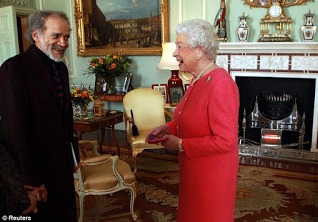
[Poet John Agard shares a laugh with Queen Elizabeth II]
In the 1990s a stint as Writer in Residence at London's South Bank
Centre cast Agard as that weirdly successful "Bard at the Beeb" whose
words became suddenly available to beebish listeners. In his latest
collection, "Travel Light Travel Dark" he pokes around the baggage of
imperial geographics for truths undeclared: "Is that the blood/ of the
Gambia/ flowing under a Thames aria?" "What light can your green
darkness, Atlantic,/ shed on a traffic that has scarred your waters?"
He assembles teams of celebrated players for a friendly (pre-season
like) game of questioning assumptions and probing paradoxes. There
are star performers like Prospero, Caliban, Jimi Hendrix & Handel
(from "Water Music"), Sussex, Chelsea, Georgetown (from Guyana),
Mayfair (from London), cane fields & horn pipes, King Lear & the Moor ,
Christopher Columbus, Michael Holding.
Some readers might cavil: this manoeuvre, set apart from modern-day
spikes of street tension, creates space for high culture cruising. And
the word play (the "hoodie in the hood", "the ship in citizenship")
makes nice rap moves, quickly taken, but seem designed to titillate
receding commonwealth sensibilities.
His metaphors might strike others as too easily summoned and put to
work. Take his "Colour Poems", for instance, in which colours ring out
fresh (and not so fresh) twists of meaning: red, he writes, "makes an
art of bleeding slowly"; and green "thrives on a single leaf's trans-
figuration".
In the wider Caribbean context, Agard's poetry calls to mind the
ground-raking "folk aesthetics" work of the Barbadian scholar-poet
Kamau Brathwaite (minus the shouter fonts, the return-home sense
of "mission".) You'll note the effort to disrupt patterns of thinking,
the shift towards new centres of creative energy; and the poet's
not-fully preparedness to embrace the literary legacy passed down
through the English tradition and old colonial schools.
"Travel Light Travel Dark" seems more like a contemporary dance
between the Queen's language and its creole relation; carried off here
with the level of clarity and responsible revelation you find first in the
poetry of Guyana's Martin Carter.
Agard might have sensed that circumstances were perhaps right to
trigger a new conversation among not quite equals, across language
borders, in a new interdependent framework ̶ "I'm here to navigate
-/not flagellate/ with a whip of the past." ̶ putting aside the recent
history of patronage or indifference; even as the issue of "reparations"
with its long memory surfaces, and transAtlantic souls buckle up for
unfinished business.
"Travel Light Travel Dark" with its readiness to "engage" raises again the
possibility of open new gates for otherness. If you follow closely when
the poems are read ̶ and Agard brings a weathery charm on stage for
his readings ̶ you'll discover his roguish wit; thought loading when he
pauses; intensity as the old angst searches for new outlets, and today's
sea-crossing survivors attempt to wire a new connectedness.
It's a stimulating collection in its own way, far in front of the one-eyed
unrelenting banality of "progressive" thinking and practice in his native
land. It offers versions and conceits that might well sparkle on the
coffee table of England's now older monarch.
- Wyck Williams
Book Reviewed: "Travel Light Travel Dark", John Agard, BloodAxe
Books Ltd, (UK, 2013), 95 pgs.

 FARJOURNEY CARIBBEAN