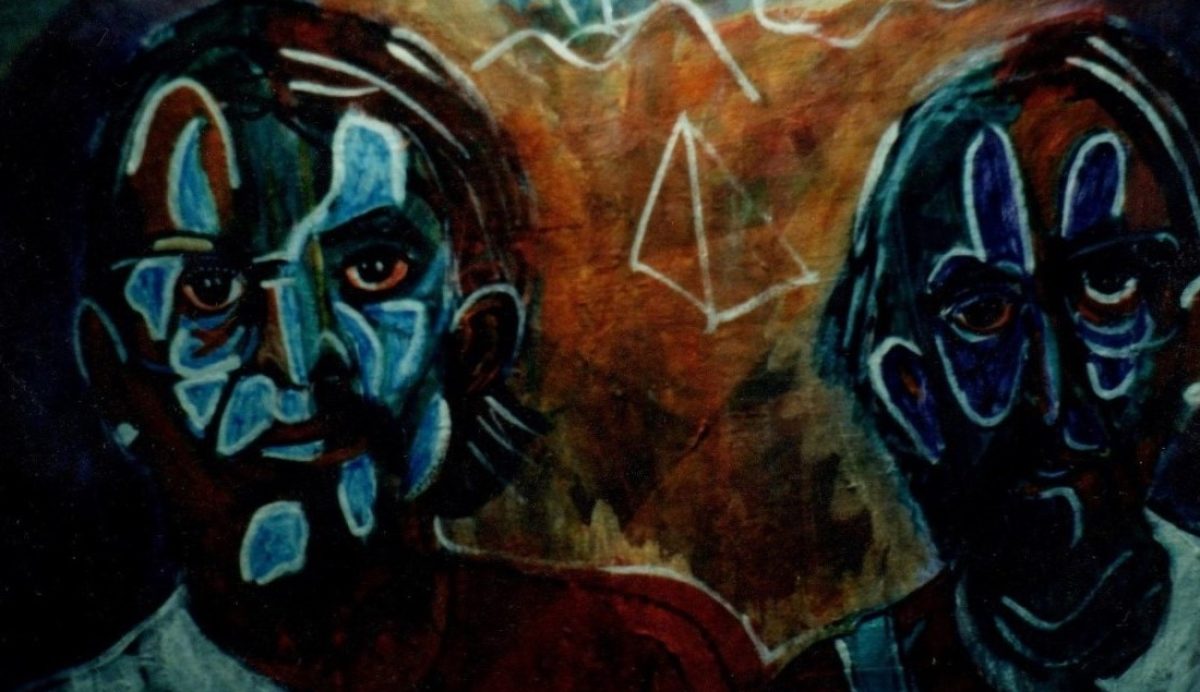
Days in the hospital bed listening to his own breathing.
His right leg was fractured, his neck was in some sort of brace, and but
for a few minor cuts and bruises and a dull pain that slept and stirred
in his body, he was alright. Judy Weiner was not so lucky. She's
suffered a concussion. Her condition was considered stable, they told
him. She kept fading in and out of consciousness, asking each time,
What happened! She couldn't remember anything about the accident.
Two police officers came to see him. One stood at the foot of his bed
watching, while the other, soft spoken and more polite, did the
talking.
Radix had little to say. The car, the man in the back seat, the
intersection ̶ it all happened so quickly. He wanted to talk about the
gurgling sound he'd heard but they weren't interested in that. They
stood by his bedside in grey suits and black coats. They stared at him,
bandaged up and braced, as if they weren't sure how helpful he could
be.
They asked his name, age, occupation; they asked where he came
from; they wanted to know what he and Judy Weiner were doing out in
the streets if they were HS teachers. A funeral? A church? Okay, what
church? Third Avenue? They knew Third Avenue from end to end. A
church on which block? They didn't think there was a church on that
block. Hey Rocco, is there a church on that block? In any case that was
way across from the accident site, on the other side of the Bronx.
What were they doing all the way over there?
And Rocco, quiet, watchful, with a surly, sad beefy face, looked around
the room, then back at Radix; then around the room, as if that was
part of his job, this suspicion of everyone and everything. Radix could
tell he too had questions of his own: like, What the fuck were you
really doing at that intersection? at that hour of the day? with a white
woman?
After awhile Radix grimaced and stopped answering; the nurse came in
to do nurse chores. They must have sensed his reluctance to continue,
his Fuck you too! which was meant for the quiet Rocco. "We'll let you
rest, but we'll be back to talk to you."
So many people in and out the room. Everyone with questions ̶ the
police, nurses, doctors studying charts; a news reporter who was
barred from entering and peered at him room the door.
And here were Aschelle, Amarelle and Sammy D. who looked down at
him with worried puzzled faces, not asking questions, just wanting
between friends to know what happened.
Sammy D. couldn't resist telling a story, meant to cheer him up, about
the time he broke his arm playing soccer; and the cast he had to wear
which all his soccer friends signed; which he still had up to this day.
Aschelle grumbled about conditions at the hospital she couldn't help
noticing ̶ "They do things differently here." She wondered if he
couldn't be transferred to the hospital in Manhattan where she
worked.
Amarelle sat on the edge of the bed and looked at him; she caressed
his forehead once, then not again. She considered staying all night but
the others persuaded her to leave.
The next day she showed up alone, her face narrow with worry. She
had gone back to the house in the Bronx, letting herself in. She
reported the glass panel on the front door was cracked; fellows were
still "congregating" on the stoop. They must have heard what had
happened, but so far his stuff and things were intact. Maybe he should
consider moving to her sister's place in Peekskill to recuperate.
Mahmood Sharif came to see him the following day. Classrooms were
buzzing with excitement. They'd heard the news from Dr. Balleret
through the p.a.system. Unbelievable! Some teachers had seen it on
the six o'clock news ̶ the car so crumpled, it seemed a miracle anyone
had walked away alive. They'd reported one person dead and serious
injury suffered by two Bronx teachers. The intersection was known for
drug and gang activity. Unbelievable? What were you guys doing out
there?
Radix kept asking about Judy Wiener. Had her condition been upgraded
from stable? The doctors assured him she would pull through but they
didn't confide much else.
Through the oblong window in his room he could see clouds and blue
sky, nothing but clouds and blue sky; no buildings, no metal fire
escapes; he could hear the distant grind of Bronx traffic; police sirens;
noises as in a forest.
(from "Ah Mikhail, O Fidel!", a novel by N.D.Williams, 2001)

 FARJOURNEY CARIBBEAN