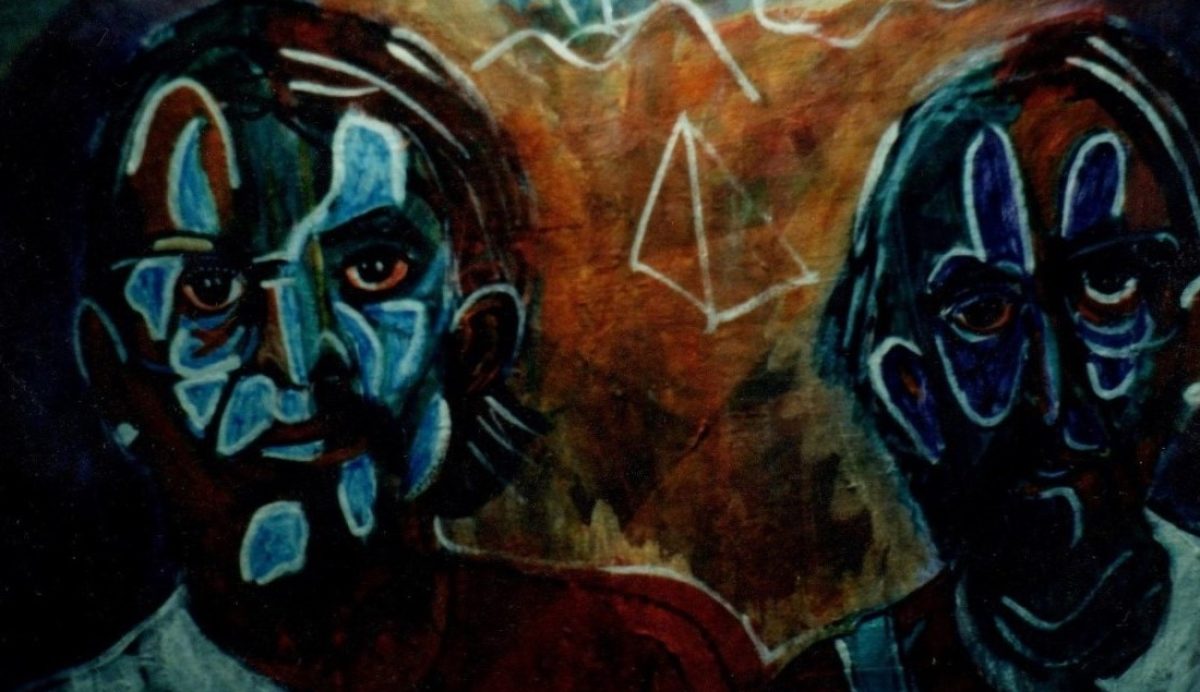
< Situations and Revelations of Passing Notice in Guyana >
Locket #10
Since we moved to this (mostly "white" family) neighborhood in Toronto
my wife has discovered the "dinner party". She invites the neighbors over.
People we know from back home come over, like on national holidays,
for food from back home, buffet style, outside on the patio. The dinner
evenings involve food from back home, too, but it's more focussed,
you know.
A life lived for dinner preparation and chitchat is really not for me.
I decided to draw the line. "What do you mean?" she asked. I said, too,
that as a couple we were definitely "incompatible".
The last dinner party was the point breaker. "He went back home to
Guyana. His father was in hospital. He had a stroke," she told our guests,
the Merridews, from across the road, like us early in their fifties. He
has a full combed brown beard and, after a recent vacation in China,
holds court like Marco Polo back from a big trip.
"Sharing" is a social tool my wife picked up after we moved here. The
people at her job "share" from the moment they arrive and take off
their coats. She gets home, takes off her coat, and sharing begins.
Doesn't stop even in the bedroom. (Starts up quickly after sex, back
from the valley! in lacy sleep wear; not a moment spared for catching
breath.)
She assumes my unwillingness to "co-share" is a signal to pour forward.
On her own. "You think too much," she told me once. The incompatibility
gap opened up between us after our two girls were born. It widened as
they grew older and became impatient with our parenting.
"He was all set to come back here," she said to the Merridews. "Suddenly
one evening he decides to go for a walk in the city. And there he saw an
old man getting mugged. Right in the middle of Georgetown."
Her head and shoulders follows the traffic of every word spoken at the
table, leaning in with opinion from as far as the kitchen area. Usually
I withdraw, into what my face suggests is careful processing, before
I chip in.
"Mugging", whatever the word means elsewhere, wasn't what happened
that night in Georgetown.
There's this walk path down the middle of the city's Main Street. It's a
tree-lined path that seemed designed for strolling. I was cautioned by
family and friends not to "stroll" after dark. The city I once knew was
now a den for "deceivers and heartless bandits", my uncle said. He
advised I walk like an overseas resident ̶ stepping with straight
ahead purpose, from place A to place B.
I took the stroll anyway, toward a shopping area where stores were
shutting down for the night; with pavements that seemed also designed
for strolling, though now street vendors have taken over, cutting off
the stroll space with precarious stuffed stalls.
"Georgetown used to be nice," my wife had earlier set the scene. "Now
with all the politics, it's more like a 3rd world country." (Authority on
3rd world countries now, you notice.)
The "mugging" victim, before he became a victim, was standing in front
of a store window, gripping a bag, and studying the merchandise on
display; electronic devices, phones, computers.
I must have been half a block from him when I heard shouting. I looked
back. He was on the ground, trying to shield off two men who cursed,
leaned over him, punched him in the face; kicked him hard, stepped
back, kicked him hard again, again. I shouted in alarm. One of them
went through his pockets. They searched his bag, then they took off.
I rushed back. The man seemed in considerable pain, breathing with
difficulty. He tried to stand up. He seemed concerned about the state
of his clothes. "Are you alright?" He said he was. He tried to stand up
again, but he crumpled.
"And while all this was going on, nobody even stopped to help," my wife
went ahead. "Two days later he reads in the newspaper that the man
had died. The same man. Died in the Georgetown Hospital. They
kicked him so hard it must have caused internal bleeding or something."
Again he tried to stand up, tried to walk. He gripped my hand. He
wanted to know if I thought the computers in the show window were
worth the investment. He'd buy one, but electricity in his village was
unreliable. "Are you alright?" I shouted.
He asked me to retrieve his bag. It contained spare parts for his tractor.
He didn't seem to mind his money gone. He'd been waiting a long time
for the tractor part to come in.
Still gripping my hand he told me his wife had left him. All he had was
a little piece of land, his house, and the tractor. He'd had an accident
with the tractor; and right after that his wife moved away. Back to
her parents. Then one day off to Canada with his son.
He hadn't heard from them in many years. Then he learnt his son was
now Dr. Sunesh Deodatt. Working somewhere in Canada. He had no idea
how all this happened. Her family wanted nothing to do with him. He
was thinking maybe if he bought the computer he could use it to locate
his son, the doctor.
A vehicle pulled up near us. Men in uniform, with dangerously idle rifles.
Wanting to know what was going on. The man sagged to the ground,
but the grip on my arm was fierce.
I told the officers he'd been kicked violently by two young men. He was
in bad shape. He needed help.
Out of nowhere another man approached. He swore he had seen "the
whole thing" happen. So someone in the shadows had watched the
attack from a distance, and stepped forward only when it seemed
a crowd was gathering!
"So my goodly husband comes back to Toronto. And now all he does is
spend hours on the computer. Up late in the night. Trying to locate
this man's son. Mind you, the man dead and bury already."
~~~
In my mind one thought kept flashing: he must have been in great
pain slumped on the pavement, going on about his tractor and his
son. Why did he ignore the pain?
"But why would you want to contact him?" Mrs. Merridew's forehead
wrinkled. I found myself studying the table cloth pattern, the wine
bottle labels. "That's what I asked him?" my wife jumped in, alert to
her goodly husband's apparent drop in temperature. "I mean, what
would be the point?" "Unless he wanted to explain he was the last
person to see the father alive."
"And shake the hand of the son." "Now that would be something."
"You mean, with the same hand that gripped the dying father's hand?"
"That would really be something?" "Was he planning to somehow say,
Hello, I met your Dad in Georgetown?" Faces swiveled my way.
My wife has brought our two grown girls into this world, and my life
to a moment of clarity at the dinner table. What has my education
led me into?
"And where would you begin the search? The son could be anywhere
in Canada?" "That's exactly what I told him" "Well, the name is
unusual."
"Sunesh Deodatt!" Sun….
"Sun-nesh" SUN-neesh
"Dee-o-datt." DEE-o-datt.
"If he is a surgeon, a name like that is bound to pop up on a hospital
staff registry somewhere." "Or maybe he's on Facebook" "It makes no
sense. He could be anywhere?" It was all very sad. A little scary, too,
the way it happened. Very sad.
I sensed my wife preparing to announce with a winner's smile that
the hour of dessert had arrived. At which point I got up and excused
myself. Stepping outside for a smoke.
That night as the electric toothbrush with the mint green handle
whirred away at her gums, I released the word. Incompatible. There
was a pause. Spitting in the sink. The bathroom light off. "What do
you mean, you think we're incompatible." "Just that. We're incom-
patible." "So wait, what you trying to say?"
My abrupt manner had rattled her. From her side of the bed, a voice
probed. "After all these years, now all of a sudden." I didn't twitch a
muscle. "You've been acting real strange since you come back from
Georgetown?" And at that first arming for argument, my eyes closed.
My abrupt manner had rattled her. From her side of the bed, a voice
probed. "After all these years, now all of a sudden…" I didn't twitch a
muscle. "You've been acting real strange since you come back from
Georgetown?" And at that first arming for argument, my eyes closed.
I was hoping it would be my last word for the night, like a pillow her
head could toss and turn on. "Look," I said, "I'm very tired right now."
She had much more to say, of course, but this was where I closed off.
Incompatible. A tree-lined detour, under construction. So that
tomorrow and in the winter months ahead we'll see which way things
go.
M. Muniram,
Georgetown, Guyana
Toronto, Canada

 FARJOURNEY CARIBBEAN