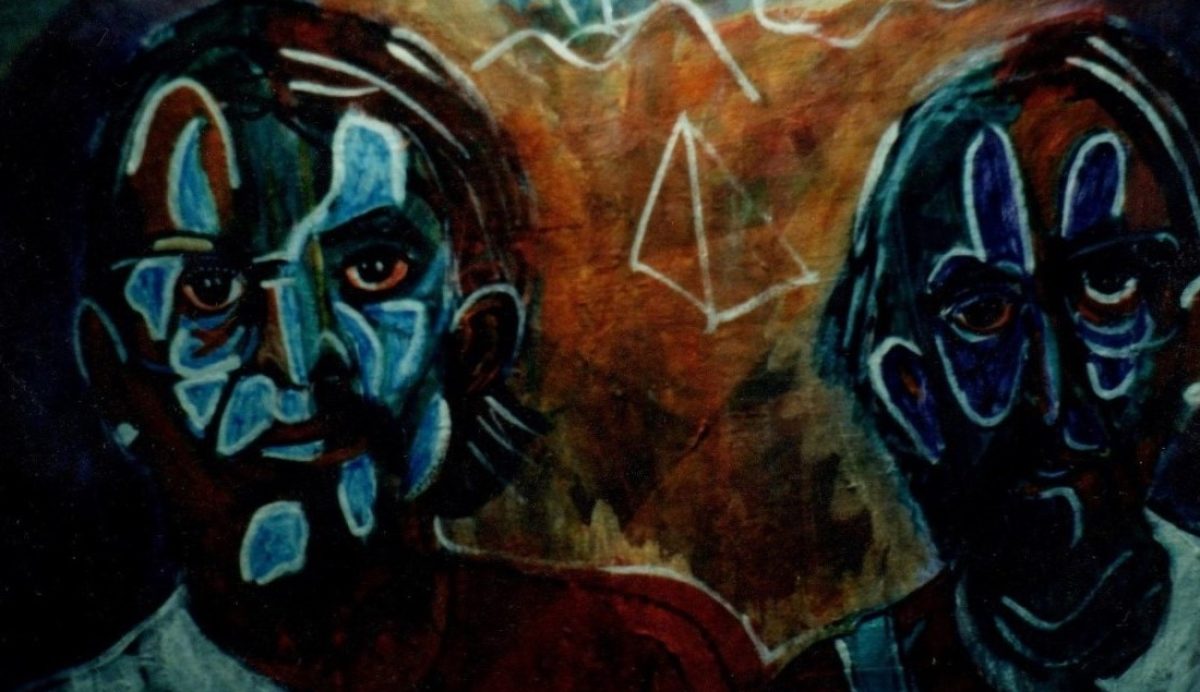
< Situations And Revelations Of Passing Notice In Guyana >
Locket #21
They announced her death on the radio. I was shocked. Mrs. Chote from Canal
District.
I didn't even know she had fallen ill, or if she was in hospital. They said they
were going to cremate the body. It would be laid out for viewing the next
morning.
I used to live in Canal District, then I moved to Georgetown. I knew Mrs. Chote
when people were whispering behind her back, Five children? In this day and
age? Or saying, What you expect? They like cows.
The question uppermost in my mind was, how she managed to maintain her
body weight. Five is a lot, but somehow Mrs. Chote didn’t get fat and fatter
after each child.
I decided to travel from Georgetown to pay my respects. I told my son (he
drove me there) she was an old friend.
Her face in the coffin looked peaceful as if her life work was over (like we
have any choice). I didn't ask anyone how she died. I prefer to think one
day she just stopped walking. From the time I knew her she was always
walking.
They had white plastic chairs under a tent, flowers and everything set out nice.
Looked like they planned some kind of ceremony. I didn't know her as a Hindu
person. All these years she was just Mrs. Chote.
Her children were all there. I didn’t recognize them at first. Grown now, big
men and women, with children of their own. I didn't expect them to remember
me, but in the little time I sat there, three of them came up and introduced
themselves. Hardat, Haimdat and Indra.
Ma always talked about you. She said you were her best friend. That was
Indra. Pushing her sadness pushed aside for a moment to greet me with warmth.
Short and pretty like her mother.
Mrs. Chote and I would meet when she came to Georgetown. We always talked
about those three. Hardat, Haimdat and Indra. Her survivors now.
"I wanted my children to succeed, but only three of them listened to me. The
others take after their father." You could say Mrs. Chote had confidence in her
genes.
From the moment she felt the new child showing she was making plans. If she
realized the child took after the father, she was measuring the months ahead.
She had designs.
She stayed with her husband, Mr. Sag Belly who snores; wake her up in the
middle of the night, handling and wanting. “I wait till he slide off, turn on
my side, try and get back to sleep.” That gave me a good laugh. As simple as
that.
When she was young she took a job in the city, in Queenstown, working in the
house of a lawyer. She said she noticed how the family seemed so concerned
with raising their two children to be proper and successful. The daughter
would become a lady, the son a gentleman.
"They were different from my family in the District. On the bus going home I
used to think, I want my children to be successful." Her children (the ones
who take after her) would grow up and leave their mark in the District.
When the family she worked for her gave her a bicycle they didn’t want
anymore (the children were moving around Georgetown in a motor car) she
found a way to transport it all the way to Canal District.
With one idea. As soon as he was finished with school, her son would start
up a bicycle business. No cane field sweating for him. That was Hardat.
Her husband complained, but the boy loved his mother and he listened to her.
He learned everything. From patching tubes, to fixing chains. To fixing and
selling his first bike. One sale led to two, two to four. In no time at all, he
had his own bicycle business, fixing and selling bikes to people in the District.
He brought the first two motorbikes to the District. Had them shiny and
leaning outside his shop. Two bikes become four. Next thing you know,
anything to do with wheels, contact Mrs. Chote son. Spare parts, accessories,
whatever you want.
Child # 2 took after the father. Mrs. Chote didn't talk much about him. He was
his father's child. Child # 3 was another boy. Haimdat. As soon as he finished
school she had a "profession" waiting for him.
The well-off family in that residential neighbourhood, whose children went to
Queens College, had family portraits framed on the walls and tables. She
decide Haimdat from the day he left school would take up camera work.
She bought him a camera, and sent him out to take photos. Family gatherings,
funerals and weddings. She arranged the pictures in an album, and sent him
off to offer them for sale.
"I told him, when you take the photos you must make them relax and hold their
head up. The boy must feel like a prince, the girl like a princess. And catch
them sometimes when they think nobody looking."
People really liked the albums. She told everybody in the District her son was
a “professional”. He don’t just point and click. And don’t waste time with cell
phone camera. He knew how to frame pictures, make a nice family album.
.
Haimdat became the Photo Album man in the District. Mrs. Chote’s son. For
any occasion. "Professional" work.
"Life does follow the laws of Mother nature. If you're the mother, you decide
what’s best. If they listen to you, they do well," she said. I didn't argue with
her.
She didn't talk much about her parents, and about the other children, how
life turn out for them. Her darlings seemed happy. She was filled with
contentment and pride.
*
Indra was her last child. A child of circumstances.
Mrs. Chote's husband was giving her problems. He had this accident. It put
him out of action for a good little while. She had to keep him comfortable,
cleaning up, attending to his moods. All of a sudden she felt unsettled, for
the first time, in her own home.
She used to travel to Georgetown quite a bit during that time. Told her
children she was going to see an old school friend. She stopped by me, but
she was visiting someone, a private arrangement. For the first time in her
life, she said, she felt real pleasure ‒ gratification, yes, with this man.
I don't think anybody suspect anything. Nobody would believe Mrs. Chote
ever felt lonely, would take her friendly nature outside the District (heart
in the right place) for a taste of difference in Georgetown.
But knowledge and ignorance does share the same bed, backs to each other.
I know from experience.
Anyway, when Indra came Mrs. Chote was so relieved ‒ at least the child
resembled her mother. I don’t know if Mrs. Chote ever told her who the
real father was. (She didn’t tell me.)
Indra was different. She got a job in a Georgetown bank. Moved up and got
a desk. When her mother found out she was going around with the bank
manager, a married man in Georgetown, she worried day and night.
She gave me an address, and asked me to keep an eye on her. “I can’t talk
to her anymore. She tells me, I’m old enough to live my own life.”
But that wasn’t my responsibility. Besides, I didn’t know how to “keep an
eye” on anybody much less Indra.
That morning Indra moved around the tent, greeting people with her bank
official pronunciation. From her clothes, her bracelets jangling when she
raised her arm, it seemed she was in charge. Still not married.
At one point I caught her looking at me, probably wondering how much her
mother’s “best friend” knew about her family. And why Mrs. Chote would
take someone like me into her confidence.
I didn’t see Haimdat taking pictures.
All this drama. People going about their business, they think they know
what they're doing. And you there trying to mind your own till you get
tangled up.
Near twelve o'clock, outside the tent ‒ relatives, neighbours, friends (who
only knew Mrs. Chote, the good mother) fanning themselves and looking
around ‒ her husband showed up, at least I think it was him. Moving slowly
from person to group, shaking hands; his face set like he decide now to
frown in grief for the rest of his life.
Before I left to go back to Georgetown, I went up to the coffin. Last respects.
Her eyes and lips still shut, her hair brushed back. In the blink of a second I
thought I saw her smile, and in my head I heard her say, Eh Eh, so you come?
I have one story to tell you.
Real drama in this world, yes. Crave and plan all you want, then lie down
again, like Mrs. Chote waiting for her fire. You can't move or hide all your
life.
Waveney MacPherson
Georgetown, Guyana

 FARJOURNEY CARIBBEAN