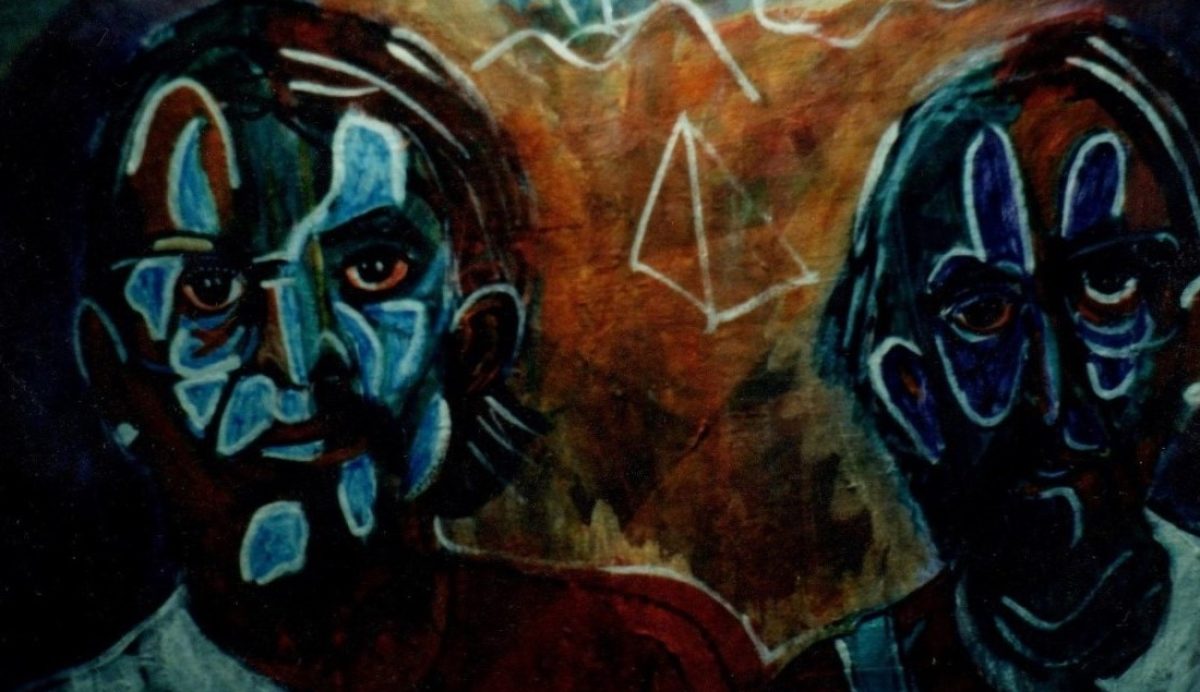
If you were restless and lucky to be creatively talented in the 1960s, living in
Georgetown, Guyana was the best of place and times. Prominent Guyanese
writers and artists visited, or found residence there. Martin Carter on Lamaha
Street. Donald Locke in Kitty Village. Melody, not percussion, waved the air.
And there was the hinterland fiction of Wilson Harris, a magnet for feverish
imaginations. His work proved exasperatingly difficult. His language elevated
you above triumphing daily news delivery meant for the people's enlightenment.
On board flights of symbol to heavens discourse.
You felt intrigued by his personal development ‒ who starts as a land surveyor
in Guiana’s hinterland, then transforms into a serene author of difficult prose?
You could wait till eternity, though, for clarity in his sentences. When he spoke in
Georgetown he used the same tortuous language of his fiction and essays, sparing
not one brief breath for audience levels of handling ideas.
His fiction almost capsized you in its rivers of metaphors. Gradually reader
reverence slipped away, leaving only career building scholars clinging to its
subsurface layers. He was either an unchallengeable genius, or one hell of a
performance artist, head sunk in his delvings into Anthropology or Carl Jung.
Either way you understood what it meant to be truly “radical”, as in departure
from same old blind fold.
“Palace of the Peacock” (1960) is for many his fiction masterpiece, the way
“A House For Mr. Biswas” (1961) is undeniably the signature work of Trinidad’s
V.S. Naipaul, and “In The Castle Of My Skin” (1953), the high watermark from
the Barbados author George Lamming.
"Palace" dealt obliquely, it seemed, with Guyana’s need to discover mature
interdependent relationships. Harris might have sensed that for a nation to
emerge, mistrustful communities had to find ways, out of constituent
“entanglement”, to build nets of (less leader serving) work platforms.
In the novel, a multiracial boat crew on a Mission into Guyana’s Interior was
constantly in conversation. They spoke disarmingly familiar Guyanese
sentences, "Ah dream you done dead already, Jennings… And the hole close up
for good for you a million years ago. You is a prehistoric animal”. They endorsed
our youthful suspicions, “Every man mans and lives in his inmost ship and
theatre and mind.”
Harris could flip your next-door neighbour’s disposition into “the strangest face
we’d ever seen”, inviting readers to look again, look closer: the fall marks, the
eye lids on desire.
He left you battered by images, his startling depiction of crew mates, and those
moments like lightning flash on the page when you thought you recognized
someone you knew.
From the 80s through the 00s, Guyana’s creative energy passed through its tribal
identity phase ‒ the poetry of ships and sorrow, the fiction of victimhood, of
lives tethered to the sugar belt ways ‒ enabled by favourers who promised their
intervention would help reconstitute body and soul, make village poverty
embraceable.
Interest in Harris and his rainforest excavations seemed to diminish in that
period. One after the other his books presented more obscure, heavier slopes.
His inventions struck some readers as “really dreaming” stuff, like the stories
circulating back then about the possibility of oil basins off Guiana’s shores.
Mercifully, his novels were short. You could hop and skip through “Heartland"
(Faber 1964, 96 pgs); decide to try again, at stop and think pace. Access to
its meanings remained restricted.
Today ‒ with chat screens and mobile keys ‒ readers might show no interest
in his dense spanning the globe words. Tech silence has displaced jungle
silence.
Packed tight, with a strange fluency of ordinary speech and wrought iron
prose, that amazing first novel was definitely on to something about the birth
pains of nationhood. You felt his characters were conducting a difficult but
necessary conversation. Just not with everyone.
What has not changed in Guyana is ‒ in the words of one character ‒ that
"oldest need and desire for reassurance and life”, for protocols and ideals
higher than what tribe comfort might provide.
In “Palace” Harris was Guyana’s world standard lifter. He invokes from left to
right an interwoven mythos as Guyana continues its growth from wary residents
to confident citizens of a nation. Back then you took his word for it; you settled
through his fiction for “the experience of his experience”.
Artists and writers who stayed spiritually in touch with his work, however
intermittently, will admit they were somehow altered. You could say he passed,
to generations eager to move on, the dare to be difficult and different for one’s
time.
Traces of this daring are evident in the incredible vibrancy of that 60s generation
‒ in, for example, the work of Brian Chan, John Agard (poetry), Victor Davson,
Carl Anderson, Andrew Lyght, Carl E. Hazlewood, Dudley Charles, Terence
Roberts (art, media installations).
Seeking individual assurance, new ideas on how to fill and chart a life, they
stood at his gate, or wandered his Palace grounds. They experienced their own
self-transformations, and like the great man eventually found a way in the
world.
From Harris they borrowed the strongest tools ‒ empathy, a fear free vision,
an eternal Amazon resolve ‒ with which to engage the difficult intimacies our
planet presents, and the old uncertainties its future now disperses.
Wyck Williams
New York, 2018

 FARJOURNEY CARIBBEAN