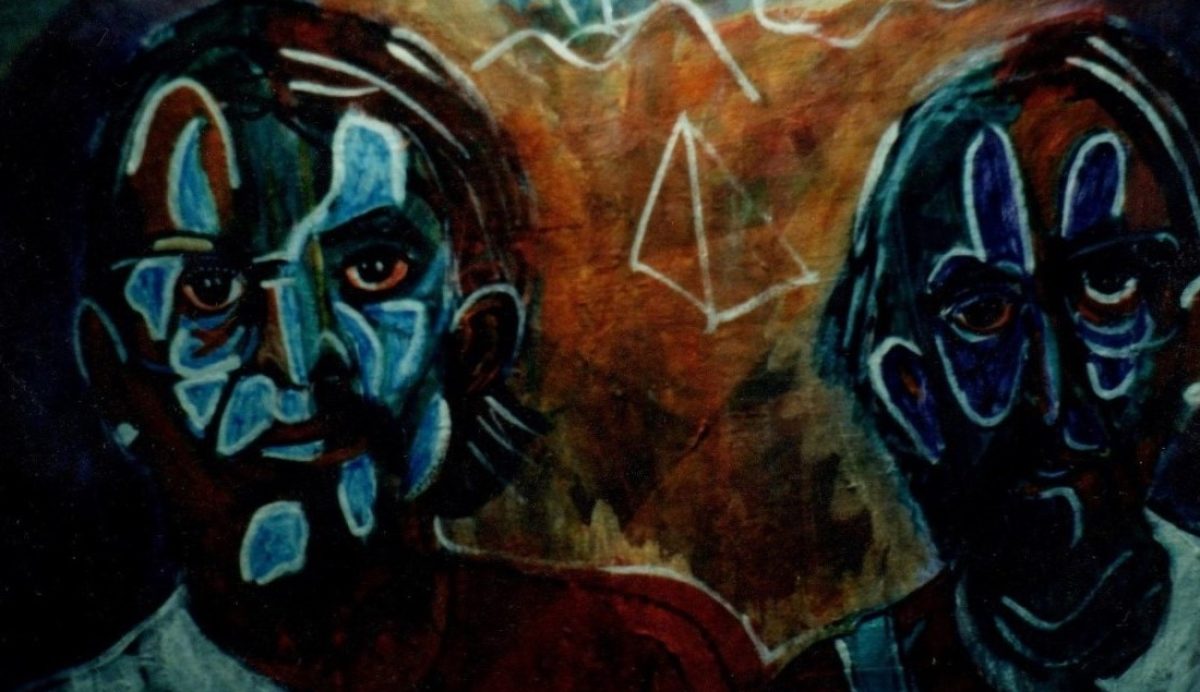
Before he completed the course for his reinvention – from Pundit
Ganesh Ramsumair to Ganesh Ramsumair M.B.E.; finally and famously
G.R. Muir, Esq., M.B.E. – Ganesh (In V. S. Naipaul’s The Mystic
Masseur) drifted from occupation to occupation. One of which was
writing. There were challenges along the way: for instance, Leela,
his childless wife and wavering supporter; the fits of rancour and
reverence from family members; excited followers in his village
(Fuente Grove, “Nobody does ever come here.”) feeding off his
diligence, and impressed by his display of learning.
Attached, selected highlights from the first phase toward Ganesh
self-ownership. That Ganesh. Trinidad,1940s.
~
* “Trinidad full of crazy people,” I said.
“Say that if it make you happy,” my mother snapped back.
“ A boy spat in disgust and said, “Eh, eh, your foot don’t see sun
at all at all!” Ganesh played no more football.
“He remembered having to walk round the body of his father,
remembered applying the last caste-marks to the old man’s
forehead, and doing many more things until it seemed that ritual
had replaced grief.”
~
* “People go want to buy that sort of book?”
“Is exactly what Trinidad want, boy. Take all the Indians in the towns.
They ain’t have any pundit or anything near them, you know. How
they go know what to do, and what not to do, when and not when.”
“All right, Basdeo, boy. The day go come when I go send you a book
to print.”
“Sure, man. Sure. You write it and I print it.”
Ganesh didn’t think he liked Basdeo’s Hollywood manner, and he
instantly regretted what he had said.”
“But when Ganesh saw the cards go in blank and come out with his
prose miraculously transformed into all the authority of type, he
was struck with something like awe.”
~
* “Leela. I have a good mind to take off my belt and give you a good
dose of blows before I even wash my hand or do anything else.”
“He had always intended to read and write, of course, but one
wonders whether he would have done so with the same assiduity if
he had been a successful masseur or the father of a large family.”
“When Leela asked, ‘Man, why you ain’t writing the book the
American people begging you to write?’ Ganesh replied, ‘Leela,
is talk like that does break up a man science of thought. You mean,
you can’t see that I thinking, thinking about it all all the time.’”
~
* “This modern method of education. Everybody start thinking is the
little piece of paper that matter. It ain’t that does make a man
a B.A. Is how he does learn, how much he want to learn, and why
he want to learn. Is these things that does make a man a B.A.
I really can’t see how I isn’t a B.A.”
“He rose at five, milked the cow in the semi-darkness, and cleaned
out the cow-pen; bathed, did his puja, cooked, and ate; took
the cow and calf out to a rusty little field; then, at nine, he was
ready to work on the book.”
“Like many Trinidadians Ganesh could write correct English but it
embarrassed him to talk anything but dialect except on very formal
occasions. So while, with the encouragement of Street and Smith,
he perfected his prose to a Victorian weightiness he continued to talk
Trinidadian, much against his will.”
~
* “Beharry and Suruj Mooma called that evening and as soon as Leela
and Suruj Mooma saw each other they began crying.
“He write the book,” Suruj Mooma wailed.
“I know, I know,” Leela agreed, with a sharper wail, and Suruj Mooma
embraced her.
“A few hawkers in San Fernando agreed to display the book and Ganesh
made many journeys to see how the sales were going. The news
wasn’t encouraging, and he walked a good deal about San Fernando
with the book in his shirt pocket so that anyone could see the title.”
“Look, is experience I have in this business, you know,” Bissoon’s feet
were draped again over the arm of his chair, and his toes were again
playing with each other. “All my life, ever since I leave the grass-
cutting gang, I in the book business. Now I could just look at a book
and tell you how hard or how easy it is to sell.”
~
* “Many years after the event, Ganesh wrote in The Years of Guilt:
"Everything happens for the best. If, for instance, my first volume
had been a success, it is likely that I would have become a mere
theologian, writing endless glosses on the Hindu scriptures. As it
was I found my true path".”
Book Revisited: “The Mystic Masseur”, V.S. Naipaul, Vintage Books
New York, 1957.
- Wyck Williams

 FARJOURNEY CARIBBEAN