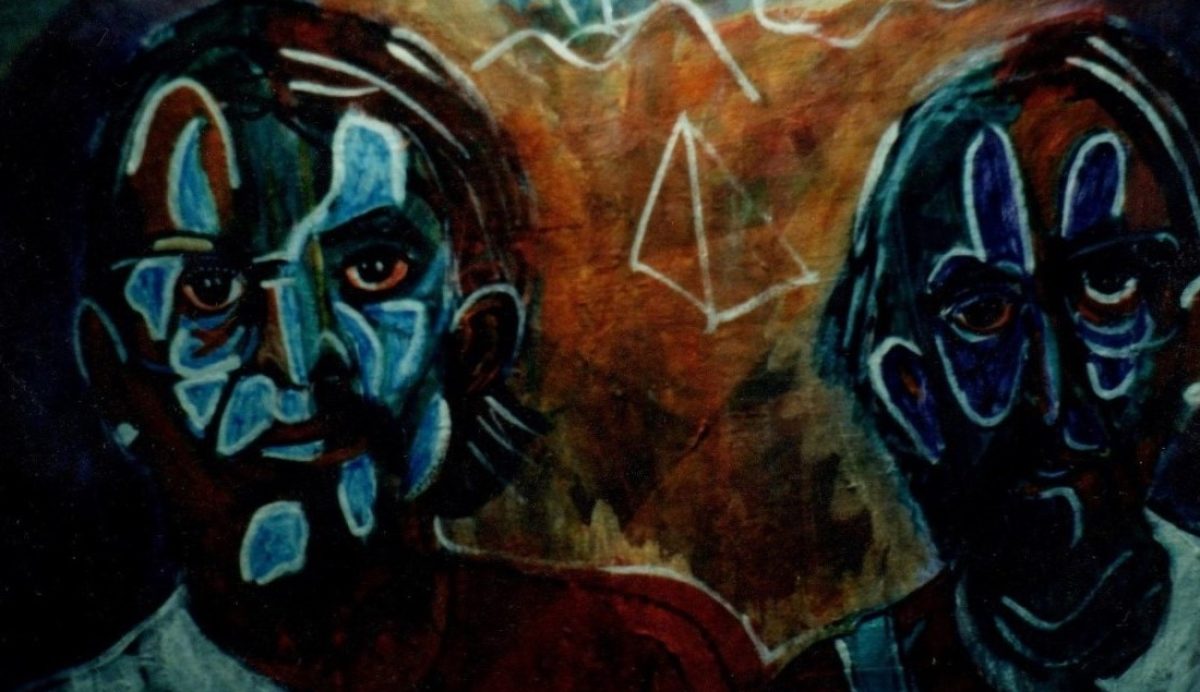
NY SLIDE XXIII: MR. GHANSAM


       When Mr. Lightbody asked what his first name was, it turned out to be an unpronounceable
   mouthful.
      "Sat…what?" Lightbody's face was a friendly grimace of incredulity.
      "Satyendradat," Mr Ghansam repeated.
      "Howd'you spell that?"
       Mr. Ghansam spelled his name and Mr. Lightbody screwed up his face and made a credible
   attempt to sound out the syllables. Finally, giving up, he said, "Listen, why don't we just call
   you Gandhi?"
       Mr. Ghansam laughed quickly. These aggressive Americans! This quick desire to abbreviate
   everything, making foreign-sounding names simple and controllable. He wasn't as nimble with
   rejoinders to their frequent jokes; but right then under the circumstances he felt the right
   response was to be the team player.
       "Gandhi!" he said.  "Well, at least that's close to Ghansam. As long as you don't mistake me
   for the Mahatma."
       "Mistake you for the great Mahatma? Naaah! I promise you that won't happen."
       When he got home he told Mrs. Ghansam what Lightbody had said. She was not amused.
       Once they'd settled into the carpool routine Mr. Ghansam sat quietly but attentively 
  through the ride, letting Lightbody, Meier and Brebnor do the talking. Even when it was his
  turn at the wheel he let them talk, the fixed smile on his face suggesting the open friendliness
  of a man from a distant culture, not quick to take offence. Besides, as he reminded Mrs.
  Ghansam, you learn a lot when you  listen to these Americans. "They like to expound on
  subjects they know absolutely nothing about."
        Mr. Lightbody had this habit of donning a NASA Eagle cap the minute he got into the car for 
   the journey home. "Why do you do that?" Mr. Ghansam asked him one afternoon?
        "Do what…you mean the cap?…I don't know. I put this cap on my head and rightaway I feel 
   I'm a different person…I feel transformed…like I'm not a teacher at the John." Mr. Lightbody's
   name for John Wayne Cotter H.S. was the John, or sometimes the W.C." "No seriously, at the
   end of the day you want to feel…like you again…like you've dropped a big load off your mind."
        And Mr. Ghansam smiled as if he'd sneaked a peek into Mr. Lightbody's soul, and now could
   claim he really understood the man.
                                                       (from "Ah, Mikhail, O Fidel!" a novel by N.D.Williams, 2001)
      

POEMS FOR GENERATION 2000 (& CALL WAITING)


                                                                            "Each day we die a little death beneath the sun."
                                                                                                – Denis Williams, Kyk-Over-Al (1949)
 

                         Everything sweet, waits to welcome you
                         gyurl, gyal
                         bai
                         bannas
                         home.

                         Weathered white old timber houses await the colours of fire
                         as champion hose & hydrant
                         wait
                         for water. Last season
                         bodies of innocence "massacred" piled up on the front page, 
                         soft 
                         loved faces
                         closed, limbs like chopped cane bundled for loading;
                         like on Nazi death camp wagons, though not like Uganda. O,
 

                         the other day young girl turn back, take one flying leap into Kaieteur.
                         Fisher men losing boats to pirates with skull &
                         crossbones &
                         night 
                         splintering pistols.
                         Rice fields waiting for flood, singing insects for blood.
                         Old estate cane fields spread flat 'til
                         swank hotel & casino hoist up like hiphiphooray! on their back.

                         Store fronts waiting for plate-glass reinforcements; we have escalators
                         now
                         everybody thiefing.
                         At the windows of high wind-wrapped buildings you could see 
                         below rusting 
                         corrugated roofs which does look real bad.  O, 

                         Ministers promise to "commission", "fast track", "task team" stagnant
                         villages if only on fours they behave; pour in
                         millions and billions more millions
                         like syrup 
                         like red ants over dry mud
lake. 

                         Roadways built by the Dutch for walking
                         barefoot cycling   
                         & Land Rover
                         leave only grass verge, 
                         watch out for headless horsemen mummifying wheels escorting sirens.

                         At the stop of forest felling greenheart men wait for river apparitions;
                         and hydro (with Ph.D) coming like snakeinyuhgrass.
                         River ferries waiting for spare revenue, the bathrooms smell 
                         of pink hibiscus. Gold men done
                         lose
                         their diamond
                         whores and hammocks to stakeholder designs;
                         they must stay awake for poachers and border movers. 

                         Teachers waiting for letters of acceptance, leaving school chil'ren
                         one
                         O level
                         away from the "braid hair criminals" > the penal colony. Athletes
                         files
                         and grandparents slipping away like bourgeois habits,
                         so animals gardens dreaming language suffering real bad.  O, 

                         Regions 4 3 2 1 lost their place names & memories; they wait
                         to be inducted into the Hall of new paradigm shifts.
                         Robes of theory and sermon, you think, would protect women
                         during power cuts
                         & power
                         demands; 
                         the truth like lonely nipples hides from power;
                         the truth waits in the body's every folded crevice. 

                         Le'me stop: we
                         not supposed to see or call evil,
                         give the country bad name.
                         
O, wait:
                         latest 
                         climate report
                         calls for periods of tribe entrenchment, thinning hair, dogma screws, shut
                         up
                        
about race -  
                         sustainable darkness, right! all over the land. 
                                                                                                  – W.W.


                         EVENING DROWNED IN A DRY SWAMP

                         The flat quarrel of frogs belching between gulps
                            of rain slapped down by a sky the very mother
                         of indifference, an unerasable grey,
                           or the silver snoring of the six-o-clock bee
                         under the brittle drilling of deaf crickets
                           forging twilight's soft breast into an armour-plate
                        against the neverending hammering curse
                           of dogs beaten hollow between rooftops of tin 
                        pelting their bricks of rage to have them hover
                           in the mind's sky like clouds of blank slate or leaden
                        farts of thunder heard but not heard as having
                           to be heard like the growls snarls yelps of beaten numb
                        men caught writhing in cobwebs of dumb memory,
                           in nets of radio-prattle or in tight cages
                       of lashing song and dance fuelled by drumming
                          veins swollen with thudding rum, the beat of hearts pumped
                       by the urge to dare, by aspirins of accept. 
                                                                                             - © Brian Chan 2000


NY SLIDE XXII: FOUR MUSKETEERS

      Mr. Ghansam (Math), Mr. Meier (Business Education), Mr. Brebnor (Math) and Mr. 
     Lightbody (Biology), all from Westchester, had formed a carpool. It was originally     
     Mr. Lightbody's idea. He'd noticed several of his colleagues at the traffic light waiting to
     enter the expressway; he followed them one day only to discover they all took the same
     exit off the New England Highway.
       "Listen, guys, do you know how much we could save on gas…? I've figured it out…we      
     pick up Ghansam first; then Bob Meier; then Brebnor…it's all on the way. All we need now
     are telephone numbers. If anyone's not coming in that day, he contacts the man who's
     driving, lets him know so he doesn't have to pass by his house".  
       Lightbody had the face of a war veteran, creased from experience in remote jungle war
     zones; his nose bent, his thin hair flat on his skull. He referred to himself as a widower; he
     made the word "widower" sound like a certificate of merit he'd earned after tremendous
     personal sacrifice.
       Bob Meier was a short wire-spectacled man, balding on the crown of his head. His hobby
     and special field of knowledge was the stock market. He had secure investments and was
    happy on the drive home when the conversation strayed into talk of falling or rising shares.
     He dressed each day like a stockbroker in crisp shirt and tie, all buttoned down for  
     business, as if setting off for a cubicle on Wall Street.
       Mr. Brebnor was a laconic carpooler. He'd get in the car and lapse into silence,
 staring
    out the window, his face set in a grimace of contempt and worry; contempt for his job
    and worry about the frequency with which he caught colds. The kids brought the flu virus
    into the classroom; kids being kids they sneezed and coughed irresponsibly around his
    desk. He took vitamin C supplements, 1000mg shots, every morning with his breakfast
    coffee; and still he came down with the flu; and fits of coughing; plus red nose Kleenex  
    flurries. But this was his job, this was his life: teaching sequential math to virus-laden kids;
    fighting student apathy, at the same time fending off the invisible virus onslaught.
       Mr. Ghansam was from India. 
              (from "Ah Mikhail, O Fidel! a novel by N.D.Williams, 2001)


NY SLIDE XXI: HOW TEACHERS COMMUTE

             
              The commute to John Wayne Cotter H.S in the Bronx depended on where you lived. 
             It could be smooth and uninteresting, or filled with nerve-wracking tension. Students
             zoned to the school lived in or around the neighbourhood; they invariably used the 
             buses or the subway. The teaching staff drove in from outside the borough; it was a
             half-hour, sometimes one hour, drive, with bridges to cross, tolls to pay and often 
             long traffic delays.
                 Because teachers were required to clock in – a bone of contention between the
             Board of Education and the Teachers Union; time clocks were considered demeaning
             "to teachers as professionals" – there was the added pressure to be in the building on
             time; to be at your classroom door on time.
                 If asked to comment on these pressures most teachers at John Wayne Cotter would
             laugh dismissively and, speaking in the tone of overworked, unappreciated profess-  
             ionals, they might retort that, well, this is the job they do; a poorly paid job; with
             diminished satisfactions each passing year.      
                "Actually, I have no problem getting in." (Mrs. Richter, Music) "Where do I live…?
             Jersey…yes, all the way out there….Yes, I cross the George Washington every
             morning, but you see, there's very little traffic on the road when I start out which is 
             about six in the morning. Oh, I'm up at five in the morning…that early! And I usually 
             get here on time."  
                "I'm not going to kill myself getting here." (Ms Sinak, Social Studies)
                "Well, I'll tell you, sometimes I'm late, but that's rare." (Mrs. Helmsclaw, English,
             leaning forward on elbows, and twitching her bottom). "I drive in from Long Island. 
             I take the Throgs Neck Bridge. My problem is, I tend to linger…I'd step outside,
             ready to leave, then I kind of get distracted by the condition of the lawn. I'd walk
             around and inspect the flowers, check the sprinkler head, pull up a few weeds…Yes,
             tending the garden while the car is warming up, can you imagine?…Actually, it's my  
             husband who's the garden buff. He spends hours pruning and pottering…no, I can't 
             explain it. I just have this desire to touch the plants and flowers as I'm leaving in the
             morning…must be something fatalistic in me…like it's the last time I'll see them…
             Sounds crazy, I know."    
                 (from "Ah Mikhail, O Fidel!", a novel by N.D.Williams, 2001)


POEMS FOR DYING TIMES (& RADIO DAYS)

                [Strong as an ox (his calf breeding wife so quiet & serving,
               luscious her mambo) he served his island with OHMS pride.
               They sent him for Sandhurst grooming, happy we were. He'd step
               beside prime ministers & royal kin, in helmet & ceremonial whites,
               body* stiff sword *keeper, such was his rank.

               In his last days he'd lay in bed, not speaking.
               I rushed to his side – what would become of his memories?
               dignitary gossip overheard?
               I hoped he'd recognize the Regiment bugler – you know,
               at the cenotaph on Remembrance Day? He frowned and turned
               aside; reached for the dial of his Grundig radio.   

               After the war that German flagship ruled the waves.
               His pleasure was pilot at dial, bowhead cleaving through white
               noise, imperious news to the ports he valued:
               chimes, fast bowling at Lords, Sunday devotions
              (though not Edmundo Orchestra & His Ros.)

               I heard he fell off his bed one moody night, cracked a bone
               or hip, reaching for that dial; and curled in pain
               until his grandson, headset paused,
               sounded the alarm ("Grandpa's sleeping on the floor".)

               For his last nights, the bed now with guard rails,
               I brought him a Sony, thinking it would cheer him
               up – you know,
               memory presets, wireless sensors?

               The batteries for this thing, they die so fast, he groaned,
               fearing his life would smash on its high seas, the spinning propeller
               out of reach, no anchor hold;
               the headwinds of shortwave passing
               service at world's end]W.W.      


                       FEAR

                       Dying alone, no friend,
                       doctor or priest to prop
                       the fiction that you have

                       lived, you reach to clutch at any
                       final voice and see at the end

                       of the arm of a stranger with no
                       number or word in mind the strangest
                       hand of desire minding its own

                       business of clinging to one more
                       straw of its habitual mind.
                                        (from "Fabula Rasa" by Brian Chan)


NY SLIDE XX: SQUEEGEE MAN

            
             The lights stayed red. The gas station looked like an island lit up but abandoned in
          the silent night. He thought he saw something move in the dark, near the concrete
          columns supporting the overpass. The homeless man in the ripped-out car seat had
          stirred.
             He'd spotted the car idling at the lights; he was moving toward Radix in a deter-
          mined manner, meaning to get to the car before the lights turned green; squeegee
          stick in one hand, a bottle of glass cleaner in the other, wanting to clean the car's
          windshield.       
              No problem. Radix had no objection to simple honest labour; his coin box was
          usually ready with quarters; the fellows worked fast, seemed harmless, and they
          could use small change.
              When the man was about ten strides away, squeegee stick raised as if hailing a cab,
          the lights turned green. Since his windshield really didn't need cleaning Radix shot
          across the roadway and drew up beside the gas pumps. As he got out the car he 
          noticed the man still coming his way. He walked over to the cubicle, shoved his notes
          in the steel tray and shouted his order. Waiting for his change he looked back at the
          car.    
              The man had got to work on his windshield, squirting glass cleaner or water, making
          vigorous circular movement with his arm; lifting the windshield wipers…squirt, squirt,
          squirt…wiping, wiping…squirt, squirt, squirt
               Radix came back, saying not a word; unhooking the pump, unlocking the gas cap. He
          was about to insert the nozzle when the man came around to the rear, smiled broadly,
          and said in a hearty voice that filled the night,"Yes, boss…I fixed you real good…now
          you can see from here to eternity."
               Had he been sitting in the car, say at the lights, his reaction would have been
          simple: reach for the coins pass them through the window…Thank you!…on his way. 
               Standing face to face with the squeegee man, whose smile revealed missing front
          teeth, who seemed in his thirties; whose voice had an aggressive, not necessarily
          menacing, tone that compelled Radix to clear his throat and match the decibel level
          mano o mano - all this now rattled him. 
               His hand  on the gasoline pump froze; the squeegee man looked directly into his
          eyes. His face beneath the hair and grime was an ordinary human face, needing a 
          shower and a shave, but a fellow human face. "Got you ready to hit the road again,
          boss," the man said, removing a soiled baseball cap and scratching his head.  
              Radix shoved his hand in his pocket, felt coins, gathered and pulled them out - 
          quarters, nickels, dimes, when did he put them there? – and with some urgency he
          passed them into the man's palm. The man looked at them; he looked at Radix; his
          face became a mask of creased incredulity.
              Radix felt his heart pounding a little faster. For seconds neither man moved. The
          hand remained extended. 
              Radix could hear the grinding rush of traffic on the highway like a stampede of cars
          pounding its way to the bridge. He threw a glance toward the cubicle where the 
          attendant, an Indian fellow wearing a turban, was watching the encounter.
              Then Radix said, half-apologetically, but firmly, "Look, that's all I have on me right
          now." He was about to insert the pump nozzle when the man exploded: "What da fuck
          is this?"  Each word distinct and aggrieved, What…da…fuck…is…this
              The sound of that voice, clear and sharp, pinned Radix to the spot. This fellow was
          seriously vexed. Radix reached deep down in his gut for a response, for anything to
          break up the confrontation. Nothing, nothing but bubbles of fear rising. 
   &#01
60;          He stood there, the gas pump in his hand, feeling helpless, hoping he didn't look
          
helpless; and the squeegee man, sensing weakness, craning his  neck forward and 
          dropping his voice now to a knife-blade clean hiss, said, "I fixed you up good…you
          could see from here to eternity…Whaddafuck you saying to me, man?"
        (from "Ah Mikhail, O Fidel!", a novel by N.D.Williams, 2001)


NY SLIDE XIX: INVISIBLE MAN

     
             He checked the slip of paper Amarelle had given him with travel directions; he didn't
      
really need to; it seemed easier to read the green signs at night, follow the stream of 
       red lights, the public holiday traffic making its weary way back to the city. He settled
       in behind a Volvo moving sedately along, a family of four, each head stiff with self-
       importance on the headrest.
             And suddenly, the sign pointing to the Cross Bronx Expressway!
             What was it about highways that made you drive fearfully when you set out, then
      return with a little trepidation as if guided by some unerring computer chip in the car?  
             The Cross Bronx Expressway…tire grooves in its surface from heavy truck traffic…
      which could throw you wobbling dangerously out of lane if you weren't careful…but  
      there it was, the gateway home.
             The warning light on his gas gauge came on. Though it was long past midnight he
      thought, what the heck, might as well fill up now; there was bound to be a gas station
      open.  
             He  came down the ramp and there he was – that man slumped in a ripped-out car
      seat beneath the overpass, his day's scavengings of soda bottles in black trash bags
      piled high in a shopping cart. They couldn't just dump people, build an expressway over
      their damaged lives, and hope they'd stay out of sight forever.
             There he was – invisible man! – using anything he could salvage to resist inconse-
      quence; refusing to crawl away and die; fighting back against extinction, the great
      human experiment gone badly wrong, foundering now in Moscow, but huddled in defiance
      under a highway here in New York city.
             And just across the street from the  traffic lights, a gas station.
  
                                       (from "Ah, Mikhail, O Fidel!", a novel by N.D.Williams, 2001)


POEMS FOR NATION PLAYERS (& THE GAME)

   
           Name me a player in the colony eleven (chain round the neck
           not yet gold) who didn't pray to be chosen:
           a calabash shower, his chance
           to dress up in cricket whites and perform
           on the green with the willow. Mark
           the padded walk (the boys copy that) his trickster runs, the googlies –
           our saviour-gladiator! like Havana's commandante, nailing
           boundaries our side of the world.

           These days he's the man at the UN podium, in never wrinkles blue suit;
           the centurion! sprig in lapel for the greenheart forest.
           With a swamp's grasp of Parfum he clutches words, he speaks
           for our trees and river dwellers who never once complained
           of regime change, not once the plunder of stillness. To the myth-
           hugging dreamers in libraries, the loin cloth swimmers up creeks
           Cha-ching! he'll go, Cha-ching!

           Tomorrow he could be our 1st man in space, all spiffy
           in orange launch suit, si senor! Waving to the people
           via stadium telecast, knowing their toes will wiggle
           in the mud as his shuttle or ship lifts off – lifts
           from tightpacked bodies, poor facing forward lean; row
           upon row going O mi god! at that up
           pushingfuelburnbillow at the base. 

           Prince of appearances, a player…Howzzat?
           "progressive"?  "delusional"?  "grandstanding"?
           Ah, merde!
           Here comes the skipper, who's up?

                                                                         -W.W.  


            IRONY

                         is the voice of challenge, a backed-up sewer's:
            when your drains run silent, that's when they're breeding
            the promise of your next plague whose eggs of sleep
            with this last straw I break so that their dark lice,
            clinging to it, might float up and be exposed.
                                         (from "Scratches on the Air" by Brian Chan)  


NY SLIDE: XVIII: VERONIQUE

     Later Amarelle would attempt to shatter the picture of marital bliss.
         Veronique, who worked at her sister's hospital, was in fact the mother of two
     children whose father – an islander and a hopeless womanizer – she'd left back there.
     She met her Jewish husband in the hospital's EKG room where he'd been sent for a 
     routine examination; and where as she tried to affix the suction cups on his surprisingly
     hairy chest, he made funny conversation; so funny, she could barely contain her profess-
     ional demeanour.
         He told her he'd never felt so relaxed, so safe, as at that moment in that room, in her
     hands.
         They fell in love. Just like that? Just like that, Amarelle said, opening her eyes wide,
     and going on to reveal her suspicion that Veronique was a little schemer: up from the
     islands with two growing children, and looking for permanent residence.
          In any event the Jewish fellow, single, about forty, balding, broad at the hips, with
     connections to a moneyed Jewish family in Manhattan, this fellow proposed to her one
     week later; and to everyone's astonishment they got married. Now she was pregnant,
     the little schemer.
         They appeared to have not too many friends, which explained their appreciation of
     Aschelle's gesture, inviting them to drive out to Poughkeepsie on Labour Day; and now
     this man also from the islands, also kind, patient, not in any way discomfited by their
     racial coupling.
         Veronique offered to refill anyone's plate. She chastised the laziness of her husband
     who, she was prepared to wager, had been spoiled by his Jewish mother.
         Left along for awhile Aaron asked, "So what do you do…? where do you teach?" Then
   he talked about a friend of his who'd gotten into trouble with the NYC Board of Education.
   Radix crossed his leg and listened.
        Veronique returned, her face and fleshy shoulders glowing with the healthy promise
    of her pregnancy; she offered to fetch drinks and went off again. Aaron continued his
    story about his friend and the Board of Education.
        A gentle, generous fellow, this Aaron; eager for friendship; talking up a tide to keep
    their tiny group afloat and perky. And when Veronique came back and sat down they went
    at each other again for a bit, husband and wife so sure of each other, staging these little
    pillow fights without the slightest embarassment.
       At some point, sensing saturation, and unsure of Radix' disinclination to talk, Veronique
   switched the topic to the subway system; how relieved she felt not to be using the trains
   so often, now that they lived in Riverdale. No, not so much the jostling crowds; not the
   terrible draft in the tunnels. It was that horrible screech of metal when the trains came
   into the station and jolted to a stop. That was what she couldn't stand.
       "Doesn't take much to make her happy," Aaron said.
       "That…and bruised fruit. I can't stand bruised bananas. You know when sometimes you
    peel them…? and they're all dark and mushy and…bruised?" 
       "Otherwise, she's one happy lady," Aaron said.
                                  
(from "Ah, Mikhail, O Fidel!", a novel by N.D.Williams, 2001)


NY SLIDE XVII: AARON & VERONIQUE


            At some point Radix decided he was sufficiently attached to one couple to hang on
            to their company, not wander back outside to eat alone.
                They shuffled away, linked to each other by the woman's happy talk; she turned
            to Radix, she turned back to her husband, her words rattling like chains. They found
            folding chairs outside and settled down, leaning forward, shaking hands: Radix,
            Aaron Friedman from New York city, and Veronique from the islands.
                They had arrived late, Veronique said, and had got lost on the way. "All this man's
            fault." They had to turn back at one point. "He took the wrong exit." They hadn't
            met everyone yet. Radix nodded and smiled.
                Aaron like a good sport seemed determined not to let the conversation falter.
                They lived, he said, pulling his chair closer, their knees almost touching, in
            Riverdale in the Bronx. Where was Radix from? He'd visited the island of Dominica
            once on vacation…had Radix ever been there…? The approach to the island's airstrip,
            that was the most heart-stopping experience he'd ever had flying.
                "Just listen to this man," Veronique interrupted. "Like he's a frequent flyer."
                "I am a frequent flyer."
                "Let me tell you, the only heart-stopping experience he has… is when he's in his
            Lazyboy…in front of the television."
                "I'd have you know," Aaron rejoined, pointing his fork at Veronique, but making his
            point to Radix, "I've travelled the length and breadth of these United States…and
            frequently too." 
                "Just listen to this man."
                "And speaking of frequency, I have never met anyone with…shall we say, voracious
            bedroom appetites…who makes frequent demands on her spouse…at all hours of  
            the day and night…Are all the girls from Dominica like that?"
                "Aaaaaron!" Veronique, mouth open, fork frozen in mid-air, taken completely by
            surprise at the baring of moments of their intimacy. "That's not fair, Aaron. That's just
            not fair."
                 Yet despite her show of chagrin she was evidently enjoying herself, and lost no
            time returning to the fray with more revelations about her husband's ways.
                 Radix was content to sit back and smile impartially. He could only marvel at what
            seemed a display of verbal pillow fighting. For as long as he sat there they would need
            him as witness to the very real probability that a New York Jew and a black woman
            from the islands could marry and experience love and happiness.