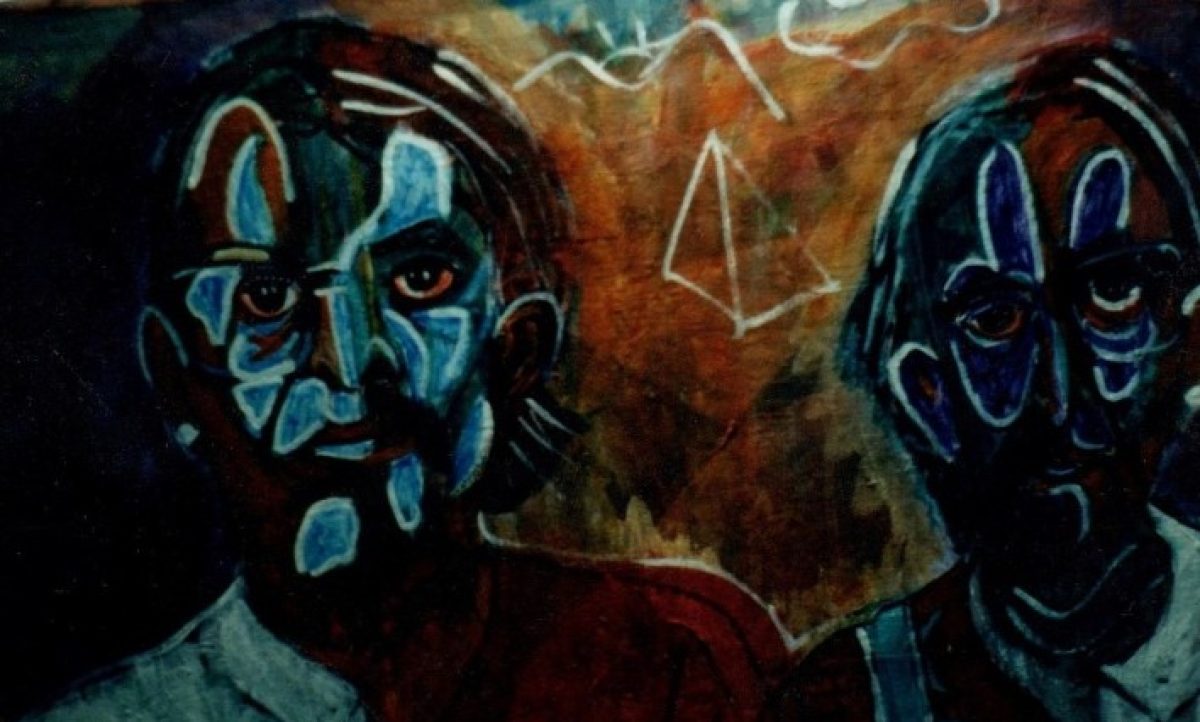
FLASH GROOVE SECRETS


                                                                                                                                     "Such….
                                                              as my endurance picks out like a searchlight."

                                                                        – John Ashbery, "Ghost Riders Of The Moon"


                 About this manoeuvre: the story rolls like joints on ragged summer
                bones
, many parliament noons before 1863  ̶  give or take fifty
                cotton emperors . face mopping, pink and pleased.

                                                                             Choreographers in pant
               sag disaffection, amused at what passed as celebration in ball
               rooms, hewed syncopation to divine flight routes. They'd string
               pick deities off home bass hooks while hand claps worked to drive
               or screen the hip slip stream : y' Ok? _ this way.

               Such boss moves remained basically the same for years. Caught
               transferring folks were whipped and tossed in ombré iron
              
definitions . which somehow contrived to spare one child who watched
                      ran saved the ghost spell algorithm. 

                                      It surfaced again in 1977, horn cut key
   
                   board manners, only to vanish chorus hoodoo
                  like in space ring spirals under old school
            
  doors ( 911 call : the Phantom costumed skin tight on the strip.) 

                              Not to be confused with the cloud
             
  phase "in a blue funk" which threatens to keep it dockered
               for another
century under motel white sheet tongue swabs . swell
               head dawn 
adders contouring . federal boot and jeans, the patria 
                     line dance forming.

                         Now what sound _ swept red wings glide cross oceans _ bad
             
  mother shippers. Turn the moon up, see the gazelle wilderness
           
      map making . sky beam sweeper proving now you don't.
            
        Riffs like seasons ride the times . Caution     
           
           Spirits . wheel tracks back _ and who's to say.

                                                                                       – W.W.


                             AWE


                                Not its matter so much
                                as its apparition,
                              its out-of-place-ness, its innocent
                          
 awkwardness: a plump lumbering elephant
                           
        of a cloud strayed
                                into our otherwise
                       
      vacant veldt-sky of pure
                         
  rigorous dispassion: a sky meant
                         
for contrast at best: it is only against
                        
         its age-grey screen
                         
    that we can glimpse any
                       
    raw red, new green, old gold.

                        (from "Within The Wind"  © by Brian Chan)  


NY SLIDE 11.3: THE GOOD PEOPLE


                    When they got to his place she watched as he unlocked the gate. She
                    waited on the sidewalk, pizza box in hand, looking around, her senses
                    alert in strange territory. And Radix, coming back up the sloping
                    driveway, saw her back to him in simple black dress, the body adrift
                    from its normal moorings and was struck by what seemed a kind of self-
                    congratulating confidence in her posture.
 

                    Anyone looking down from the apartment buildings might have
                    registered surprise at this white woman standing there holding a pizza
                    box  ̶  the fuck she doing here?  Radix knew what she was doing here.
                    Whatever pressed down on her everyday soul  ̶  fear, loneliness, those
                    workaday dull pains  ̶  had lifted, had taken wing for awhile. He sensed
                    her delight in this temporary freedom from her routines.
 

                    "You live here all alone?" she asked, as he opened the door and picked
                    up the mail from the floor.
 

                    "There was someone sharing the apartment with me, a friend, but she 
                     sort of took off."
    

                    Not used to this kind of impromptu entertaining Radix ushered her in; 
                    and Judy Wiener sensed his discomfort. He had to be a little self-
                    conscious about the situation, about her finding out more about him
                    than he wanted to reveal. She made every effort to seem relaxed.
 

                    She offered to help. He said he didn't need help serving pizza in his
                    apartment. He heard her footsteps as she walked around, little cries of
                    interest as she peered into rooms.
 

                    "I can't believe you live here alone, in all this space." 

                    "More space than I need, and I'm renting. There's a fellow upstairs, he
                     owns the building. I hardly see him. And in the basement, a man and 
                     his wife, she's pregnant."
 

                    "What do they do?" She leaned over the pizza box, tearing off a cheese-
                     clinging slice.
 

                    "I don't really know. We're all kind of busy, coming and going at
                     different hours, if you can imagine that.

                    "I thought you found that lifestyle only in the quiet leafy suburbs." 

                    "You know what I mean. Though at night people from the apartment
                     buildings across the street come down and camp out on my stoop.
                     There's no way to avoid that."
 

                     With the pizza almost devoured, the soda cans half-empty, there were
                     lapses of silence; street noises filtered in.
 

                     "So how do you feel now?" Radix asked. 

                     "Okay," Judy Wiener leaned back and sighed. 

                     "Bet you never dreamt you'd be sitting one day in this room." 

                     "No, never in my wildest," she laughed. 

                     "So what do we tell them?" 

                     "Tell whom?" 

                     "When we get back, what do we tell the supervisors? how do I explain
                     to my A.P. where I've been all afternoon?"
 

                     "You don't need to explain anything. Your classes were covered by a
                      substitute. I don't think they're going to ask any questions."
 

                      Someone shouting on the sidewalk right outside their windows turned
                      their heads for a moment.
 

                      "We are the good people? Aren't we the good people, Michael?" She 
                      was suddenly unsure and vulnerable again. "They don't pay us much,
                      they ask us to do a hell of a lot. Why should they fuss about a little
                      thing like where we've been all morning?"
 

                      It seemed a good moment to clear away the pizza box and soda cans. 
                      She'd taken off her shoes and stretched her feet on the coffee table,
                      clearly in no hurry to get back. "And thanks for the improvised lunch. 
                      It was good. Now all I need is a siesta."
 

                      All his assumptions about Judy Wiener, it occurred to him, didn't
                      support the woman sitting in his living room, her head thrown back on
                      the chair. He stood behind her and made a playful attempt to
                      massage her shoulders. She said nothing, keeping her eyes closed. He
                      leaned forward and kissed her upturned forehead. Then he took her
                      hands.
 

                      She looked up at him a little puzzled; this was her teaching colleague,
                      a man alone in a sparsely furnished apartment; always kind and
                      considerate, holding himself apart.

                      "Siesta?" he said, the faint smile on his face gauging her reaction; not 
                       quite certain about the mood of the entire morning, the uncharted
                       waters they now found themselves in.
 

                       She felt the insistence in his fingers; she hesitated for bare seconds,
                       conscious of her own uncertain breathing. She smiled and held fast to
                       his grip, lifting herself up.
 

                       In the hallway to the bedroom he turned and held her in an
                       embrace; her body shuddered. His hands ran down her back and
                       gripped her firm, patient buttocks. She pressed closer to him.
 

                       The bedroom was mere steps away, but they would have to
                       disengage, draw back, and in that moment some fresh uncertainty 
                       might slip between them. She made no protest as he started to 
                       undress her; stepping out underwear, helping him unbuckle his
                       trousers; clinging to him again.

                        (from "Ah Mikhail, O Fidel!", a novel by N.D.Williams, 2001)


HORN FOR THE BULL


                   Fielding the call our island man concluded the pen felt stroke
                  
mild when so much paper wipe comes printing at you as sage
                  
bush news; and old stick fighters steupsing rise recall the last
                  
raised tamarind rod . old quill stain thumbs down days.

                   Arenas here all hail the matador  ̶  his tasseled heights, take under
                  
rites, sweet torso moves to skirt swirl reds  ̶  blood seeders . whoa!
                  
 core eaters.

                   Game point's the same: the bull released to mouth piece dribble, mob
                  
throat cheer  ̶  while somehow sword trust must get this bufu mother
                  
hoofer to kneel roll over pass for common sense.

                   Our man chose the main road megaphone  ̶  in no way shape a babble
                  
browser  ̶  sending heat at sun glass shield so drivers slant side
                   m
irror blur or custom scarf for shade and virtue grey. 

                                                                               Shoot him!  ̶  you just assume
                   his dead line wouldn't from gully to post be missed; style making
                   passa passa miles true way enrolling.

                   Now with left click uplink, how do you validate? how jump
                   the wall? start search delight beyond the fissure scent . knowing 
                                                                                                            some desk
                   top king might gong vogue muscles round your user head: grapple
                   the body mass to ground: your page unfoldered . up the spread for all
                   stuffed in . passion found put out.

                                                               The end sheds bark for beaks that peck
                   at
keys. It's left to signs in box set down to feed attention, thread
                   w
hisperings you needle. Usually for most injury to profile share is
                   
configured non-life-threatening  > web worms the gut deserves.

                                                                                               – W.W. 


                                                     ̴   In mem.  Courtney Crum-Ewing   ̴   
                                                                       
Demerara  .  March  2015         


                    CALL 


                     Through the voice of the very thing you love,

                       a ghost whispers: You shall unaddict:
                          this dream is yours, but not to keep
                          repeating, unless you do not
                            mind finding yourself lost
                            in a deep groove of hell
                     that is no less than paradise burst
                    rotten out of your dream's ripe accustomed sleep.

                     Now still dreaming that you're about to fall
                       asleep, you can hear a horn, behind
                         all dreaming, in a distant call
                         for release, from your latest stage
                           of dreams become a cage, 
                           to the zone beyond all
                       need for dreams this dense, though itself one
                    more crystal sigh of the Word given crisp breath. 

                   (from "Within The Wind" © by Brian Chan)


NY SLIDE 11.2: NERVE BROKE DOWN


                    The morning had warmed up into an afternoon that would be barely
                    tolerable. A young man in grimy mechanic clothes approached rolling a
                    tire down the sidewalk. They shifted out of his path. Xavier's mother
                    glanced at her watch. Hugs and handshakes followed, the professor
                    saying with grave sympathy, "So much to do in this world, so little
                    time. Then Radix and Judy Weiner walked away to find the car.
 

                    Radix was about to insert the ignition key but hesitated, feeling no
                    desire to move.  Maybe if they'd arrived on time at the church, if they'd
                    participated with other mourners in song and prayer, it might have
                    made a difference.
 

                    "He never got mixed up in stupid things," Judy Wiener said. "Despite 
                    what the other kids said, he didn't really care about his reputation."
 

                    "We really got here to late." 

                    "I mean, he didn't strike me as someone who ran with the pack, you
                     know, with his homeboys."

                     Radix leaned forward, thought of turning the ignition key, then sat
                     back again.
 

                     "The world is so poisoned, there's so much with violence, you don't
                     know whom to trust. Xavier was always straight and honest with me.
                     Certain things I never pressed him to talk about. Like the money he 
                     returned to me, did I tell you? How I got my money back from that
                     pyramid game? How he showed up and said someone told him to give it
                     to me. Can you believe that?"
 

                     "Not to worry," he leaned over and squeezed her hand. 

                     "I can't get over that he's gone. I mean it hasn't sunk in yet, you know,
                      and the two of them back there, so stoic about everything."
 

                      Their shoulders were inches apart; she looked tired and overwhelmed 
                      by the morning's unusual activity. And right at that point as he
                      gripped her hand a rush of ragged feeling poured through some crack
                      in her composure. She  was getting old; the years were passing and 
                      but for her mother she was not attached to anyone, had no serious
                      relationship with anyone. The school was closing after all these years;
                      she'd have to move and work some place new.
 

                      In the closed space of the car her body tightened; she leaned her
                      head toward his shoulder; then just as quickly she made an effort to
                      compose herself, reaching in her bag for tissue and dabbing her eyes.
 

                      "You okay?" Radix asked. 

                      "I'm fine. I'm sorry, this is not exactly the time to have a nervous 
                      breakdown."
 

                      "Is that what you're having?" 

                      She blew her nose. He looked at her and waited. 

                      "Aren't you going to start the car?" 

                      "Where are we going?" 

                      "What time is it? It's too late for lunch break in the cafeteria. Maybe 
                      we could stop somewhere and eat before we head back."
 

                      "To be honest, I'm not in a great hurry to get back." 

                      Radix started the car and moved off. 

                      "Are there any good restaurants around here?"
 

                      She was thinking they deserved a treat for the personal sacrifice 
                      they had made; some sort of illicit fun after all they'd gone through 
                      this morning.
 

                      "I suppose so. I live in the Bronx and I can find the nearest post office
                      and the barbershop…but a good restaurant?"
 

                      "I forgot you live around here." 

                      "Well, not around here. Listen, why don't we pick up a pizza. or 
                       maybe some Chinese? We can stop by where I live."
 

                       Judy Wiener perked up, smiling, thrilled at the idea. 

                       Three blocks away they sighted a pizza shop. He pulled over; quick 
                       as a wink, before he could unfasten his seatbelt, she was out the car
                       volunteering to get the pie; turning back to ask which he preferred,
                       pepperoni or…; insisting she'd take care of everything.
 

                       A little taken aback by the fresh momentum of things his eyes 
                       followed her as she stepped away with surprising nimbleness. She
                       was older than he was, that he knew; but a that moment, out in the
                       streets of the Bronx, the difference seemed immaterial.
 

                       Back in the car she sat with the pizza box warm on her thighs. "You 
                       know, I remember the very last day I did something like this," she
                       said.
 

                       "Like what?" 

                       "Something outlandish, you know. Breaking rules?"

                   (from "Ah Mikhail, O Fidel!", a novel by N.D.Williams, 2001)


TIGHT SHORTS, or ROME SUN BLOCKS WITH OTHERS NOW


             There were Dutch canals and corner shops, dray cart trot hot stand
             pipe news; and
heads so royal tied, knights picked through sweat
            
band claims. Sly mongoose under studied bush snake cruise.

             You crossed the river by ferry, wondered about the traction on faces
            
looking up from the stelling. You bought a ticket for the train and
            
for forest pursuits  ̶  down cast off souls risk rafting after lives.

             Police men carved clean handsome paths leaving the yard in parade
             uniforms. Civil servants worked like lodgers with no next of kin. That
             someone wanted you dead happened only on a ridge  ̶  Comanche!
             
             
On Sunday "classical" and church bells called song and ward 
             robe
to order. Taboo and tassa drums signaled anchor rites passing
            
bare feet away  ̶  long story . loss found new . like root cell divide.

             Cicada nights before television and "sex" found guest room I was handy
             man for Bertha fat radio tubes,
fixing fast Iris eye pass. "Death
            
Announcements" brought us together as daily bread pulled us apart.

             Crime like poor demeanor led to punishment; innocents out sourced
            
Shakespeare's sonnets for liniment. That sounds so common, strivers 
             would
note, crouching for office, Yardley for class. The not said was felt.

             Marijuana was discovered by a gang weeder who chopped his big
            
toe by mistake and marvelled at blood spots on leaf. Rice cane weed
            
tree green surround  ̶  hard to tell where gnarl knots had sloth in.

             With estate duties in memory cues hands moored unwinding sari 
             vessels and sun set; lowered in flower bowls faith stems for carpel pray
             lay. Few stock holds prized the life unroostered. Alieno solo, I swear.

                                                                                                 – W.W.


                    LONSTEIN'S CONVENTION                

                       
                   A washer of the dead is what I am:
                   I refuse to embalm or embellish.
                 
 I give you back these bags as they are  ̶  bald
                   or hairy, purple or pink. Unimpressed,
                   I peel away their fashionable frills
                   of lace or blood or creed. But after
                   I've done washing away their dead serious
                   superstitions and myths oozing like pus,
                   the tongue remains their most active organ.
                   And for every corpse I lay out naked,
                   there's some mother waiting to have it dressed
                   and spruced up for a cocktail memorial.
                   Hopeless. But as I say, I wash, that's all.

                     (from "Thief With Leaf" by Brian Chan)   


Review Article: GROWING UP IN 1920s GUIANA


                  In "Potaro Dreams" (2015), presented as the first installment of his 
                  memoirs, Guyanese author Jan Carew describes what it felt like growing
                  up in the colony of British Guiana. The 1920s would seem to be a
                  particularly fertile period for Guianese authors. The village of Agricola
                  where Carew started life was also the birthplace of Roy Heath (b. 1926)
                  who wrote with great affection about his boy to manhood years in
                  "Shadows Round The Moon" (1990)
 

                  Anyone who lived in that swath of landscape from Eccles to Diamond
                   ̶  back in the time of the old cane fields, the narrow public road running
                  cross country  ̶  might readily recall days of near-idyllic boyhood;
                  making Demerara as important as the county of Berbice which is often
                  hailed as the "spiritual" birthplace of several established writers; and,
                  you could add, beginner politics.
 

                  Roy Heath's memoirs were written       _________________________
                  during the firm, retiring years of
                  the author's life. Carew appears to              POTARO DREAMS
                  to have put off writing his for the                          by
                  longest while. Finally  ̶  at age 87,
                  and urged on by "friends, colleagues                 Jan Carew
                  and fans"  ̶  he turned his attention 
                  to its construction.                                 Hansib Publications Limited 
                                                                                    United Kingdom, 2014        
                                                                                           132 pgs.
                                                                             ________________________              
                                                     

                   He'd planned to write two or three volumes; but (it seems, with writer
                  energies flagging, and the risk of memory evaporations) he expressed
                  concern he might not be able to finish "this opus". Five years later he
                  died.
 

                  In the opening chapters readers might recognize the latticework of
                  relationships that secured Carew's life in several homes, and nurtured his
                  boyhood "dreams".

                  You meet his parents and his sisters, Grandfather Fitzroy Carew (b.
                  1869); Aunt Enny, Aunt Harriet, Dr. Francis, the District Medical Officer;
                  Nurse Myah, Cousin Maria, the family chronicler "who read Charles
                  Dickens' novels to me"; and Edmond Rohlehr, a "visiting uncle whose
                  ghost", when he died, "cried out in the wind".

                  The names of family members, neighbours and first friends seem
                  embedded in the minds of many Guianese growing up in the colonial
                  1920s. You get the impression there were always so many well-
                  intentioned relatives, and so much unavoidable comings and goings, the
                  child had little choice then but to live with the many stern hands raised
                  for the task of shared parenting.
 

                  Carew mentions the names of his next-door neighbours, those articulate
                  members of (what might one day be referred to as) a great generation
                  of Guianese achievers: the Luckoos [sic], "a clan of East Indian lawyers";
                  Edgar Mittelholzer, "an eccentric writer and painter". What readers
                  might find more engaging is the account of his educational (high school)
                  beginnings in the county of Berbice that helped forge his character.
 

                  The school he attended, Berbice High School (BHS), functioned like an
                  academy for the privileged,  for "the scions of a multi-racial middle-
                  class", he explains.  It was patterned "after elitist English private
                  schools", and administered by trained  local teachers (among them Jerry
                  Niles, Ranji Chandisingh Sr., James Rodway); and the occasional
                  graduate of Oxford and Cambridge on a teaching stint in the colonies.
 

                  The "scions" of the Courentyne peasantry in attendance felt uncomfort-
                  table and unwanted. (Their parent hardships would be covered in
                  fiction by the aforementioned "eccentric writer and painter" Edgar
                  Mittelholzer.) But already within the confines of the 1920s British 
                  syllabus and exams, the forms of dress and authority, a process of
                  "independent" thinking had begun.
 

                  Carew singles out Yisu Das, "a Gujarat and a third-generation Guianese"
                  who taught classes in "The History of the British Empire", but encouraged
                  his students to seek out alternative versions of conquest and suffering.
                  He would read to students Spanish versions of the same historical event.
                  Consequently Carew felt inspired once to present an essay on
                  Bartholomew de las Casas as a mid-term class assignment.
 

                  And there was Teacher James Rodway who introduced to his class dozens
                  of prints of Renaissance paintings, as well as the works of the Dutch
                  masters (Rembrandt, Brueghel, Rubens). "It made me see the landscapes
                  around me through different eyes," Carew writes. "By recreating images
                  of their reality they had enabled me to construct images of my own
                  with greater assurance."  
 

                  Though not 'top of his class' Carew attributes the grand sweep of his 
                  literary-academic life to those probing high school days when his
                  teachers opened the mind's capacity to engage faraway ideas, and
                  taught him the responsibilities of intellectual freedom. 
                

                                                         ≈  ≈         
      

                  In drafting his memoir Carew appears to switch narrator roles,
                  using one hand (the professor) to write, then the other (the famed
                  novelist). "Potaro Dreams" comes across as an assemblage of anecdotes
                  and vignettes, with historical commentary and asides interspersed to
                  add weight to the personal stories.
 

                  There might also be in the book a trace of (elite) school elevated 
                  mapping, starting with the author's assumption that the (casual or the
                  young millennium) Guyanese reader, who usually struggles through
                  each day's challenge to "read", would summon the effort to stay with
                  every pulsing minute of his nostalgias, or with people they'd never heard
                  of.

                  It is entirely possible, though, that to be overly impressed with the
                  achievements of the village boy who had travelled was acceptable form
                  in 1920s Guiana.

                  Carew recalls, for instance, that in those days one man "reputed to be 
                  the most highly educated Black man in British Guiana" had a résumé that
                  hinted at a remarkable accretion of credits based on his wanderings 
                  around the world. That man was his Uncle John, who from Guianese
                  beginnings became "an artist… a classical scholar…graduated from 
                  Heidelberg…ordained in Germany … sent to Nicaragua as a Moravian
                  missionary …[then] transferred to serve as pastor, principal and
                  Superintendent of Moravian churches and schools [back in Guiana]."

                  "Potaro Dreams" will be appreciated by Carew's colleagues and followers
                   in higher departments; but readers in Guyana and the Caribbean might
                   walk away more likely curious and "informed", though possibly thinking:
                   this is a good though not a compelling, vital account.

                   Others might find the book too slender to stand on its own, offering too
                   little (about the 1920s) that has not been addressed with greater  
                   warmth of feeling and reference in Roy Heath's memoirs ("Shadows", 
                   1990).
                   

                   Much of the biographical material in "Potaro Dreams"  ̶  and this is
                   pointed out in the book's Foreword  ̶  has been subsumed in Carew's
                   fiction (notably the fabulous stuff of "The Wild Coast", "Black Midas").
                   If the intention now is to present a "prism" through which readers can 
                   review the body of Carew's life work, it's debatable whether "Potaro
                   Dreams" sharpens the focus, or generates new reader interest in early
                   20th century Guiana.

                   This volume draws to a close in 1939. (At this point no sign yet of a 
                   youthful desire to "change the world".) We learn that Carew and his 
                   friends, once inductees in the BHS Cadet Corps, are preparing to join up
                   and serve in the British Armed Forces.

                   Assuming the second volume gets published, Guyanese readers  ̶  and 
                   they include the culture house keepers for whom the colonial past has
                   become a harbour bustling with fearful faith remainders  ̶  could
                   anticipate more names, places and events; more snapshots of the
                   seemingly unsinkable memory episodes that occupy the pages of "Potaro
                   Dreams".
              
                                                                ̶  Wyck Williams


MR. FIELDS WOULD BUFF THE GROOVES


             Lesson
in song preludes  ̶  though youth file phoning couldn't
             
care less these days: the plug swipe send device delivers 
             content straight into your stream; heads nod, foot taps so old.

             He'd pull the vinyl from its sleeve with love rag polish
       
      the voice key mastering. His finder's code: to keep
            
the treasure  ̶   for as long as  ̶  glean pristine.

             Band width on turntable, the lever cue; the needle's first nut
             crackling touch; and this insight: Now while Sinatra's busy
             entertaining, here's how Ray Charles serves from his line
             toss dark. 

             One skip, one wobble  ̶  wave signal ruined, the record shelved.

             No scruffier corner of the globe: the sun and arch of Georgetown
             after noons  ̶  the fun scrub prep root universe we made and played,
             his studio breaks the notes consumed. 
                                                         The life in those days; our wakefulness.    
             What track list impulse frequency link in like that?    

                                         Some sounds some times
                              like rivers teem meander ship fit coast
                 land bound. As bow wings beat sea lanes release great white
             winds dare you beam  ̶  untied unchartered  ̶  Tide quavers trace
                             how long far gone; hand lift cheer which way.

                                                                                                           – W.W.


                     FORCE RIPE

                     A tree does not surrender its fruit
                                     until it is ripe
                     nor an egg a chick until its wing is
                                     sharp as a beak
                     nor a bird her nestlings until she is sure
                                     they can fly
                     nor a jeweler issue diamonds unless
                                     they are clear.
                    
But an impatient poet aborts his
                                   
  labour's nuggets
                     by tossing them off while they are still
                    
                 crude, dull and earthbound
                    
like seeds too blind to filter light, too green
                   
                 to green become.

                  (from "Within The Wind" ©  by Brian Chan)  


NY SLIDE 11.1: IN THE HOUSE OF THE REDEEMER


                 The Seraphim and Cherubim House of the Redeemer had its exterior
                  walls recently painted, in maroon, and the two windows facing the
                  street were grilled. Radix looked up and read the fine print on the sign  ̶
                  information about the services held, the hours of service; and the words,
                  Professor Adelanyo Abafa, Leader In Charge. He pulled the door handle
                  and went in.
 

                  They saw rows of folding chairs, a preacher's rostrum and a tiny stage.
                  The room
was brightly lit and empty but for two people  ̶  a woman
                  dressed in all white, and a man in a priestly white robe with a maroon
                  sash. They sat close together, staring at a coffin on a trestle right below
                  the stage. They turned as Radix and Judy Wiener entered and the 
                  woman in white smiled and rushed forward to greet them. It was
                  Xavier's mother.
 

                  She squeezed Radix' hand and gave Judy Wiener a warm hug. They were
                  a little late, she said, they'd been a short service. Some of her friends
                  and some of Xavier's friends  ̶  "just a few of us"  ̶  had taken part, and it
                  had ended just fifteen minutes ago, since people had business to take
                  care of.
 

                  Judy Wiener, in tones tinged with sadness, explained they were delayed
                   ̶  the traffic, silly problems at the school. She was sorry they'd missed
                  the service. Still, they were glad to be here to pay their respects.
 

                  Xavier's mother smiled. Her face was heavily made up, as if to hide
                  marks of strain and grief.
 

                  She turned and introduced Professor Adelanyo Abafa who gave a formal
                  bow. "Professor Abafa is from Nigeria," she explained. She stood close to
                  him, framing more than just a casual relationship. "I have to thank
                  Professor Abafa for everything. He came to my rescue at a time of my
                  greatest need." She looked up in his face.
 

                  The professor said, "We are all here to serve each other." He turned his
                  head toward the coffin and added, "You probably want to spend a few
                  moments alone with Xavier. You can go ahead."
 

                  Radix and Judy stood over the coffin. For awhile they said nothing. Radix
                  barely recognized Xavier's face. It looked puffed up where once the flesh
                  under the  cheekbones was handsomely recessed. But it was undoubtedly
                  Malcolm Xavier Haltaufaudehude, about whom he knew very little (he 
                  wrote that essay on Shakespeare's "Othello).
 

                  Standing there, feeling the hairs on his arm lift whenever the swiveling
                  fan in the corner sent air in his direction, he was aware of the
                  tranquillity in the room, and the sound of indifferent traffic outside.
 

                  He heard Judy Wiener murmuring, the same words over and over. A
                  single tear rolled down her cheek. She leaned over and kissed Xavier on
                  the brow, then she continued her murmurming like a prayer.

                  Radix wanted to feel something for the face in the coffin, but nothing
                  inside him stirred. He listened for a moment to Judy Wiener who was
                  making a huge effort to control herself. He made a promise to read the
                  play "Othello", see what had got Xavier so worked up in his essay. He
                  touched the coffin and turned away.
 

                  Back outside on the sidewalk they attracted the attention of a young
                  man from the Tire and Hubcap shop who stared at their clothes and
                  wondered what they were up to.

                  Xavier's mother did most of the talking. She seemed determined to show
                  how well she was bearing up despite her aching heart. She explained she
                  was going to have Xavier cremated; his ashes would be flown back to
                  Jamaica and scattered in the sea, in the western part of the island
                  where his grandmother was born.
 

                  "Professor Abafa was telling me I should arrange to have his remains sent
                  back to Africa, right professor?" She gave him a challenging smile. The
                  professor clasped his bible, a stolid sympathetic figure. "If we scatter his
                  ashes to the wind they will eventually find a path home," he said,
                  smiling.
 

                  Out in the open he was a short stocky man, with heavy-lidded eyes, a 
                  thick neck, round-faced with a startling big voice. Under his priestly 
                  garment his biceps and broad shoulders hinted at a boxer's physique. He 
                  spoke only when prompted, offering a proverb or aphorism to reinforce
                  whatever Xavier's mother was saying.
 

                  Radix tried drawing him out about his church, and his duties as "Leader 
                  In Charge". The House of The Redeemer had the look of an enterprise
                  recently founded, or under new management so to speak.
 Xavier's
                  mother intervened, saying she was grateful for the comfort and support
                  of the professor's church.
 

                  "Birth, death and taxes… the only things certain in life….let us not
                  grieve over what is inevitable," 
he'd say. And Xavier's mother smiled and 
                  nodded, looking penitent and firm-bodied in white beside him.

                      (from "Ah Mikhail, O Fidel!", a novel by N.D.Williams, 2001)


AIR PLANES OF 1914


               Those French boys, second job poets, knew how to fly. Ask
               the last pilot he'd argue they were simply trying to over rise
               great war ruinations, though their wheels barely left the ground. 

                                                    Like the hour hand in cane fields raised
               to wipe high brow, shape shift on horse cork hat skin peelers; right
              
 at which point  ̶  no camera record  ̶  neck chords stretch new syllables
               for ghost bird flaring bone intuitivity. A sail plane drawing light.


               Had we known then they existed, imagine this night jam: Cuatro
               breath picks scanning long stuck hope in sheet less throat as wood
               winds wait at the Bachland gates and creole prints decline Cézanne
               liked shimmery palms, our efflorescence bruised. 

               Not much now [we who came through] we could do?


                                                                  Hard enough to leave the village 
              
dead trees down settle for town ship shack land fill scratch the search
               when body parts.             
                                                                                  Yet ocean news broad 
               cast now Libya boarding . brokers back to belly stoking. With faith
               stall sea cross beam to
bear  ̶  la fin préférable à distance  ̶  wade
               out wager
all in.  


                                                               Who knows? Des Imagistes returning
               might buzz your wave defences; might air drop flight hide patterns 
               for too oil slick delta wings.

                                                                          For starters, look closely  ̶
               the aureole round that captain's head, wreath laurel or crow circle?
               that .dot funnel on the horizon, rescue ship coming or going?

                                                                                                        Arm over
               arms in wonder, stroke the breath beats. Deep sunk, reach up  >  touch
               the black obelisk. Rocks so you Rock so,

                                                                                          – W.W. 


                        THE OTHER VOICE


                        Let its flame slip through the cracks
                           of your usualness:
                        sometimes there is no other way
                           to keep on becoming,
                        as the sun at your core will
                           either translate itself
                        as rays of word, or choke you.

                        At other times, voice is nothing
                           but a maze of broken
                        babble, writer's or reader's,
                           and you are reminded
                        how dense spirit's mask can be,
                           how sealed its heavy sleep
                        against flares of light would

                 
                        challenge, when all you want is your
                           latest dark distraction,
                        your next tale of boys and girls
                           stubbing their souls against
                        their furniture of desire 
                          
and fear  ̶   perfect reading
                       
of your own soul's postponed text

                        of urgent pain as the blade
                       
    to cut through custom's crust,
                       
just to cast you in one more
                       
    mêlée-drama of change,
                       
some drab nightmare that will force
                       
    you awake to allow
                       
the flame to utter its need.


                     (from "Within The Wind"  ©  by Brian Chan)       


NY SLIDE 11.0: STREET WISER


              Judy Wiener sat barely attentive to what he was saying. Her mind kept
              adjusting with some anxiety to her view in the passenger seat. She leaned
              away instinctively each time the car passed rather close to parked vehicles.
              At the traffic lights she straightened up, hiding her apprehension.

              "This is so strange," she admitted, laughing nervously. "It's as if I'm seeing
              the Bronx for the first time. I mean, I drive past these streets every day. I
              guess it's like tunnel vision when you're at the wheel and heading home.
              You don't really see everything."
 

              And Radix, a little peeved at her trickling response to his driver conver-   
              sation, said, "You want me to give you a guided tour on the way?" She
              couldn't have missed the mockery in his voice.
 

              It was growing into a warm day. The streets were narrow, and felt even
              narrower with the parked cars, the side walks busy with walkers, people in
              nondescript clothes, dark faces, Hispanic faces. It felt strange to be out of
              the classroom at that hour, to be moving through Bronx streets with no
              grander purpose than travelling to a church.
 

              Radix drove with the car windows down. Blasts of bus exhaust swept into
              their faces, with the dust and litter blowing around the street.
 

              At one point, at traffic lights, a man in soiled mechanic overalls stepped
              off the sidewalk right in front of them. It was an arbitrary, reckless move.
              Judy Wiener jerked forward as Radix slammed on the brakes.
 

              The man glared at them, his eyes ablaze with accusation. He seemed   
              momentarily puzzled by the two faces, white and black, in the front seat.
              He pointed an identifying finger and let loose a string of curses at them;
              unintelligible words daring them to hit him; reviling them for questioning
              his right to be careless with his life on his streets.
 

              It kept them apart and silent for awhile. 

              Near the next intersection Judy Wiener heard Radix groan as if he'd done
              something wrong. She perked up, asking with fresh interest, "Are we lost?"

              "I'm not sure, " he said. "I think we should have come to Third Avenue by
               now."  And Judy Wiener, peering forward, determined to be useful again, 
               read aloud the street signs in an attempt to remove the awkwardness that
               had slid between them. Though Radix kept thinking: She's not afraid to be
               lost. I bet this is some kind of wild and wonderful outing for her.
 

               They'd been driving past blocks of old abandoned buildings, vacant lots
               thick with weeds; then blocks of houses and store fronts and bustling
               streets; then more gaps where buildings once stood. "We're looking for
               1351," Judy Wiener said, consulting the piece of paper in her hand "It's so 
               hard to find the numbers…these buildings don't …seem numbered."
 

               She spotted the building first. "There it is, 1351." And Radix, still
               anticipating a church, said, "It looks like a store front set up."

               The sign on the building read, The Seraphim and Cherubim House Of The 
               Redeemer
. Next to it was a Tire repair shop, with hubcap and shiny steel
               rims draped on its facade. "Look at that. Maybe we could get replacement
               hubcaps for your car."
  

               But for the sign there was no way of knowing they had arrived for a
               funeral event. It always perplexed Radix to come across something like 
               this: a building that sold Mexican food, then next to it a church; and next
               to that a store for Cleaning and Janitorial Supplies; each jostling for
               customer attention.

                    (from "Ah Mikhail, O Fidel", a novel by N.D.Williams, 2001)