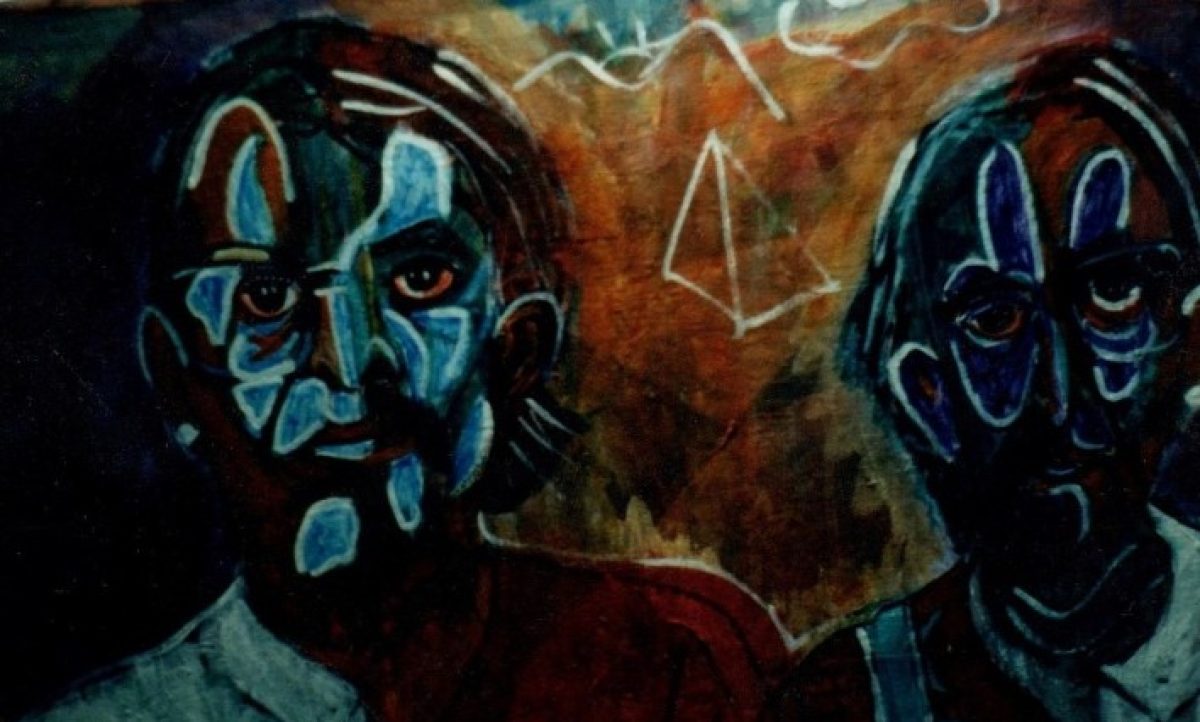
BLUE HUNDRED NOTES FOR JULIO


              Evening moist bites on dry bed lips testing the initials
              of youth dew kiss still cling sharper than the first search party
              mapping curve mound signs; or spring tide swell moon up
             
on the sea wall  ̶  permit at last to storm.

              On air brushed island bicycles, cow amble and cart
              in our path, we lost ourselves in Walcott-like land tie dyes;
              prince and princess, never more crowned, cool valleys
              like Marley's, never more owned. Valve insert keys golden,
              our kingdom full come. 

              The morning you disclosed your ovaries contained no eggs
             
designed to child; straight backed away  ̶  your ten o'clock intern
             
ship call [On the Rayuela Périphérique: * Even if Heaven is
              close by, all life in front of one.*]   
                                                                  Did you know then who you'd
              become? your hands scrubbed in would people house wife smiles?

              I'll go happy parts of us clasped to my chest rare coins on eye
              blinds open (nose holding casket scents).


              I'll clutch
these strips, not yet expired, like magnets on
              the chance
there's the same swipe system for the paradise side:
              a rainbow One source blues stop @ "Bird & Miles"
  ̶  a pint round
              about midnight for Julio  ̶  as hip hop tattoos sneak a peek.

              Ripe plum pluck and good luck! risks of innocence distinguishing;
              Fellini's FIN.
                                                                  < Yo, corbeau! head red 
              that garden lizard's fire fly snaps, the tree climb pause to pose,
              Eh-eh, what became of,  
                                                                             
                                                                               – W.W.


                                        ̴  Ça va Julio Cortázar (1914 – 1984)  ̴


                    COCTEAU


                    I:
                 

                    My taste for moment-to-moment death yeasts
                    the liquor of life that waters the taste.

                    This tongue is ghosted by my brandy's ice-
                    dry vapour drifting in and out of being.  


                   II:

                   Now I am a stone in a running river,
                   split by the sun into a thousand moons;

                   now the river drained to a widow's bed,
                   a tongue of sand clogged with a million stars.


                   III:
 

                   My house is all windows of seamless glass
                  
with soldiers drifting by them, like stray clouds.

                   On its walls, I'm a shadow with ten eyes
                   whose target is any, whose aim is all.


IV:

                   From branch to branch of this flowering tree
                   I hop, a bird who has traded his wings

                   for a hundred songs from as many beaks:
                   fickle to each branch, faithful to one tree.

                  (from "Scratches On The Air" by Brian Chan)


NY SLIDE 10.9: PERMISSION TO LEAVE THE BUILDING


               Radix had some difficulty getting away for Xavier's funeral the next day.
               His supervisor was in a disgruntled mood.
For long moments he appeared
               to ignore Radix, rubbing his temples and complaining to his secretary
               about his sinuses acting up. He indicated he had too much on his plate
               that morning and suggested Radix take his problem to Bob Darling (A.P. 
               Admin).
 

               Bob Darling asked Radix questions: did he know the student? was he
               staying out all day? did he have lesson plans for the teachers covering his 
               classes?
 

               Then there were forms to fill out, some running back and forth for
               signatures of approval. His supervisor, still unhappy with the short notice
               given, said he wasn't sure he'd find teachers to cover the classes.
 

               Finally, with a gesture of impatience, he got Bob Darling on the phone,
               and must have been persuaded it would be good for community relations
               to have teacher representation at the funeral of a John Wayne Cotter
               student.
 

               When that point got through to him, his manner became less irritable. Still
               complaining of his sinuses, as if that was the reason for his irritability, he
               asked friendly questions about the dead student. But by then Radix had 
               had just about enough of him.
 

               He'd arranged to meet Judy Wiener in the lobby at the end of period 3, but
               he had to go looking for her. She was still at her desk in her classroom,
               giving last minute instructions to the covering teacher; and not in any
               great hurry to get moving. She wore a black dress, black stockings and
               shoes, and she had touched up her cheeks and eyelids. Radix for his part,
               in his workday long sleeves and skinny tie, hadn't thought of wearing
               something different for the funeral.
 

               Later when he remarked on how attractive she looked in black, Judy
               Wiener threw him an anxious look and asked if he thought her wardrobe
               had gone a bit too far for the occasion. They decided to use his car.

               When they emerged from the building on the sidewalk they were seen, 
               recognized and hailed by students on the third floor who shouted Radix'
               name and wanted to know why he was cutting class; and where was he
               taking Miss Wiener?
 

               "So where are we going?" he asked. 

               Judy Wiener took a piece of paper from her bag. Xavier's mother had
               called the night before, apologizing for not contacting her earlier; she was
               having a "hectic" time with the police, her lawyer, the funeral arrange-
               ments.
 

               "I wrote it down here…The Seraphim and Cherubim House of the 
               Redeemer
." Radix gave her an incredulous look. "That's what his mother
               told me. It's on Third Avenue."
 

               "I know where Third Avenue is. Never heard of the church." 

               "It doesn't sound like a church. In the conventional sense, I mean." 

                He eased into the mid-morning traffic; they' would avoid the expressway,
                taking the route through the Bronx streets choked with pedestrians and
                stop lights.
 

                He told her how difficult and begrudging his supervisor seemed in letting
                him go. "Oh, they do that all the time. They monitor every step we take
                inside the building, outside the building."
 

               "I don't understand why we must account for every word, every minute we
                use. The punch-in clock, the lesson plan. The other day I heard someone
                suggesting they mount video cameras in the hallways….he was serious
                mounted video cameras would help cut down on the hallway walkers, the
                perps banging on the doors."

                             (from "Ah Mikhail, O Fidel!", a novel by N.D.Williams, 2001)


DEPARTURE GATES OF CHOICE


                       Not envy we envy the cliff sheer drop, the glass tower dive,
                       the bridge that spans decoupled cravings or whale tides
                       unembraceable.
                                                        Is just – apart from bands and bandits –
                       we like to leave, not fall shoot jump. 

                       Few islanders stage the debunching show  ̶  last stand on a ledge
                      
as watchers point or talk for inches grab at sleeve phone
                      
fame; and one womb flat in disbelief recalls how nipples
                       swollen in support placenta fluids swished.

                       There is the sea  ̶  its dread head home stretch for horizon
                      
squints; cupped coast line candles for long memory holds; illusion
                       heals. Not one soul here would venture leave the puzzle of a topless
                       bobbing boat (reported stolen) with "Jesus Saves" fish oars.

                       True islanders prefer a self clean fire burn! straight like rum
                       hatch down
 ̶  what scours breast plate stain and tears at loss
                      
fault stuff that silk our spirit cells in weeds.

                                                               The nerve to count stop in ferment
                       grape years less seed . gap centuries less home.

                                                                                                 A bush burning summing
                      
up, you could say: Exit breath on own site terms.        
                                                          
                                                              No love late bells no message fat claim
                       
chance of reparation never mind what conch shells backing bone
                      
collectors say.                 
                               
                       Morn fortunes break wait, night star clusters yes. Light
                      
you see.

                                                                                                            – W.W.


                         THE TREE MAN'S COMING WINTER


                         The white throats of death circle
                         above my head, calling warning 
                         drawing the limits of my days.
 

                         The wind keeps making a drum
                         
of my skin, and flutes and rattles
                        
of my bones: funeral music,

                         dumb sadness that keeps my heart
                         pulping in the sun, regardless
                         yet careful, ruthlessly tender.
 

                         It's a cloak against the wind,
                        
this peace of knowing soon it will
                        
blow every last dried leaf nowhere. 

                         This is the only one of twelve
                        
voices the wind finds, leaves in me.
                        
All I shed, rehearsing axes.


                       (from "Thief With Leaf" by Brian Chan)


NY SLIDE 10.8: SHOCK AND REGRET


              At the library desk, as Radix walked in, Dr. Balleret and Judy Wiener
              looked up
and smiled, as if happy at that moment to see him. "There he is,
              the man's everyone's been asking for,"  Dr. Balleret announced. There was a
              brightness in her eyes he'd come to interpret as danger signals. He nodded
              and looked at Judy Wiener, wondering what the excitement was about.

              "Did you hear?" she said. Heard what? "Xavier died over the weekend." The 
              shock and disbelief must have showed on his face. They watched him
              closely and, since it was apparent he hadn't heard, they seemed to be
              measuring the impact the news had on him. He simply repeated the word
              Died? and waited to be be told what happened.

              Dr. Balleret tried to relieve the shock by saying next: "I knew him by his full
              name, Malcolm Xavier Haltaufauderhude. He didn't come here often, but
              when he did I'd say to him, Malcolm Xavier Haltaufauderhude, to what do
              we owe the pleasure of your company
? And he'd say…" (she stiffened her
              back and raised her bony arms in an effort to dramatize Xavier's manner)
              "…all puffed up with pride, or maybe he was upset about something, I
              don't owe you no book, Miss Balleret
. Just a little game we played
              whenever he showed up, which wasn't too regular. He was such a pleasant
              young man when you got to know him. He gave me no trouble." And Judy
              Wiener said, "We knew him only as Xavier. He was a hard worker."

              By then Radix had sufficiently recovered from the first news impact. His 
              eyes fastened on Judy Wiener's face.
 

              He couldn't understand her apparent nonchalance. This after all was
              shattering news. This was Xavier they were talking about. Her Xavier.
              They'd been to the hospital to visit him, Judy Wiener and Radix. Not Dr.
              Balleret. Surely there was more to be said between them, some expression
              of sorrow; not this idle chatter in the library.
 

              Dr. Balleret now wondered if there was sufficient time to make a public
              announcement, during the homeroom class break. She found a ballpoint in
              a drawer and began taking down particulars from Judy Wiener; and Radix
              drifted off to find a work desk. He half-expected Judy Wiener to come over
              when she was done, but she didn't.

              Dr. Balleret made the brief announcement about Xavier, but to many it
              sounded like old news. Those who knew him had heard already about his 
              death. Most students and teachers didn't know who he was; his name
              sounded foreign, and in any event he was from Special Education.
 

              Later in the teacher's cafeteria he saw Judy Wiener again, eating heartily,
              and deep in conversation with a plump teacher who moved food to her
              mouth with practiced speed and pleasure. He stopped at the table, still
              thinking they needed to say something more to each other about what had
              happened.
 

              She looked up, her face cheerful and serene; she gave him a bright "Hi". 
              He shook his head and by way of broaching the subject said, "So, what a
              shame this had to happen." She shook her head, catching his meaning: "Yes,
              isn't it terrible? Isn't it terrible?"
 

              She put down her fork and turned in her chair to him, as if to pass on
              information of a confidential nature. Still poised to moved on and sit
              elsewhere, he leaned forward.
 

              And in a voice just above a whisper she said, "I only found out about it this
              morning, from the kids in class." Radix opened his eyes, amazed. "That's
              how I heard he'd died. One of the kids told me."  She seemed unhappy
              about that. "But didn't his mother contact you?" he asked. Judy Wiener
              shook her head, as if very disappointed.

             It became clearer to Radix. Xavier's mother had not called Xavier's teacher
             at John Wayne Cotter to let her know her student had died.
 

             She dabbed her lips with a paper napkin, and looked hard at Radix as if to  
             say, How could she do something like that?  I should have been the first in 
             the building to hear about this.
And Radix shrugged his shoulders,
             suggesting, Yes, that's strange. There must be some explanation.
 

             "Anyway, the funeral is set for tomorrow morning, so I was told. Are you
              going?'
 

             "I don't know. Tomorrow morning? While we're in classrooms?" 

              "You can arrange for someone to cover your class…it shouldn't be a
              problem…talk to you later."

              Radix moved away. He'd seen the first twitches of sadness on her face. He
              heard a little crack in her voice, like something lurking in her throat,
              working to subvert her. It sounded like the Judy Wiener he knew.

                      (from "Ah Mikhail, O Fidel!", a novel by N.D.Williams, 2001)


HOME COME TO COUPLING


                    Night watch the eagle prize titled, you dove breast day
                    maker. Heart heave not too close to his scout feathers long
                    
aloft  ̶  home  ̶  fortunes balding.
                                                                   Tier attired for mate he'll trade
                    our plantain rough stuff for chips and retrofits.

                    If your skiff never left its island berth he'd have his way your 
                    way not grained to stay. In sandals he might propose a resident
                    vista: you could do a lot worse dashing wool hat through the snow
                    bells up North ringing. Our bearing strait is not a site for frost
                    no cross road cues.
                                                                                            Besides, observe
                    how, sweet on after noons, our grazing office pens shut down
  ̶  
                    Islanda Nervosa, tide orange yields shore lime.
           
            
                              Friends fast talking might conceive a link with him sets up maypole
                    limb weave. Our suns need rest sheds; desire, a colony turning
                    cheek on stilts, could wobble to unattainable.

                    With pipe line accessories he'd front gait an invest in native
                    shingles, fruit fresh trays, a choice of shanty smiles; the root 
                    scent dialectals give off soothing travel scrapes of skin. 

                    My smooth avocado, he'll pre-enter  ̶  you not quite in the right
                   
position to (you) know  ̶  Silo maintenance costs!  ̶  skim cream
                    your prime till tempers set off alarms blow horn men hear.  

                                                                      Brace for it  ̴̶  his thinking dug in
                   
you sweet sour sap juicing; faith cupped for tea steep rounds.
                    Wait for it  ̶  rush come of sacrifice redeemed rewinding.

                                                                            Otherwise, time to remove
                    the moon boots  ̶  okay!okay!  ̶  time to poke the marabunta nest.

                                                                                     – W.W.


                       +ADD+SUBTRACT+DIVIDE+MULTIPLY+

                           Wanting what You are for myself,
                            the self which I forget so
                         as to want You, is like striking
                         flint against my heart's stone whose spar-
                            king greed seeds a thousand fires
                         that feed every storm we invoke.

                   (from "Within The Wind" © by Brian Chan)                     


NY SLIDE 10.7: CHARACTER SERVING PRINCIPLE


               At some point, his curiosity sufficiently piqued, Radix asked other 
               teachers about her.
What was their opinion of the lady in the library?
               Which lady?  they usually responded, You mean, Val? They offered
               unflattering profiles.

               Dr. Balleret was into her 27th year at John Wayne Cotter. She showed no
               readiness to retire. She ran the library like a colonial outpost. The books
               on the shelves were old and outdated; they left dust on your fingers. You
               could read the names of the students (some of whom Dr. Balleret
               remembered fondly) who had taken them out in the 70s. She asked me to
               pay for returning a book late! can you believe that?

               Everything else, like the librarian, was slowly and neatly decomposing on
               the library shelves.

               Only Tom Maypole (Biology) had good things to say about her. (He wore a
               jacket with a patch at the elbow and a tie, and he smoked a pipe; and
               everyone called him the Professor.)

               "A wonderful….truly generous person…much misunderstood," he said.

               "Tell me about it, Tom."

               "No seriously, you have to understand the world she lives in."

               "And what world is that? I thought we all lived more or less on the same 
               planet."

               "Don't forget, she's been here longer than most of you can recall."

               "I remember how excited she got about organizing student trips to the 
               Museum of Modern Art," someone conceded.

               "Did you hear.. about the reunion of teachers and graduates she's 
                organizing…? from as far back as 1971? It's for a big send-off party, since 
                they're closing the school. Didn't you get a notice in your box?"

               Dr. Balleret was, indeed, a wonderful organizer of friendly school 
               events, which was the reason the school administration valued her. 

               Despite her prim, good-old-days rigidity, the principals who had passed 
               through the school knew they could turn to her for events that required a 
               small intimate  gathering and light refreshments; like conferences, 
               seminars or ceremonies of one kind or another. The library was the 
               perfect setting, and Dr. Balleret, once she was given timely notice, the 
               ideal organizer.

               It was Dr. Balleret who organized the special tribute for Travis Willosong
               when he died. Colleagues were invited to the library during periods 5 and
               6 to share their fond memories with Mr. Willosong's mother, who had flown
               all the way to New York to attend. Dr. Balleret stood at the door, chasing 
               away curious students, and directing teachers to the arranged chairs. She
               had asked Pete Plimpler (A.P. English) to preside over the event.

               Radix was chilled at the announcement of Mr. Willosong's death. Dr.
               Balleret read it over the school's p.a. system in  a heartfelt, dignified way.
               She made a short speech about the great loss to the John Wayne Cotter
               family. Someone else might have ruined the moment, causing discomfort
               and restlessness by going on too long.

               In her measured tone Dr. Balleret asked for a moment of silence. No one
               else could have mastered that instant of public sadness with such control 
               and dignity.

               Her voice was the last closing bell in the school's fading tradition; not
               heard too often, but reminding everyone there were standards, a higher 
               purpose of decency and achievement, to live up to.
                
                     (from "Ah Mikhail, O Fide!", a novel by N.D.Williams, 2014)


DESERT ISLANDS BUCKTA POSING


                                                                                   for
Terence Roberts

                            I

                       Like cow down on grass reservation oceans away from  ̶  right
                   
 click  ̶  camera eyes securing fear contagious, our shelters huddle
                     up.
                                 Gone the estate thatched roof levels. Demerara windows
                     rattle. Age tilled fields choke at what those Ox yoked registers
                     have provisioned. 
                                     Rum and racket fire unrest all night; street chandeliers
                     deflower the hours. Until their day the meter men read leaves.

                                       Watch as cut off this old lady's bones await departure 
                    
in galvanize rust wrap. Next door a dry good Boysie build one
                    
double decker grilled roost with chariot parked and back yard
                    
pooled for swim mate ceremony  ̶  making patently no difference
                     
to heads of deportment around the world. 
                                                                                                          So sky
                    
ward off the past  ̶  a kind of luxury  ̶  he must be guard and 
                     feeding
something: baskets of coinage hanging like bats; hairy 
                     spider
lips  ̶  with balcony to belly up window blinds to peep
                    
whisper kneel behind; focus on quiet sucking.    
                                                                                                 Cane sweet    
                
     habits slow to burn, oui!

                                   
                         II

                     The sun probes each day's caries, bite clamps we grind on.
                    
The years hang sheets of flesh wrung signs young life will
                    
all its moisture spend here.
                 
                                               Faux book bound mirrors flatter fault
                    
line tremblers, peon feet stick tending mud with cow. In wonder
                     land like Sisyphus our Kaie climbs gold rungs up to falls you can't
                     imagine.
                                                   Quick! blame the coca brokers, the pain
                     box drain no longer working; seed beads sewn on chest
                    
vests east or west we wear.
                                                                      And wait, nah! we still arriving
                    
from old continents: jaguar optics, bit inland map reading. Need more
                     time to hack scrub out: particles faith lionising, limbo spine toll
                     gate raising.

                     As midnight cools the savannah  ̶  listening above the crickets
                     for jangling
spurs, good old Clint!  ̶  grab iron fire ball full moon
                     tales  ̶  Yep, just a few
flight deck finishing touches left.

                                                                                                  – W.W.


                      IN THE DESERT


                      To shorten the distance between oases
                         carefully cross each, and hold fast to none. 
                              Take each one's pool and fruit as your breath
                                 made lighter the briefer their taste,
                                    but a dark stone the longer
                                    you remain, more and more sand
                                 collecting about your ankles 
                             till the water and figs disappear,
                          leaving you in the shadow of a stump
                       to pin on it a picture of its green past.

                  (from "Nor Like An Addict Would" © by Brian Chan)


Review Article: RAMPAT REMEMBERS, TREMBLES AND PRESSES ON

Back in 2013 Guyanese writer Ryhaan Shah published her second novel,
“Weaving Water”. It ventured into settings already crossed by, for instance,
David Dabydeen in his novel, “The Counting House” (2005). The concerns
are similar: characters are shipped from their native India and set down as
indentured labourers for the sugar estates in British Guiana.

               As a professor at a British University, author Dabydeen leavened the
historical drama of his novel with the grain and weight of his research
activity. Ms  Shah’s writerly origins are in journalism, and her novel, based
on a less solid retrieval grounds, follows a winding path between “fantasy”
and a wavy rendition of a familiar theme.

               There are telling differences in             ______________________________
the narratives. The vessel leaving
Ms Shah’s India  ̶  “the “SS Ganges”  ̶                 WEAVING WATER
is the last ship “to cross the kala pani                       by
for British Guiana in 1917″. Her central
characters, Rampat and Parvati, take               Ryhaan Shah
on roles and responsibilities that might
have taxed the sympathies of other           Cutting Edge Press, 2013
passengers with worries of their own.                    254 pgs.
___________________________

Without given the matter second thought they decide to “adopt” a baby
born on the Guiana bound ship (the mother dies and, with little ceremony
or teary detail, is buried at sea).

The ship borne “family” arrives eventually in the village of Corriverton,
Berbice and begin the heartfelt mission of the novel: bury talk of
“returning”, raise Neela, the “adopted” child, and build new family
bonds and a grounded residence. Much of this “building” will take place
under the mesh scaffolding of duties, deities and rituals.


≈  ֍  ≈       


With no physical connection to her biological mother, or to her “mother
country”, Ms Shah’s Neela grows up as a quiet, self-absorbed child and
then as
a girl of extraordinary capacities. Her parents, as if compensating
for their own childless rel
ationship, pour love and devotion into her
upbringing.

               She is kept away from colonial school rooms, and at age 15 “[she] read the
‘Bhagavad Gita, the whole of it, in Hindi…sang all the bhajans and chalisas
at the mandir in the most beautiful voice.”

               Village folklore and superstition develop around her; stories spread about
her gifts for “magic…omens and signs… to become water itself then turn
herself back into human form.”  Rampat, her “father”, registers the real
life family concerns about her future  ̶  her marriage prospects, her willful
behaviour at times (her frequent unexplained disappearance from the
household).

                Ms Shah uses chunky pages and paragraphs to describe the colonial forces
arraigned against the family’s survival. These include the Canadian
Presbyterian Church, the British (Anglican) school system, plantation
owners, the neighboring creole culture. And a particular menace in the
form of a black overseer named Sampson, appointed to whip and keep the
indentured labourers in place.

                Black Sampson paves the way for the introduction of another central
character, Billa. He is from the North of India. He worships a non-Hindu
god, but on the ship and in the village he strikes a lasting jahaji bhai
friendship with Rampat and Parvati.

                Defying archival images of the slender, dhoti-clad estate labourer, Billa’s
work routines on the estate bulk him up   ̶  “[his] arms became muscled…
his stomach flat…[he] bristled with fighting energy…big laughter”  ̶  to
the point where he fancies his chances in a duel as redeemer of ethnic
manhood.

                On the banks of a canal, one day, a brawny Billa challenges and defeats
the bullying black Sampson, and is rewarded with the loser’s “respect” and
a seal of intercultural friendship. (They continue through the novel as
village buddies, sharing confidences and memories of the fight like retired
heavyweight contenders.)

                                              
                                                            ≈  ֍  ≈       

It is through Billa’s expanded filters that worrying reports of change
 outside the village boundaries come to their attention.

                People and agencies are raising issues in the city: bright young men like
Cheddi Jagan (handsome, guest at a village wedding); Forbes Burnham
(eloquent, back home from London); variant party politics and talk of
Independence; communism and the CIA; Walter Rodney, general elections
and those Africans who menace innocent voters with sticks.

                At this point Ms Shah’s authorial hand seems unsure how to weave these
“real life” intrusions into her fictional village.

                Her aging originals, The SS Ganges cast, soon retire from making
observations. Their descendants  ̶  joining the author in a narrative leap to
the 1950s  ̶  seem cautious and speculative in their fictional roles. They
express alarm at the restlessness in the city, but merely note for the
record their anxieties about the players and proposals for change; and the
flood of events that could one day race through their barely rooted, not
fully accepted life habits.

                You get the sense, then, that with one eye on history Ms Shah’s purpose in
“Weaving Water” is to take her readers on a pleasant  “spiritual” Sunday
afternoon drive  ̶  past signposts of village cohesion, famous names and
places; past her carriers of survivor traits (enhanced for “symbolic”
cultural value)  ̶  so certain this is all her readers want to hear and see.

                The novel bypasses the opportunity to pause and examine, if only briefly,
how the indentured mind (apart from the big Billa & black Sampson
punch-up throw-down) grapples with issues of contact, adaptation and
(mis)understanding; as well as those usually undisclosed contradictions,
 and areas of personal darkness. 

≈  ֍  ≈

                The kala pani-to-indentureship “experience”, sometimes referred to as an
“odyssey”, has been embraced by enablers of “Indo-Caribbean Writing”. (A
recent addition to the genre is “Coolie Woman”, 2014, by Gaiutra
Bahadur.) The assumption is that these journeys through fiction  ̶  blurring
and holding the ethnic/individual lines  ̶  might recover distant connect-
ions, and provide corrective insights into “what really happened” to the
ocean-crossed labourers from India. 

                Ms Shah’s first novel, “A Silent Life” (2004), was a stumbling, not very
good entry to Guyanese fiction. This time around, after what seems many
long years voyaging to publication, “Weaving Water” shows evidence of
renewed writer confidence.

                Her sentences, flecked with authentic Hindi words, ripple along in narrow
homely straits, determined not to upset anyone; slowing for pages of
tender (at times sentimental) descriptions of village innocence; on
occasion sliding into a “fairy-tale” lyricism in an effort to tighten reader
embrace of her characters.

                And more often than you might expect, old-time sentences like, “Rampat
always trembled when he remembered…” pop up like speed bumps on the
way.

                As part of the colonial indenture “recovery” act (which some consider a
“political” act) “Weaving Water” might succeed in its retro-construction
goals  ̶  in “filling in the gaps and silences”; and offering sea and land
markers for readers studiously retracing the kala pani routes.

                As a work of fiction, in the wake of similar “new world” evocations  ̶  by
established authors Edgar Mittelholzer, Jan Carew and David Dabydeen  ̶
the challenge for Ms Shah’s imagination is still to find fresh material, and
the prose strengths that make for a path-breaking connection to a wider
Guyanese and Caribbean and world readership.

                In other words, finding ways to measure and interpret those stubborn
“gaps”  ̶  with newer understandings, fewer cherished sweetmeats; and
with courage as free ranging as before.

                                                                                   – Wyck Williams

OLD HORSE MAN’S LAST COOL


                       His time place purpose model was probably not Napoleon
                       whose memory he might have scrolled urging his frost
                      
gripped units: trust those bayonets like desire  ̶  Engagez,

                       Engagez! clear the path to Moscow's gate: wait turn back
                       bend cold fear to foraging  ̶  roots grown down fill stomach
                       hollows  ̶  never mind the boots ice crusted left behind  ̶  Engage,
                       Engage!

                       This stylist for ragged lives needs no saddle and wouldn't gift
                       a pony to grand kids. One shouldn't be attached to horn
                       hat rolls and rein hard rules, he would repeat, shifting on 
 

                       his velvet cushions, easing out an arc of cross-legged
                       beaten air. He's wired like veins you never see unless
                       you tap. Rows calm before his tiger tender with sun

                       glasses. Not much is required of you on his mark; arched,
                      
under the styling cape, head piece  ̶  Détends-toi!  ̶  receiving.
                       Close barber for bitch fibres in his days remaining.

                                                                          Faith leap in stocking
                      
 peeler hands, breath all for giving  ̶  your spinal pose will stir
                       the spirit up, uncurl the future's limbs. Not for one pigeon  
                       side glance should you flinch.   

                                                                                    – W.W.


                         THE WAY

                    1

                         What is meant by it? What kind?
                         Where does it lead, Laura Dern?
                         'I have a specific gift.
                         Whatever rôles are mine will
                         come to me.' Non-action: here
                         is nothing that is not done.
                            Might births breath, breath midwifes might. 

                    2

                         Push it  ̶  and there is no ahead;
                         pull it back  ̶  there is no behind.
                         Lift it  ̶  and there is no above; 
                         press it down  ̶  there is no below.
                         Face it  ̶  you will not see its face;
                         look at it  ̶  and there is no form;
                         listen to it  ̶  there is no sound. 
                            Firmness as stewardship of the soul.  

                    3

                         Build it up  ̶  its glory's no higher.
                         Detract from it  ̶  it keeps its value.
                         Multiply it  ̶  it stays the same x.              
                         Divide it  ̶  to no less than itself.   
                         Hack into it  ̶  it grows no thinner.
                         Slaughter it  ̶  it does not stop breathing.
                         Dig into it  ̶  it cannot be plumbed.
                         Fill it in  ̶  its depth remains unchanged.
                            Courtings of formlessness serving form.
              
                    4

 
                         It threads its course beyond the four vast points,
                         seeping into the tiniest spaces,
                         boring into even the slightest crack.
                         It and its traveller are not alien
                         but lead to a light every newborn brings
                         back to our world of the Great Forgetting.
                         But even when it becomes your neighbour,
                         you shun it for disrespecting all rules.
                         Still, attend to it over your mind's fence.
                             Patience the humane masseur of its knots.


           (from "Readiness" by Brian Chan) 


NY SLIDE 10.6: THE LECTURE


                 If anyone seemed to invite confrontation, that loud back-in-your-face
                 behaviour so common in classroom, it was Dr. Balleret.  Yet here 
in the
                 library the students were thrown back on their heels, conceding her right
                 to be brash, to rap their knuckles, smack them on the side of her head 
                 with her well-spoken words. Not a whimper of protest slipped from
                 their lips.

                 "They're basically nice decent kids, notwithstanding the terrible 
                 circumstances they live in," she was saying to Radix, her eyes darting
                 from table to table. "I had these three kids…I'll always remember
                 this…these three kids were kicking up a squall in the hallway one 
                 morning…you could hear them through the library doors. I stuck my head
                 out and looked at them. They sort of froze, waiting to see what I'd do
                 next. I invited them to come inside. One of them ran off. The others
                 looked at me as if I were crazy. Come, come inside, I want to talk to
                 you
, I said."
 

                 She took a deep breath, and adjusted her clothes.

                 "So they came in, and I sat them down at a table and I said, Okay, I want
                 to talk to you, one by one in my office
. Naturally they were mystified.
                 What do you want to talk about?  So I said, Well, why don't you come 
                 into my office. One by one, and find out
? And they came…one by one 
                 they came into my office. I sat them down and gave them the lecture." 

                 "The lecture?"  Radix shifted his feet and looked sufficiently curious.

                 "I call it "The Seven Pillars of Achievement and Success". I explained to
                 them what "responsibility" means, why it's important to get things done,
                 especially things they regard as boring."

                 "They hear a lot of that in the classroom," Radix said, more than a little
                 irritated now by her air of self-importance.

                 "You see, I've discovered what is sadly lacking in these kids. Lessons in 
                  moral standards, appropriate behaviour. Nobody talks to them about
                  these things."

                 "They get that from their parents, and when they go to church on 
                  Sundays."

                  "No, I don't mean all that motivating…I am somebody!…stuff. They're 
                  tired of hearing that. They get bullied every day with that. No, I mean
                  mean ideas for successful living… your basic bootstrap ideas… that 
                  
would lift them out of the awful situations they find themselves in. 
                  And I'll tell you this: those kids sat and listened to me as if they were 
                  hearing everything I said for the first time. And the following day one of 
                  them came up to me and said, "I've come for my lecture." Your lecture
                  I said. "Yes, my lecture. The other kids got theirs; I wasn't there; so I 
                  want my lecture." She laughed in a curt, amused way. "That's how much 
                  it meant to them."

                  That day Radix left the library thinking: how pontifical, how ancient this
                  woman is, for all her sensitivity to student issues.

                  And for awhile he couldn't get rid of her. She'd come over to where he
                  sat with the New York Times. She'd smile, remove her glasses and say,
                  Good morning, Michael…and how are we today? She'd look into his eyes
                  with what seemed an offer, a promise of eternal friendship. He'd stop
                  reading, lift his head and listen as she relayed in a voice just above a
                  whisper something of human interest she'd observed; something amusing
                  or sad.

                  He remembered only words and phrases he'd heard no one else in the
                  building deliver with unfailing civility and dedication  ̶  Michael, I kid
                  you not;
and Notwithstanding.

                  (from "Ah Mikhail, O Fidel!", a novel by N.D.Williams, 2001)