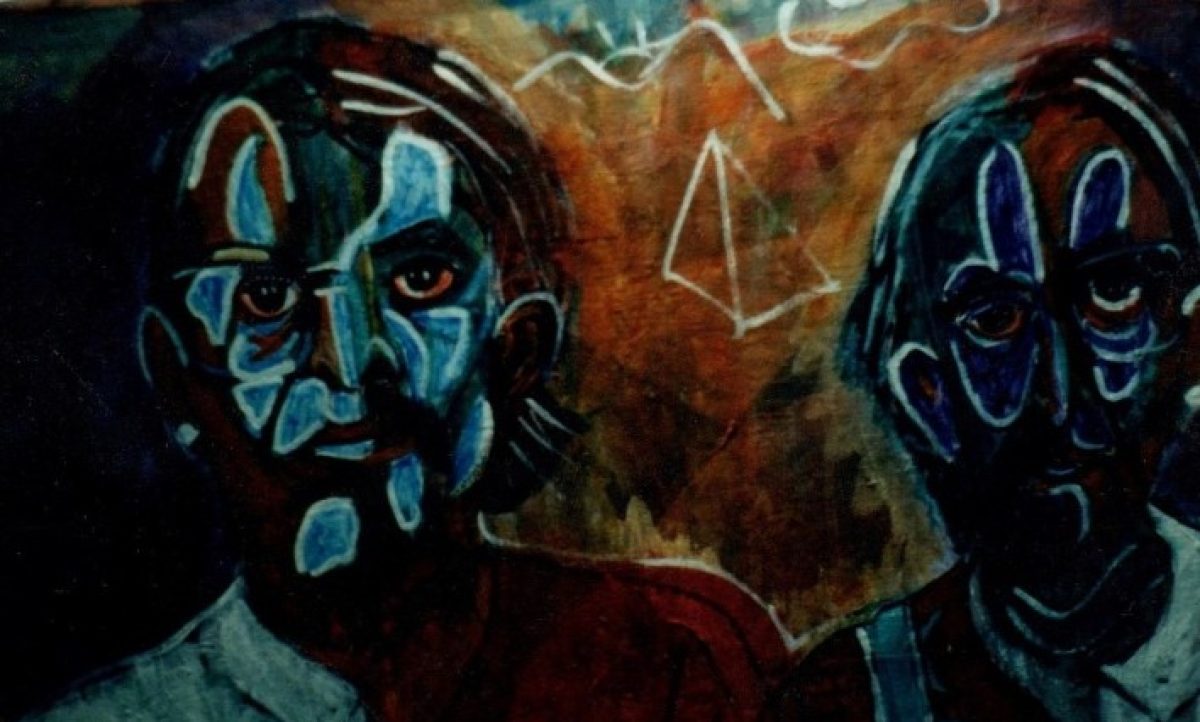
POEMS FOR LOVE SPUN HOME (& SWEPT AWAY)


                                                                               for Sandra L. and Alison K.

         I

         
      When they returned like seamen from trawler toil – with Hons.
      tales of head winds cold, tastes acquired (for excellent wines,
      say) – a village heart just had to have one. Indra snagged
      hers the night he spilled his drink; she fussed with napkins,
      touched a purple stain, jamoon desire. (Estranging logic
      strings our castnets and dreams, shaghopper.)

      Dry walls and ankle bells could mute nightie passion,
      sheets smiling. Indra learned to furrow the plough
      place lips up loading the plough man – Flag?
      what easy virtue honour shame? when a girl
      bone sensors high alert! moves out wants
      in for the pound?  

      After the first child she tired, wait nah, he picked on her
      house care 'not geisha', politique oblige leaving her out; for
      each shed tear a name. Rivuleting through hot irons heart blisters
      she'd gather down stream from his singlet & silence; bhaji boil,
      done.

      II

      
      Indra shaped out the day the alter hero sailed in – an ecofriendly
      Canadian on assignment, mast head stiffened by how the races
      seemed to get along; proof of which he took back. (Love conquers,
      the wharf dwarfs the ship; take a cruise, you'll see, bloghopper.)

      In his suburb docked away seems now she's doing just fine;
      a second child's come along plus wardrobe for seasons
      leaf raking the attic and Omigod! headlights on deer.
      Ok, flag wavers, prance: bare navel gaming the other;
      the tribe betrayed; cow shedding all along.

      Up wining wings expecting gyurl with braids? grip comfort
      while you wait. World traveled miles make nest ballooning
      news; for canefield stems chic fodder, Vedic kokers embittering
      fuse. Incoming over soon, packed camel heart.
                                                                       – W.W.


                          WE MEET, 

                                embrace and then I can but lean
                    in silence towards you like a bough full
                    of fruits listening for the voice of the earth-
                    locked roots that feed it: you and I are of
                    the same tree of disinterested passion,
                    ardour well-behaved 'as a guide or mode
                    of hope' that will not call its name for fear
                    of so slackening the rope of balance taut
                    between not enough and too much, the path
                    of light above the circus-sand sprouting
                    dry grooved totems to the gods of routine
                    that promise plastic fruits and cowards' nets
                    of if for when (as we fear, so we must)
                    we fall.
      
                       (from "Gift Of Screws" by Brian Chan)


NY SLIDE LIII: BULLDOG DRUMMOND


         "You would not believe what happened to me today," Lightbody announced to the carpool. "I got a visit from the new morals police chief, you know her?…Burton?"
     "Haliburton."
     "There you go. Well, she knocks on my door, this is five minutes before the bell, the lesson's over, I'm bubbling in my attendance sheets and the kids are doing what they usually do, throwing paper balls, goofing off…anyway…she knocks on my door and walks in, and she's looking none too pleased with what she sees…and I say to her, Yes, can I help you? …and she asks me if I know a Mrs. Drummond, who is a crossing guard, she's at the corner of Myrtle and 105th…"
     "I thought you parked at the gas station," Meier said.
     "Well, I used to but it's beginning to add up, how much I'm paying this guy. I figured if they're going to get to my car, they can hit it there just as easily, then with the snow and everything…anyway she asks me if I knew this Mrs. Drummond, and I said, I know who she is, I've never spoken to her, and she says one of the kids complained to her I had made offensive remarks about this lady."
     Everyone threw quick glances at Lightbody, listening for the slightest ripple of guilt and trouble in his voice.
     "I said, Madam, I've hardly exchanged two words with this lady. Truth be told, I did once, when she flagged me down. She came up to my car, knocked on the window with her knuckles, and told me she's going to report me the next time I ignore her and cross the zebra lines. And I said, Madam, what are you talking about? Apparently, the day before, I'd passed in front instead of waiting for the kids to cross the zebra…I mean, I didn't even see the woman signaling, and in any case I was running late that morning… anyway this Haliburton lady says she'd received a complaint that I'd referred to the Drummond lady as a dog." 
     "You did what? Called the crossing guard a dog?" Brebnor said.
     "I did no such thing. Actually, that's what the kids call her, the bulldog. I'd asked the class if anyone knew who the crossing guard was, and someone, I think it might have been Ramos, said, You mean the bulldog? and I said, That's the one. Any of you come across this woman?"
     No one had. Everyone seemed amused.
     "I had no idea at the time the woman's name was Drummond, the crossing guard I mean, so when this Haliburton lady tells me I'd insulted this Mrs. Drummond I tried to lighten up the situation by asking her…I mean, the thought just popped into my head… I asked her if she'd ever heard of Bulldog Drummond, you know, the detective in those novels? I said, Did you ever read those Bulldog Drummond books when you were a kid?"
    The carpool thought they knew where Lightbody was going with the story and erupted in laughter.
     "She didn't know who I was talking about. She said she'd read many authors but she hadn't heard of any Bulldog Drummond, and in any case she didn't think it appropriate for me to characterize – now listen to this – it was inappropriate for someone like me to characterize anyone, and certainly not this Mrs. Drummond, who lived in the community, whose job was just as important as any teacher's job… to characterize her as some sort of animal. So I started to explain, Madam, I did no such thing, and she just walked off."
     For awhile they drove in silence. Then Brebnor, returning to Lightbody's attempt to lighten up the situation, muttered the words 'Bulldog Drumond'; unleasing a fresh outburst of laughter.
               (from "Ah Mikhail, O Fidel!", a novel by N.D.Williams, 2001)


POEMS FOR PAIN GRATITUDE LOSS (& HARDSHIP ISLANDS)


   PAIN

              "Overnight, pardner, a corbeau drop one  
               on yuh boy brand new (dhal colour) cruise;
               and now watch him driving to work,
               no time to stop and car wash;
               at the traffic light, in the three lane crawl
               is work that drop working on the car paint."

              "I know the feeling. That does hurt, boy."

             
               GRATITUDE

              "When de Minista find them a big work
               they so excited, 1st paycheck they bring
               a mango fo' he."

              "That could cause problems fo' de Minista."

              "Nah, once the mango below 2000 yuh clear."
               Over 2000 you might have something to declare."    


                HARDSHIP

               "Is why you walking so slow? like
                you in turtle speed."

               "Is tired I tired, hear nah:
                last week was pain no gain at the airport. Mon.
                I had three wheelchair. Tue.
                I had four wheelchair. Wed.
                I had five wheelchair. I had
                was to call in sick the next day.
                Is strain & drain pushing dem old people, boy."


               GONE ARE THE DAYS

                           
                Sign on the front gate: Beware Of The Dog.
                Fella in yuh yard, he bust through the back fence,
                he looking plum & mango – "And I talk to him
                about it" – gone are the days.

                Your pit (maul pampered, not Johnson & Johnson) ketch
                him red rump like agouti, you proud of the moment.
                Medic pronounce him blood lost on arrival, 
                fellas in white overalls cart him away.

                Yuh pit name Caesar, all who jump the fence
                must render unto Caesar – gone are the days.
                Is eyepassing, right? what he doing in yuh yard?
                the laws of the tall grass; is sad, one less.

                Some dogs dangerous, some fellas gone baddest;
                temperament shots some dogs and fellas need.
                Hosing down the scene, still proud of the moment?
                for plum and mango? – gone are the days.

                Wave something and goodbye - ripped souls beg comprehension,
                old wounds refresh unseen; easy to bed time night lime,
                pretend your hands wash clean. Oi, down the road I
                gone, boy; that bass and steel drum play mean.
                                                                                  -W.W.


NY SLIDE LII: WORLDS APART


     All the signs indicated that Amarelle was moving away. After the first weekend absence, when she met her sister in Manhattan, there was the evening she phoned to say she would be spending two weeks at her sister's place. The reason? Sammy D. had flown back to his island on vacation. Aschelle was all alone in the house.
  She arranged to come to the Bronx for one evening. She cooked a pot of food and a tray of chicken cutlets which was stored in the refrigerator; all he had to do was heat it up in the evening, make sure he bought fresh vegetables; and he'd be fine.
  She stayed that night with him, fussing, asking questions about the neighborhood as if she'd been away for months: did they catch the crazy man with the gun? you mean, he's still out there waiting to shoot at people in their doorways? And the Spanish people – still hanging out on the stoop at night? In bed her hips hinted at readiness; then the following morning she was off to work; and that evening she was back at her sister's in Peekskill; leaving him his books and his silence; not understanding why anyone, give a chance, would prefer to spend more days and nights in the Bronx.
   Radix didn't complain. He'd been self-sufficient ever since his college days.
   Living with him in the Bronx was at first a daring modern move for a girl from the islands. Back home her parents were telling islanders their daughters were having the time of their lives. One lived in a nice house in upstate New York; the other had chosen to live with someone in rather dangerous circumstances in Harlem. ("Daddy thinks you've moved in with someone in Harlem," Aschelle announced, delighted at the stir the sisters were creating back home.)
  One Saturday afternoon, unusually bright and mild for mid-October, Radix went into a store and bought a bicycle. It was a slender-bodied American bike with multiple gears and bright colours. The store owner gave him a reasonable price since summer biking was over, and the young man spent some time inspecting the frame as if it were a horse. He tried to persuade Radix to purchase trimmings and accessories. Radix settled for a helmet. He rode out the store into streaming traffic which to his delight treated him fairly as another road user.
    The following morning he stepped out his building; fellows on the stoop made room for him to pass. They commented on the bike and watched him, curious and respectful.
    He thought they'd be less traffic to contend with so early in the morning as the city still slept. He crossed a bridge and rode all the way into Manhattan.
           (from "Ah Mikhail, O Fidel!" a novel by N.D.Williams, 2001)


POEMS FOR MUSIC LOVED & PODCASTS NOW (REMIX)


      Back when radio ruled the waves the BBC, main tunnel
      from the world, brought to our shores "Greensleeves"
      and Victor Sylvester. Lacking creole traditions like Trinis
      with Christmas parang, I longed to hear pop maestros of string
      instruments.

      They sent down Cliff Richard, the Shadows, "Telstar", well you
      know. Those cool girls from Jobim's Ipanema. And dazzling 60s
      riffs by the Eagles and Jimi Hendrix. Those were the days
      Ravi Shankar turned sitar friendly.

      Back then (I think) I heard Victor Uwaifo ("Guitar Boy") four times,
      his scratchy Nigeria picks too many oceans far for channel shipping.

      The good news: finding the tunnel's end: on the //www.dials
      You can watch "Guitar Boy"! Uwaifo's guitar licks
      couscous steamed in 70s high life.

      And hear this: what must be the gold coast of string harmonies
      rocks by the rivers of Mali, from the diamond fingers of (the late)
      Ali Farka Toure; Toumani Diabete.

      Where were you all those years, guitar fathers? What trade winds
      blocked this young heart access to those kora waves, ces vieux jams?
      Radio Ghana. Desert moons. Faraway missed years.

      Tunneling protocols, I know. Old pirates ♫
                                                                            – W.W.


                REAL SLOW JAZZ

                Voices taking time to make
                time feel

                both tauter
                and stretchier than we would

                know from the limping clock,
                the pace of the heart sure

                beyond the need to run across
                bridges of love, statements

                of the tension between spark
                and flame, spirit and flesh,

                the tears of gods only men,
                of men brimming with light.

           (from "Fabula Rasa" by Brian Chan)


NY SLIDE LI: WAYS IN THE WORLD


     Amarelle was on the line, speaking loudly, for apparently she was using a pay phone. He kept asking her to repeat what she'd said, so obtrusive was the background noise. She kept saying, "Can you hear me?" She seemed to be listening for signs in his voice that he was annoyed or worried she had not come home.
  She explained she'd met her sister Amarelle in Manhattan; they'd had a girls' night out
doing the town; she didn't think it made sense to come back to the streets of the Bronx at that late hour; instead they would go to Aschelle's place in Peekskill; she'd spend the weekend there.
  Radix let her gush through the background noise which transmitted a sense of the great churning fun she was having right then; which, she seemed to imply, he was sadly missing.
This was what they ought to be doing – getting out more often, especially on Friday nights; away from their wretched neighborhood; amidst the neon and headlight flow, the traffic and sidewalk strollers, clubs and restaurants.
   "I have to go, they're waiting for me in the car. We're parked near a fire hydrant."
   She didn't say where off Fifth Avenue they were, who "they" were; but he imagined her hanging up the phone and stepping back into the world she'd found; wanting that now more than she wanted him.
    And as if to confirm what world it was he had elected to live in, the dog at the back of the house next door started barking. Ark ark ark. Then a seven-second silence, then more arks. The dog could be hungry or angry or bored with its chained status, he couldn't tell. Only its owner understood its language.
    He heard another sound, someone bouncing a basketball on the sidewalk outside his front windows. Bounce bounce bounce, some conversation, then bounce bounce.
    He peered through the blinds. The streets had the usual derelict look. The baskeball bouncer, tall and narrow-faced, apparently returning from team practice, a duffel bag slung on his shoulders, had stopped to talk to his homeboys. Carlos and the crew were camped out on the stoop; they passed around a marijuana joint and a large bottle of beer in a brown paper bag. They talked in their fierce crotch-reaching way, shifting from foot too foot, walking away to dramatize a point; struggling to make sense of their world.
    A full moon was out in the clear night sky. He hadn't seen the moon in a long time. The upper regions of the universe seemed to vanish as night fell, leaving him to contend with indifferent street lights, obscuring brick buildings.
   This life in the streets – its underground runnings, the corner businessmen - had a way of absorbing the unexpected and carrying on. A man is shot in a hallway; stains on the walls get washed away, the body goes off in a black zippered bag; grime and debris swept up. The roadway clear again, everything prepares to forge ahead.
   Radix turned back to his bedroom. He had a long weekend in front of him, and no one to bounce his thoughts off like a human backboard. But like the barking dog next door he'd find a way and language to engage the world.
              (from "Ah Mikhail, O Fidel!" a novel by N.D.Williams, 2001)


POEMS FOR ISLANDS HOW & WHERE WE ARE


                                                                          for Kendel H. and Boots S.

          
            At the bank or any public building where your business is
            none of mine, a stranger comes through the doorway
            says "Good Morning"; and everyone answers,
            sprung from cell or pride, every one answers.
               Gross inequities that moment make way,
               charismatic bones click and play.
            This is our island, your search connection.

            And configure this: bodies wrapped up in road crash metal, 
            shoes poking out, a death in town by gun: and passers slow,
            level breath short at blood spots news sheets flower shrines.
            Dry mouths murmur – holler heart to bowel –
                aie aie aie, shadows and goodness,
                reverse reboot this earth flat speechlessness.

            Island identity, oui, garcon! Test it when you travel
            on city subways – there, see? can't quite hold that in
            turn locking out the iText cargo cramped beside our selves.
                Your eyes feel up for looking round
                    "the fuck you looking at?"
                    bon jour you waiting for.

            Mannered residuals from plantation back lash? nah;
               and not no virgin marie hip sway
               bonding for miracle income either. Ok,
            despite the bankruptcy of Ministries someone will call
            respond decelerate to suck the poison of indifference
            out before it spreads. Ask any band head granny. 

            Nou groMambo Paradisio? whoa! that's where
            we are: love rising up at brake light notice: storm used
            islands, once ankle and tongue tied, deserving of love;
                 site for new found land eternal eyes;
                 gone water colour twilight sighs.
                                                                    -W.W.


                     PARADISE

                     These islands we people
                     as ghosts, no matter how
                     rooted our crops, cities
                     and walls against the sea
                     that lets us these altars
                     of our masochistic
                     leaf-passion for the wind
                     coming to rape our trees
                     or over the sea's edge
                     flinging our fishing boats
                     like shadows, like black leaves.
                       (from "Thief With Leaf" by Brian Chan


NY SLIDE L: CAUTION// MEN AFTER WORK


          Lightbody and the carpool were stuck in traffic on the New England highway, Ghansam at the wheel, crawling along on a day they wanted anything but clogged roads; just to get home. And since they'd had a jumpstart on heading-home traffic, leaving John Wayne Cotter H.S. at 2.30, it was reasonable to hope roadways would offer smooth uncluttered passage.
     But there was road work to contend with. The orange cones and road signs warned there would be over a mile of slow going in the weeks ahead. They should be prepared for at least twenty minutes of agony each afternoon.
     Brebnor was slouched in his corner of the car; he stared out the window and wished he could by some feat of kinesis lift the car he was in up and over all the obstructions ahead. He also wished he had not got out of bed.
     He'd got in the car that morning, saying, "I think I'm coming down with something", to which Lightbody had remarked sharply, "Why don't you stay home then?" Brebnor coughed a mucous-stirring cough, then blew his nose to show he didn't give a spit what Lightbody thought.
    Meier for his part was staring at the huge tires of an 18 wheeler running beside them. The truck shuddered whenever it moved forward, its vibrations giving off what felt like hegemonic roadway tendencies.
    He wished Ghansam would speed up. The man drove hunched forward, his hands gripping the wheel. If only he could be a little more aggressive, they'd be past the truck with its hissing airbrakes. Crawling beside the massive tires – he could reach out and touch them if he wanted – made him anxious. A lapse of concentration at the wheel, and before you know it the truck could veer into their lane, smash right into his side of the vehicle.
    "You know what's amazing?" Meier said.
    "What's amazing?" Lightbody said. They'd been traveling for awhile in silence.
    "On the side of the road, have you noticed…? bits and pieces of tire, curled up, lying there like they'd been bitten off or something…? and bolts and screws that must have fallen off vehicles. Makes you feel there are creatures on the road just waiting for slow traffic like this, so they could reach up and tear at the insides of passing vehicles."
     No one seemed moved by Meier's amazed observation.
     Driving cautiously, three car lengths away from the vehicle in front, Ghansam had not yet passed the 18 wheeler. Meier sighed and shifted in his seat.
     "Which reminds me," Lightbody said, "has anyone noticed the fluorescents in the hallway on the second floor? Some are broken. You feel you're in a dungeon somewhere
… all dark and depressing."
     "So why don't you report it to the custodial staff?" Meier snapped.
     "What makes you think I didn't?"
     "Where is the Custodian's office?"
     "It's on the first floor. You go in and there's this secretary lady who stops you and asks what is it you want, while the guy who's really in charge sits there in a blue suit and this weird polka dot tie – have any of you seen this guy? – like that's all he's paid to do, just sit there looking like the man in charge. And the secretary lady tells you to fill out a request form. So I asked her, why do we have to have to fill out forms? why can't they just send someone to fix it rightaway? And she says, Well, you aren't the only one with problems in the building… you'll have to fill out a request form. And I said to her, Madam, do you have any idea how much paperwork I have to deal with every day? And she says, If you want your hallway lights fixed. You have to fill out. The request form."
     Lightbody did a sneering high-pitched imitation of the lady's voice that was so good, it raised a laugh from Ghansam. He picked up a little speed and slipped past the 18-wheel truck.
      (from "Ah Mikhail, O Fidel!", a novel by N.D.Williams, 2001)

NY SLIDE XLIX: ANOTHER YEAR OVER AND OUT


     The D'Arizon matter was playing out just as Bilicki launched his campaign for the post of Chapter Chairman in the Teachers Union election. He decided to make it an issue. He pointed to "corruption nesting in high places" and the school's double standards; he spoke of the need to insist on high academic achievement for all students.
     When he dropped by to solicit Mrs. Haliburton's support they sat in her office after school and chatted for about an hour. The conversation was cordial, she told Noreen. Bilicki went on and on, outlining his philosophy; he told her his aim was "empowerment" for students and parents in the community.
     All in all she was convinced he was a decent man; she could see how his motives could be misconstrued, how determined he was at all costs to do the right thing. Still, she'd said it before and she'd say it again: though his heart was probably in the right place, in her heart of hearts – and given what she had heard about the D'Arizon affair – she could not give him her vote.
     The issue spurred rancorous debate in the teachers' cafeteria, dividing the faculty. Bilicki won considerable support from the Math department but lost the election. The tensions generated by the issue and the elections left a sour atmosphere that hung about right to the end of the school year.
     On the very last day before everyone took off for vacation the principal held back distribution of summer checks until every department had reported the satisfactory completion of grades and paperwork. It was an emotionally soggy day. Teachers milled around the hallways, the cafeteria; some had afternoon flights to catch out of the city; everyone felt exhausted and irritable: swearing that for the next eight weeks they wanted nothing to do with the Bronx, nor their mean-spirited principal and his fucking school; and the hopeless students they'd tried to educate all year.
                               (from "Ah Mikhail, O Fidel!" a novel by N.D.Williams, 2001)

JOBS SECURE, ROOTS IN WATER


                                                                           for Victor Davson

          The pale young man who came first, a drain cleaner,
          went to work in the basement; nothing mattered but
          his snake machine, a quiet efficiency (his father:
          disappointed? proud?) eye courtesy on exit.

          The second stranger, a problem solver, wore a Jah
          Jah tam and made this poem wait in the bath tub
          while he changed the meter
          so it measured each swollen syllable and drip.  

          Island accents tease hard fibers out. Soon – stopping
          to show – he opened his job portfolio: love water
          from I was a boy; then as apprentice pipe fitter,
          bringing privilege to standpipe users, Yes I.

          When him beach up North him join the Redeemer kno seh
          the Water Authority: twenty years now them never let I go
          while native bredren success bound were losing
          ground to race ways and recession. (EU portals open/closed.)

          Some back home skills in body bags of water
          prove winners anywhere – you think?
          child minding, dough kneading; tend salvation herb;
          river roots & pride  > smart swimming, Yu see't
                                                                              -W.W. 


                 LONSTEIN'S CONVENTION
               
                 A washer of the dead is what I am:
                 I refuse to embalm or embellish.
                 I give you back these bags as they are – bald
                 or hairy, purple or pink. Unimpressed,
                 I peel away their fashionable frills
                 of lace or blood or creed. But after
                 I've done washing away their dead serious
                 superstitions and myths oozing like pus,
                 the tongue remains their most active organ.
                 And for every corpse I lay out naked,
                 there's some mother waiting to have it dressed
                 and spruced up for a cocktail memorial.
                 Hopeless. But as I say, I wash, that's all.
                    
                  (from "Thief With Leaf" by Brian Chan)