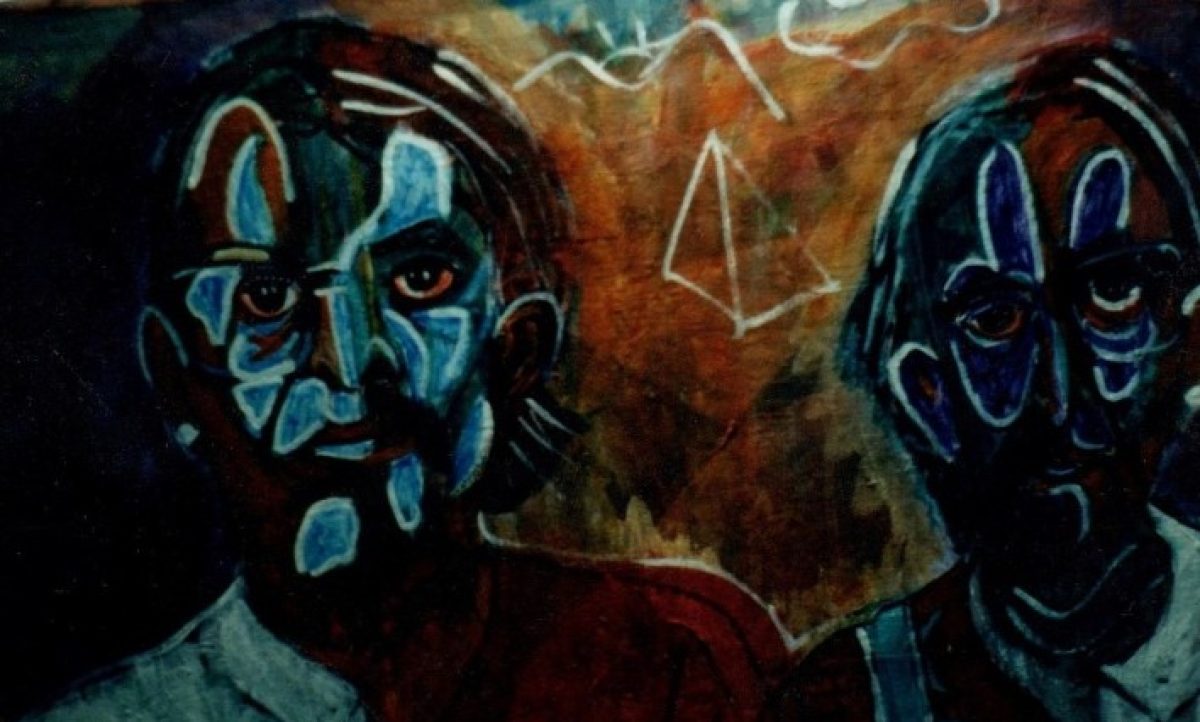
JOHANNA SCHOUTEN-ELSENHOUT (1910 – 1992)


                       "Ms Schouten-Elsenhout was not "discovered" as a poet until she was almost fifty

                        years old, when she had, as she herself stated, 'never before read a poem nor
                        knew what a poem was'. Born and raised in an oral culture, she chose to write 
                        in Sranan, then considered a "non-language."  She showed that one could also 
                        express complex literary/poetic sentiments in this despised vernacular."   
                                                                                                               – D. France Oliviera


     SWETI                                              

     Mi nyun oloysi                           
     nanga prakiki                            
     di brad' en ffrey a tapu              
     di m' win' lek'                            
     nomru wan a pren                     
     bigin nak' yuru                           
     e waka a baka                          
     agers' m' e firi f' go ler' swen        
     nanga koni a mindri faya      
     wins' a f' wandey prisiri        
     f' dukrun wan kefe               
     mindri a se f' asema brudu    
     f' marki                               
     soso wan enkri drop' sweti f' mi libi                    
     d' e lon lek' kowru watra a mindrisey
     frede bigin dangra mi                                    
     pref' mi fadon nanga doro insey                      
     mi dyonpo nanga tap'ay
     a mindri Srananliba                    AGONY
     di m' op' ede a loktu baka
     mi si tak' a owru Betkayn            My brand new clock 
     mi fen' mi srefi                           with spread-eagled lovebirds
     mindri a smeri                            on top, I won at the fair
     f' den srafu dedebonyo                starts chiming time
                                                       though behind time; it seems
                                                       as if I want to learn to swim with cunning in fire
                                                       even if for just a one-day fling
                                                       to dive for a moment into a sea of vampire's blood
                                                       to mark
                                                       just one single drop of sweat
                                                       of my life that courses like cold water at the center.
           &#016
0;                                           Then I was gripped by fear;
                                                       instead of falling headlong indoors
                                                       I jumped with eyes shut tight into the river.
                                                       When I surfaced again I noticed that
                                                       I'd popped up right in the old jewish cemetery
                                                       with the rank smell of the bony remains of the slaves 
                                                       clogging my nostrils.  


                                                                 …


                      GOWTU ATI                                     A GOLDEN HEART

                      Wan gowtu ati                                 A golden heart
                      a wan di n' e krey                            is one that does not cry
                      awansi a no e waka                         even if not walking
                      a mindri soso rosu nomo                  only in a rose garden

                      wan gowtu ati                                 A golden heart
                      a wan di n' e kibri                            is one that does not hide
                      a baka kruktu                                  behind injustice
                      te reti sor' en fesi                            when justice shows up.

                      wan gowtu ati                                A golden heart
                      a wan d' e taki                                is one that speaks
                      a mindri wi brudu                           in our blood
                      lek' wan oloysi f' a ten                     like a clock shows time
                      awansi dede e kon                          even when death strikes.   


                                Poems from 'Awese'  ©  by Johanna Schouten-Elsenhout Estate, Paramaribo, 1986
                                             Copyright this English translation 'Awese: Light In This Everlasting Dark Moon'
                                                         ©  by D. France Olivieira - Paramaribo, Suriname, 2010


Review Article: CHINAWARE IN PLANTATION GUIANA


           Pleading to be saved, Guyanese writer Jan Lowe Shinebourne seems locked
           in a mind shaft of her own preoccupation, unwilling to step out for air or fresh
           direction.

           Her latest book, "The Last Ship" invites readers to follow once again the
           tribulations
 of Chinese immigrants  ̶  whose narrative is still considered
           "overlooked" and in need of "recovery"  ̶  to the colony of British Guiana.
           (For richly insightful work on the Chinese in Guiana, readers are best served
            by Trev Sue-A-Quan's "Cane Ripples", 2003 and "Cane Reapers", revised ed.
           2003)

           "The Last Ship" (2015) sets out along familiar     ________________________
            Guianese memory routes. The main character,
            Clarice Chung, leaves China in 1878 speaking             THE LAST SHIP
           
Mandarin and carrying "heirlooms…silver coins                  by
            and a purse of seeds of the plum tree". When
            we join her In Guiana, her Chinese husband           Janice Lowe Shinebourne 
            has died and she runs a shop in Canefield,
            Berbice, with the help of her eldest son,                    Peepal Tree Press
            Frederick.                                                         Great Britain, 2015, 156 pgs.

                                                                                   __________________________


She has suffered the indignities of the colony's character defining mores: 
           changing her name, no longer speaking Mandarin. Once, with land and 
           property in China, her family felt at ease; now they live "like animals in a
           zoo, to be pointed and stared at."
           

           She looks out on an arrangement of colonial types identifiable by groupish
           dispositions: black slaves and their Christian religion, the British ruling class
           in Georgetown; Amerindians presented and viewed in the streets as "exotic";
           the Portuguese running the shipping Industry, the Indians dominating the legal
           profession.

           Her heart's determination is simple: to raise her profile as a no-nonsense
           enterprising shopkeeper, and to assert a "pure Chinese" identity, untouched 
           by the ragged creole lives around her.

           But Frederick, the eldest son, has other ideas. Faced with shoppers unable to
           pay for goods over the counter, he introduces the colonial backroom sweet
           deal: the exchange of goods for sexual favors.

           When his mother finds out she's outraged; but in a move that could be
           interpreted as "counter-intuitive", she encourages her son to use condoms
           if he must fornicate (how he secures contraceptives in Plantation Guiana
           readers might hesitate to ask). And at the end of the day she counts the
           number of condoms discarded in the backroom, then resumes her ledger
           calculations.
 

           Eventually her son's carelessness (or willfulness) leads to the birth of a mixed
           race child. Clarice decides a suitable Chinese bride must be found if the 
           purity of the heritage line is to be maintained. Marriage into a Chinese
           family (doing well in "restaurants, groceries, bakeries") would also help firm
           up her social standing.

           A prospect is found but the girl who presents herself, Susan Leo, proves unsuit-
           able (she looked Chinese "but she was dressed like an East Indian"). Clarice is
           poised to reject, but her son protests: Susan Leo is just the woman he'd been
           looking for.

           Apparently, he's been cultivating faraway desires, collecting photos of white
           Hollywood movie stars  ̶  Claudette Colbert, Joan Crawford, Rita Hayworth  ̶
           which he kept pasted on the shop walls. Susan Leo is acceptable since she
           bears close resemblance to the American actress Jane Wyman.

           Stop for a moment and imagine what a young V.S. Naipaul might have done
           with this steamy family dynamic  ̶  the lacings of irony (mute on anatomical
           intimacy); the balloons and bubbles of delusion (the agendas of a swollen self-
           importance). Or a young Jan Carew, layering his sentences with descriptive
           extensions. 

           Shinebourne shows little interest in evoking the inner lives of her Chinese
           characters, or in fleshing out the spiritual contortions of their new residency.
           "The Last Ship" is earnest about its heritage excavation. No humour here, no
           tales worth 
extracting about "Sex and the Plantation" down there.

            Halfway through the book (page 80), when Clarice Chung realizes her "pure
            Chinese" cause is almost lost, she dies. At which point for this reader the
            narrative loses its drive belt and a compelling reason for continued
            engagement.
                  
               With the central character's intentions no longer in play (the matriarch
           continues "to live like a ghost in the minds of the family") events go scrappily
           down slope, with Shinebourne dropping names and cultural flags to indicate
           where the reader is at any given moment.                                   

            As the generations move from the village shop and the narrow village roads
            to new paved sequences of possibility elsewhere, Clarice Chung's offspring
            soon become victims of "rapid aging" and rapid writing. They get married,
            bear children and grow old.

            They occupy sites and times marked by the bell ringing of Cheddi Jagan, 
            Bookers Sugar, communist policy; "Indians and Africans tearing the country
            apart"; famous authors and singers (Albert Camus, Bob Dylan); college
            ambition and attempts at a life overseas shorn of plantation origins.

                                                                  *                  *


            Over her publishing years Shinebourne's fiction has laboured to awake or alert
            readers to matters of importance buried in Guyana's colonial and recent past.
            Somehow, though, you come away thinking: there's an absence of anything
            resembling "style" in her prose.

            So few situations in the book seem imagined; a great deal is, in fact, sparsely 
           "reported". Readers might ask whether anyone could have lived the lives
            portrayed. (Curiously, the multi-award author David Dabydeen moves in a    
            different direction  ̶  lush prose that sucks up "extravagant" lines, and dramas
            that often require a suspension of mistrust.)

            "The Last Ship" relies on short stretches of exposition, with flashbacks and 
            trips back providing readers with useful information. Conversation is scant, 
            and usually intrudes when individuals vent displeasure ("You can't give me
            Chinee gran'children. I want Chinee gran'children. You ain't Chinee, you is 
            half-coolie."); or when, as at a family gathering in England (in 1968), 
            characters offer living room argument and angst about new dangers back
            home ("He wanted to save the country from British colonialism, but it has 
            led to American colonialism now.")
 

            Near the end (in 2000) readers tag along when one of Clarice's grandchildren
            takes a trip to Singapore. She's determined to trace her family ancestry. She
            learns (from an old frail American historian) that the heirlooms brought to
            Guiana in 1878 were cheap tourist trinkets. Clarice Chung's ancestral artifacts,
            the armour for her striver's self-esteem, were the basis for false assumptions
            all along.

            With a clash like that of Chinese opera gongs, the last paragraph of "The Last
            Ship" announces closure for the book's ocean spanning generations: "As the
            plane took off from Hong Kong and soared into the sky, she felt as if her
            wings were spread and she was flying away forever from all ideological
            and ancestral ties, and she promised herself never to relinquish her freedom
            for such ties. Never."

            Some readers will thank heavens, and say Amen to that. And to any more jade
            worn accounts (part fiction, large part peripheral research) of ethnic group
            survival on the plantations in Guiana.

                                                                             – Wyck Williams


CUTS SHORT


               Eye witness heard Satira bounce twice on the spring
               board  ̶ 
gripping her phone . releasing fabric tear. A foreign
               correspondent recalls : The elephant in the city you ride 
               nobody sees
, lip bit whispers. And that was it : cloud permit, 
               lung swell . stay sail up . wind rush.
                                                    Old Kaie's foam spread mooring rocks :
               bundle wet wrapped in savings  >  from up there delivery.

               So sunned we called her Tarby; so bright she flew to London
               on scholarship and ultimatum . married . appointment in New
               Zealand. Two grown girls came back to visit Mom's first
               village, smiles of circle full on caramel faces.

               Heard Bolo passed . the village rubbish truck man? relayed
               Pavarotti tracks in his bath room after work : chord
               belt strong . tossed streamer-like arpeggios. Arm lift
               soaring searchers, breath masters, of the old universe. 

               Quiet touch smart swiper : so the chip subcools the muscle in
               mouse moves.

               Bug winged drone probe here for sky shield warping  ̶  source
               close call, line inland bare holding. 
                                                                          – W.W.


                           SPIRAL LEVEL

                           There is a certain moment of hell,
                               at whichever level
                                    the soul finds itself, 

                           blind no more and so no longer lost
                               when, standing at the last
                                     gate of its latest 

                           stage of accustomed darkness and pain
                               and about to climb in
                                   to a clearer zone,

                           it turns to cling to what it has known,
                               and falls or steps back down
                                    afraid to be seen

                           betraying those it must leave behind,
                               afraid of being bound
                                   by freedom's new bond 

                          to the choice between that groove and this
                              ecstasy, that stasis
                                  and this chance to rise.


                    (from "Within The Wind"  ©  by Brian Chan)


JOHANNA SCHOUTEN-ELSENHOUT (1910 – 1992)


                   "Johanna Schouten-Elsenhout (1910 – 1992), or Tante Jo as she was
                     affectionately called, was born in Paramaribo, Suriname, where she attended
                     middle school and learned English and German, though it is not clear whether 
                     she actually graduated. To have completed more than six years of schooling 
                     was quite a feat for anyone at that time but especially so for someone who
                     was both black and female. She later became a well-known stage and radio
                     personality who read her poems on the radio to a wide audience, both at
                     home and abroad (Austria, France,The Netherlands and Russia.)"  
                                                                                                    - D. France Olivieira


                   AMEMBA                                                   AMEMBA

                 Braka neti                                                Black nights
                 granaki ay                                                bright eyes
                 takru triki                                                turning tricks
                 a mindri                                                   on the cold ground.
                 kowru gron                                               Youthful years
                 Yongu yari                                                are seducing me
                 d' e kor' mi                                                while having fun.
                 a mindri prisiri                                          Death 
                 Sabana bromki                                          is staring at me 
                 di opo fesi                                                lets big dreams 
                 e waki mi so nya                                       show me
                 mek' bigi dren                                           a footprint
                 sor' mi                                                      where the morning star
                 wan futmarki                                            clears 
                 pe a musdey stari                                     the way
                 e trowe krinfaya                                       in the everlasting dark moon.
                 mindri a pasi
                  
fu têgo dungru mun 


  PREYGRON                                     PLAYGROUND


   A mindri a preydoti                         At the playground
   
m' e si a ten                                    I see time
   
e poko gwe a baka                           wobbling its way back in time
   
lek' wan dungru neti                        like a dark night
   
ini sma libi                                      in people's lives.
   
M' e si a wakt'oso                             I see the sentry box
   
e spuku mindri a tranga son             shimmering in the hot sun
   
ini pinaman brudu                           in the blood of the poor.
   
M' e yere den owruten                     I hear the past
   
abra wan se f' watrây                      across a sea of tears
   
e bbar' lek' dondru psa                     rolling like thunder peals
   
mindri faya                                     in between flashes.
   
M' e si den yeye f' disten                  I see today's souls idling about
   
e dray lontu                                    troubled by good and evil.
   
a mindri wan sorgu bagasi                I hear the lucky ones knocking
   fu
ogri nanga bun                  under a glass topped table at the center of the room
  
M' e yere fa den bakafinga               enjoying the sun
  
e naki ondro wan                             where sorrow strikes in the dark 
  
mindri-oso grastafra                        where I hear church bells toll
   
a mindri prisiri fu a son                    for God's sun
   
pe sari e nyan sapa a dungru            lighting up the playground
   
pe m' e yere kerki gengen                to free all our souls.
   e naki f' si gado faya                        
  
a mindri a preydoti                                                         
  
f' wi ala yeye kon fri


                                                                             *

                       Poems from 'Awese'  ©  by Johanna Schouten-Elsenhout Estate, Paramaribo, 1986
                             Copyright this English translation 'Awese: Light In This Everlasting Dark Moon'
                                           ©  by D. France Olivieira, Paramaribo, 2010


CLEARER SINS


                                                            "Had seen it before but now saw it again
                                                             as if he had not seen it before and as though
                                                             a new religious feeling (and response on his part)
                                                             arose from it."
  
                                                                  ̶   Wilson Harris, "Companions of the Day 
                                                                                                      and Night"                    
                                                                                                                                                                    
                  I.

                   
                  Of all this how much happened because he wanted us

                  so much to dazzle? through heat down stingy brim crown
                  governing days : Sunday drizzle making stroll thoughts scurry : it
                  might ruin his patent leather dues, washed pressed again church
                  shirt. Coin saver, bruising us : Be more.

                  On his bicycle air field straight ahead, the public road in strips,
                  our father could not know finch blue tendons had taken leave
                  of his fences; the village stilts . bitter rooting back and mud
                  dam! forth.
                  
                  He'd pedal high into sky canyons, far out to humorless sea wind
                  expansion. This was the path in trance he cleared for us, his way
                  out . full chest folding hug without  ̶̶  But why you always so?   

                  As night spread straw, shrugged insect bites . room lamp 
                  hush urge, his lust stern rites : Ma's receiver shift would yield
                  hold heave the maroon banana . green peel and flagrancy.


                  II 
 
                        
                  Braid tight high fibres recognize their kind  ̶  what vines
                 
face climbing find  ̶  the tree the river mountain rock.

                  III

                                At gravity's prompt home wages paid, one Welcome
                  nod was all : received : head still hard shoulders back to crop
                  sown brooding days.

                                He loved to hear  ̶  sight in retreat; does humming calm
                  as done hand shakes
?  ̶  how we'd turned out in capitals : London,
                  New York : so far from where the leaf blade willed . cane to punt 
                  bind grind molasses pointing . crystal vessels away.

                                Lot marks of wrist  ̶  who would believe some cursive            
                  
tissue dwelt inside this script? Own man who tended dreams
                  in tamarind, the stone prepares . sensing
 ̶  fates unclasped,
                  l
ast twilight ceding  ̶  eyes dried might watch the glow pass on.

                                                                                          - W.W. 


                                                      -   In mem C.A.  


                    THE POINT'S CIRCLE'S POINT


To be thankful for the pointing points
                 
  of breath itself is life itself given
             
         flesh of pointed mind and rounded heart
                
    ̶  though but one man's, the whole universe's;
             
           only one point in time, its centre
                
   in floating detached love for the circle
             
           it has seeded and allowed to sprout
                  
   dreams of its own, with witnessing dreamers
                   
      ̶  as a naked Winter tree still bears
                
   the eager memory of the return
                 o
f her dreamt and dreaming fruits of Love's merci. 

                   Look, the tree is empty but also full
                
       of the buds of bird wind cloud sky and
                
   a man's eyes becoming its fruit, the egg
                
      of the Sun unyolked by clouds, only
               
   to have its light filtered regardless pure
               
       across a morning so still you know
              
    it is still dreaming and still being dreamt
             
          ̶  as a bird quivering at the peak
                
  of an evergreen, affirms  ̶  in its flesh
            
         of gratitude for wings  ̶  that dream-flight
             
  by both glad circling and eager centering.

                      (from "Within The Wind" © by Brian Chan)


NY SLIDE 11.6: CLOSURE CLOSE


                    Days in the hospital bed listening to his own breathing.

                    His right leg was fractured, his neck was in some sort of brace, and but
                    for a few minor cuts and bruises and a dull pain that slept and stirred
                    in his body, he was alright. Judy Weiner was not so lucky. She's
                    suffered a concussion. Her condition was considered stable, they told
                    him. She kept fading in and out of consciousness, asking each time,
                    What happened! She couldn't remember anything about the accident.
 

                    Two police officers came to see him. One stood at the foot of his bed
                    watching, while the other, soft spoken and more polite, did the
                    talking.
 

                    Radix had little to say. The car, the man in the back seat, the
                    intersection  ̶  it all happened so quickly. He wanted to talk about the
                    gurgling sound he'd heard but they weren't interested in that. They
                    stood by his bedside in grey suits and black coats. They stared at him,
                    bandaged up and braced, as if they weren't sure how helpful he could 
                    be.
 

                    They asked his name, age, occupation; they asked where he came
                    from; they wanted to know what he and Judy Weiner were doing out in
                    the streets if they were HS teachers. A funeral? A church? Okay, what
                    church? Third Avenue? They knew Third Avenue from end to end. A
                    church on which block? They didn't think there was a church on that
                    block. Hey Rocco, is there a church on that block? In any case that was
                    way across from the accident site, on the other side of the Bronx.
                    What were they doing all the way over there?

                    And Rocco, quiet, watchful, with a surly, sad beefy face, looked around
                    the room, then back at Radix; then around the room, as if that was
                    part of his job, this suspicion of everyone and everything. Radix could
                    tell he too had questions of his own: like, What the fuck were you
                    really doing at that intersection? at that hour of the day? with a white
                    woman?
 

                    After awhile Radix grimaced and stopped answering; the nurse came in
                    to do nurse chores. They must have sensed his reluctance to continue,
                    his Fuck you too! which was meant for the quiet Rocco. "We'll let you
                    rest, but we'll be back to talk to you."
 

                    So many people in and out the room. Everyone with questions  ̶  the
                    police, nurses, doctors studying charts; a news reporter who was
                    barred from entering and peered at him room the door.
 

                    And here were Aschelle, Amarelle and Sammy D. who looked down at
                    him with worried puzzled faces, not asking questions, just wanting
                    between friends to know what happened.
 

                    Sammy D. couldn't resist telling a story, meant to cheer him up, about
                    the time he broke his arm playing soccer; and the cast he had to wear
                    which all his soccer friends signed; which he still had up to this day.

                    Aschelle grumbled about conditions at the hospital she couldn't help
                    noticing   ̶ "They do things differently here." She wondered if he
                    couldn't be transferred to the hospital in Manhattan where she
                    worked.
 

                    Amarelle sat on the edge of the bed and looked at him; she caressed
                    his forehead once, then not again. She considered staying all night but
                    the others persuaded her to leave.
 

                    The next day she showed up alone, her face narrow with worry. She 
                    had gone back to the house in the Bronx, letting herself in. She
                    reported the glass panel on the front door was cracked; fellows were
                    still "congregating" on the stoop. They must have heard what had
                    happened, but so far  his stuff and things were intact. Maybe he should
                    consider moving to her sister's place in Peekskill to recuperate.

                    Mahmood Sharif came to see him the following day. Classrooms were
                    buzzing with excitement. They'd heard the news from Dr. Balleret
                    through the p.a.system. Unbelievable! Some teachers had seen it on
                    the six o'clock news  ̶  the car so crumpled, it seemed a miracle anyone
                    had walked away alive. They'd reported one person dead and serious
                    injury suffered by two Bronx teachers. The intersection was known for
                    drug and gang activity. Unbelievable? What were you guys doing out
                    there?
 

                    Radix kept asking about Judy Wiener. Had her condition been upgraded
                    from stable?  The doctors assured him she would pull through but they 
                    didn't confide much else.
 

                    Through the oblong window in his room he could see clouds and blue
                    sky, nothing but clouds and blue sky; no buildings, no metal fire
                    escapes; he could hear the distant grind of Bronx traffic; police sirens;
                    noises as in a forest.

                        (from "Ah Mikhail, O Fidel!", a novel by N.D.Williams, 2001)


BAMBOO POST IN YUH ROUNDHOUSE


                  After the feast so much depends on no one noticing till you reach
                  Canada. You could be "sent on leave" if you get caught. But listen,
                  ask for Chouki; he's mih friend; tell him I send you.

                  Prime time consummation : the bridegroom in beads plays the theme
                  for love there after : complaining he tired sitting and smiling all
                  afternoon : So hurry up, nah : seedlings seething.

                  We don't skin crêpe like Americans. Our Indians didn't hunt buffalo.
                  I know is you, this driver smiled, as Clint Eastwood walked away
                  from his maxi taxi (the horn does honk La Cucaracha). 

                  Out of sadness out of words hand wrings touch your arm. Our victims
                  prefer the sponge. Heart don't swim in numbers, don't speak Statistics.
                  The Book of Revelation sheathes my sword and everybody's business.

                  This child we call Nation, considering the licks he get from parents
                  poor, growing up sullen and own way : a crocodile on the bank, field
                  gold in John Crow circles, he breathes in sea particles. Tewé Vaval, 
                  
his call.
 

                  You dry log years in office, shifty for highness . Grade I. Then one
                  
day : braps! : bad feelings. That pasture holding strain . set 'o crab
                  hard in yuh grass, roots man . more than you know. 


                  This English explorer would move a finger up the thighs of his
                  Amerindian help mate. There are subtle differences . fate lines,
                  he felt certain. In his published findings not a snitch.


                  Pertaining to plantain shares, consumer confidence remains high. Plus
                  as you may recall : some women practiced meditation picking bad
                  rice from enamel bowls back in the day; hind most mind full
                              on haunch, it cured essential tremors.

                                                                                           – W.W.


                  THERE'S A THREE-LEGGED DOG


                  keeping pace with his brisk unsentimental mistress
                  who leads him across
                  pulsing veins of impatience we call city-traffic
                  and makes him climb stairs.
                  All this he does with a graceful lack of fuss: nothing
                  to do but balance
                  from the centre of his lack of symmetry, the line
                  quivering between
                  his eye and the ground his second fourth and first fifth leg.

                       (from "The Gift Of Screws" by Brian Chan)  


NY SLIDE 11.5: ALL SO FAST


                    He didn't notice the lights had turned green. No cars waited behind him
                    otherwise he might have been alerted by someone leaning on the horn,
                    wondering what the fuck was wrong with him holding up traffic. He
                    rolled down his windows, there was not much air in the afternoon sky,
                    and he was about to suggest that Judy Wiener do the same on her side.

                    He heard the car door behind her open as someone jumped in. He saw
                    a face  ̶  youngish, Hispanic, damp with the sweat of desperation. A
                    narrow, handsome face whose twisted mouth screamed, Drive this
                    fucking car. Drive. Now
. The sound more terrifying than the face.
 

                    There was the scent of cologne, as if the man had stepped fresh out
                    the bathroom into his clothes and onto the streets, then into their car.
                    He heard Judy Wiener gasp as her heart leapt up to her throat.
 

                    His first thought was, How did he get inside? I didn't leave the back
                    door unlocked. How did he get in
?
 

                    Then he saw the gun in the man's hand, the first real gun he'd ever
                    seen in someone's hand.
 

                    What happened next happened fast but he remembered it slowly: the
                    distorted face; the words like detonations in the car; the gun in the
                    man's hand. And then the blood, lots of blood on the man's shirt, some
                    sort of beige golf shirt, but drenched in red stuff that had to be the
                    man's blood.
 

                    He heard popping sounds, like pellets hitting his car, only he didn't
                    think at the time they were bullets. He heard Judy Wiener say, "Oh, my
                    God".
 

                    The man slumped on the back seat. He managed to lift his torso, he
                    pointed the gun at Radix, shouting again, Drive. This time Radix looked
                    straight in his eyes. They were pleading for help, the face damp with
                    perspiration, the shirt messy red. And the hand that held the gun
                    shaking.
 

                    All so fast. The man seemed to sag back in the seat, the arm going limp
                    for a moment, as if his gesture of intimidation had sucked the last
                    breath out of him.
Only then did Radix, his mouth now dry, a fierce
                    pain in his stomach, snap into action.
 

                    He stepped on the gas pedal, shooting forward; and at this point he
                    couldn't recall clearly what happened next.

                    They told him he'd run straight into the path of a van. The van hit him
                    broadside and sent him in a spin. The car hit a wall that divided traffic
                    going into and coming out of a tunnel, then it came to a stop.
 

                    Radix felt the jarring contact right through to his bones. There was a
                    howling in his ears as of tortured winds; then stillness, as the silence
                    closed in. And through that silence he distinctly heard what sounded
                    like a baby's gurgle, then a long sigh.
 

                    He kept returning to that sound long after they'd extricated him from
                    the vehicle wreck. They told him it could have been the man in the
                    back seat grasping at life, releasing the last scraps of air in his lungs as
                    he expired. That must have been what he heard.


                      (from "Ah Mikhail, O Fidel!", a novel by N.D. Williams, 2001)


GROUND SWELL OF LONELY


           Fat hunger finds a church where Wednesday readers huddle
           over the Bible
trying to measure how our loneliness moves  ̶   
           the
pastor kept secrets, a mother's sleep loss; an uncle who feeds 
           scraps
of guiltiness to roof pigeons. 
                                                               Sworn knees worn . bosom
          
bliss closed . Say grace the last fixed wing.

           And here's one more, a game bored soul core alabaster, who
           knocks on the door; no hymn no hood. And true to faith
           the study circle toss suspicion link him
in  ̶  till he pulls out
           the Charleston intervention nobody prays for . severing kin.

                                                                                                 Man
           kind hands count as grass scythe swings long weeds depose; thigh
           organ swells that squeeze the peace released at peak. Okay, but
           what does that mean?  the delivery man lingers. 
                                                                                     
Caught you . back
           from the camel park where each hump matters . minds jog dark.

                                                    Hearts halved bewildered sealed  ̶  here's
           healing news : custom services resume as Sundays follow uncorked
           nights to cold bed rocks . unsaved noons.

                                                            With phone cam?  Yes, you can  ̶  
           take pictures of Redeemer come high mass : shots overhead of corn
           field rich, disciple table; the message belt criss-cross on leader
           chest . stones waiting for the devil.

              Once 20th Century Studios worked cavalry magic rescuing
                blue on silver screens; tears choked you gum chew blood
                 due burbling up.

                                                                               – W.W. 


                                      [ In mem. Charleston, S.C.    * June 2015  *    Souls taken ]


                            APARTMENTS    

  
                           Between one loneliness of focus called me
                          
and two others over there each called tree
                          
dart two birds unknowing such terms
                          
by drafting ribbons of connection between
                          
isolations of tree and tree and these eyes
                          
and these fingers emulating wings at play,

                           for what else can a winglessness hope to do
                          
but try despite its cage of terms to be
                          
a bird of language that might start
                          
to reveal the web of invisible links
                           
lacing everything together underneath
                          
this crust of apartments built word by glazed word.

                            (from "The Gift Of Screws"  by Brian Chan)


NY SLIDE 11.4: MEANING AFTER


                    When it seemed Judy Wiener was taking an extraordinarily long time
                    in the bathroom Radix knock on the door. She didn't answer. "Are you
                    alright in there?"

                    He heard a soft "Yes, I'm alright" so he waited for her in the living
                    room. Eventually she came out and stepped boldly in front of him.
                    "How do I look?" she asked.
 

                    Taken aback by her new perky manner he didn't know what to say. Her
                    dress looked rumpled, though he didn't think anyone would notice. "You
                    look presentable to the world, " he said, getting up to go.
 

                    Just before they stepped out the door, she paused, searching in her
                    bag. He turned to her; she looked in his face, and leaned against the
                    wall. "What's the matter? Lost something?" he asked. "It's nothing," she
                    answered.
 

                    He put his arms around her, and once again felt her body trembling
                    close to him; her breath on his ear. "We've got to get back," he told
                    her.
 

                    The afternoon light filled their eyes as they stepped outside. The street
                    was empty of the hangabouts. Cars went by. Those shiny bulging plastic
                    bags of garbage hadn't been picked up. The usual lounging faces were
                    nowhere to be seen.

                    Where was Carlos? He was supposed to be at his new job, outside the   
                    bodega, some sort of Security job. There had been an attempted
                    robbery, men in ski masks waving pistols and demanding money. The
                    bodega owner had fired his gun, killing one of the men. Since that
                    incident he'd hired Carlos to sit on the dumpster and confront any
                    suspicious people before they came in.
 

                    Carlos was now a holoperos. His job was to nab the holope, or dash
                    inside and lock the door. Right at that moment Carlos was nowhere
                    near his post.
 

                    No one took notice of them except a middle-aged man from across the
                    street who sat at the third floor window with the guard rail, smoking
                    and looking down. Not once had he ever made a friendly gesture, a
                    wave or a smile, when he saw Radix. Just his face looking out, half in
                    shadow, minding its own business.
 

                    There was no real need to hurry back since it was near the school
                    dismissal hour. With classes still in session kids were probably
                    preparing to stream out the exits into the afternoon streets.

                    On an impulse he decided to take the route through the local streets,
                    staying off the highway which would be dense with traffic heading for
                    the bridge. If he took the local streets, then the Expressway for a few 
                    miles, then back to local streets, they'd get there in half an hour.


       "Michael." He heard the soft questioning tone in the voice and shrank a
                     little from it. "All of this…"
 

                    "All of what?"

                    "What happened today. All that happened, wouldn't have happened, if
                     Xavier hadn't  died, and there was no funeral to attend." He hadn't
                     anticipated words so contorted. "What do you think it means? Aren't
                     you a little curious about what it means?"

                     "I don't know what it means. Do we have to attach meaning to
                     everything?"

                     "This morning everything started so, you know…. unrehearsed. First
                      we couldn't find the funeral home. Next, we're together looking into
                      the coffin. One moment we were back there, and now we are here.
                      It's as if we weren't in control of anything that happened."

                      "I thought you said there was nothing to worry about."

                      "It's not about the school. How can we do this? Move from one thing to
                       the next like this, and not be worried about, you know, how it adds
                       up." 
 
                 
     They were waiting for the traffic lights to change, on a slight incline
                       in the roadway, so that Radix kept his foot on the gas pedal. They
                       were at a crowded intersection, with bodegas at the corners, a
                       shopping strip with a string of stores on either side, all with weather-
                       beaten awnings; cars taking up every inch of space near the curb.

                       He glanced at her, wondering what had come over her. Maybe he
                       should have given her more time to compose herself  ̶  not just rush
                       away from the building back to school. Their intimacy, so frantic
                       with relief, wasn't likely to repeat itself  ̶  not under the same 
                       circumstances. Like a dropped anchor the day's chain of events was
                       pulling itself out of the water. But now was definitely not the time
                       and the place for this conversation.

                          (from "Ah Mikhail, O Fidel!, a novel by N.D.Williams, 2001)