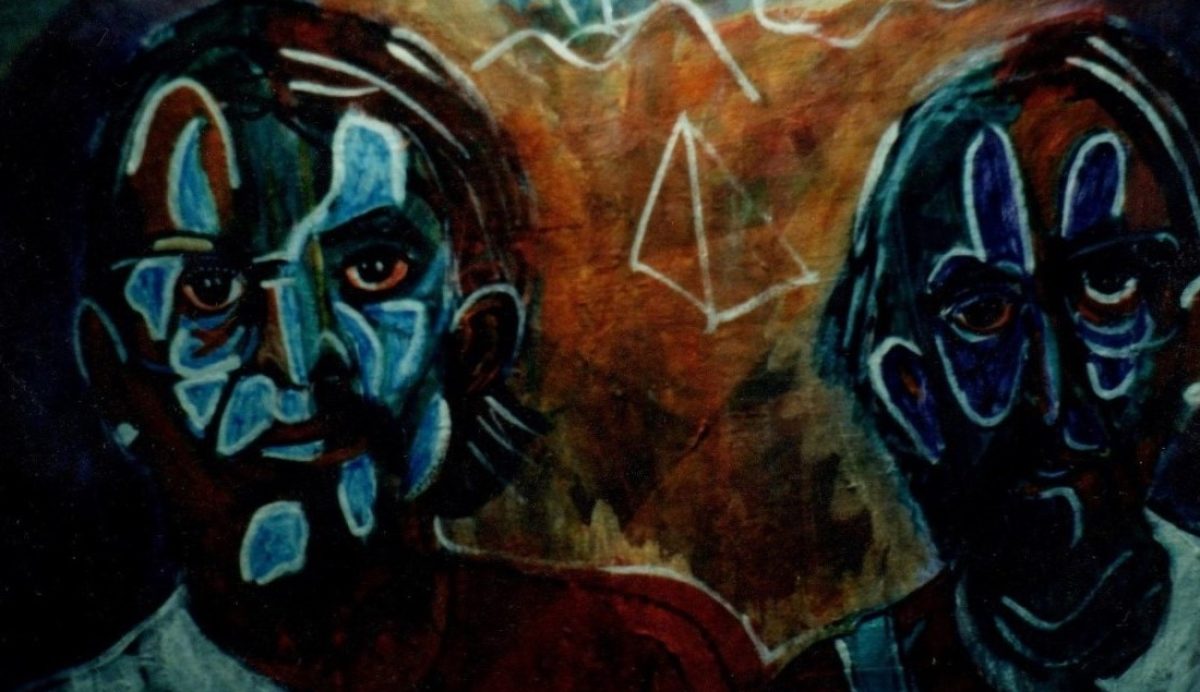
THE FLAGMAN’S OCCURRENCE WAVE BAND


          < Situations and Revelations Of Passing Notice in Guyana >


         Locket #3


         Fyzabad and I were classmates in secondary school. He had this thing about
         dogs and cats. You wouldn't catch me dead hugging a dog or petting a cat,
         but Fyzabad (that was our name for him) would get angry and shout at people
         throwing stones at animals.

         Years later he make this big turn, and now he is this big animal protector.

         I was in the gold fields trying my hand at shaking and sorting. (Actually I have big
         plans: setting up an employment Agency for the gold fields; with me as Chief of
         Operations; yes, man). On a trip back to the city I heard he was in trouble with
         his Village Council. And I want to believe this all started with late-night cinema
         shows.

         Late-night weekend cinema was our schoolboy passion. It look like he never
         really gave up the habit (electricity was not reliable where he lived). After
         the show, while people on the road drinking and arguing, or planning nefarious
         activities with guns in their cars, Fyzabad hurrying home on his bicycle, the
         orange reflectors flashing on the pedals; slowing down only when he pass
         animals on the public road; a stray cat, a stray dog.

             He started riding with a shovel, cause some cars and minivans blasting through
         the night does lick up anything that don't get out the way fast. Drivers leaving
         animal carcass like tire tread strips on the road. All of a sudden he is this burial
         man for hit-and-run animals.

         He would stop, lean up the bicycle; scoop up the dead animal, and bury it in a
         shallow grave off the road.

         If you driving home on the country road late at night, and you notice somebody
         digging and digging on an empty piece of land, like he find a map and he
         searching for buried treasure, that was Fyzabad.

         The property had to belong to the government or somebody; he never stop to
         find out; wasn't worried an officer might jump out the bush and arrest him. In 
         the heat of the moment, in the dead of the night, he there giving these animals
         a proper resting place.
              

         Eventually he had to stop. Somebody sneak up one night and steal the bicycle;
         left him right there on the road with the shovel and a crocus bag, looking round
         in the dark, wondering how his bicycle could disappear just like that.

         He buy another bicycle but the same person or somebody else sneak up and steal
         that one too. That was how the whole late night burial business come to a halt.

         I hear next that Sanita, his wife, went back to her mother with the children,
         saying she tired staying in the house all day cooped up; couldn't even relax
         outside in her vegetable garden.

         What really distress her, and this is what start the problems with the Village
         Council, was her husband's new occupation. Fyzabad was now driving round in
         a van rescuing animals.
In the middle of the night he out there in this van
         looking for stray dog and stray cat.

         He decide next to open an animal sanctuary. When I visited him he had 99
         stray dogs and 31 stray cats in his backyard.

         He started giving each of them names, but he had too many animals, or maybe
         he run out of names; so he stop with the names. But he kept correct count and
         'Date of Rescue' in an exercise book.
 

         "These creatures are like family. Nobody want them. I taking care of them," he
         told me. Then pointing with owner's pride, he said: "You see these two?  
         Spartacus and Shane?"  He whistled, and they came over. "They show more faith
         in this country than most people I know, I'm telling you." (Spartacus and Shane
         were assigned front yard warning duty, to keep intruders off the property.)

         People in the village were up in arms: who in their right mind would drive
         around saving stray dogs? not missing pets with collars, mind you  ̶  stray
         dogs
! This country could barely afford anything like a Dog Pound, and he 
         there playing big Dog Saviour.

         The backyard with the mango tree and with wire mesh fencing and food
         bowls and the galvanize shed was a living disgrace. It was hard to imagine a
         place like this anywhere in the world.
 

         The next door neighbors condemn it as a big health hazard; the owner not
         even qualified or trained to look after animals. "He bringing these dogs from
         the public road into the village, which in turn bringing down property values,"
         the lady across the road was saying. "At least with chickens, they give you eggs
         you could eat or sell. All we getting from his backyard is noise and smell. And
         on hot windy days this place is real hell."

          Fyzabad was convinced he had the only human solution to the problem: "All
          they doing is complaining and complaining, they wouldn't lift a finger to take
          care of these creatures. You see the people I have to live with?  Hold their nose
          at corruption, everywhere is corruption. Smelling to high heaven. But you
          should hear how they address an honest working man like me."

          I wished him all the best. I told him to be careful; do what he think is right,
          what make his life start up and run every morning; but look outside every now
          and then just in case somebody sneak up in the dark and thief the van while he
          at the back with the dogs and the cats.

          T. Sennah
          Georgetown, Guyana

Review Article: DARK MUSIC IN THE BONE


         Published before (1955) in Great Britain, "My Bones And My Flute" (2015) was
       meant to be an entertaining work of fiction, "a ghost story in the old fashioned
       manner". Which might tempt old-fashioned readers to anticipate haunted houses,
       cobwebs and creaking doors. In the hands of Guianese readers back then, it was
       a boldly invented tale that scared the living daylights out of many.

        In (pre-television) 1950s Guiana, reading habits were more empowering than what
      passes as functional literacy today. Local folklore was filled with "jumbie" (ghost)
      stories of headless horsemen, and unseen tormenting spirits just waiting for city
      residents to step into the Guiana forest with its Amerindian guardian myths.

      Pioneer Guianese poets and writers turned     ________________________________
      to the coastal and forest interiors for        
      phantasmagorical material and metaphors.             MY BONES and MY FLUTE
      Human mysteries were solvable and literary                        by
      detectives like Sherlock Holmes and Watson     
      were the preferred gentlemen of reason on               Edgar Mittelholzer
      the job. (Mittelholzer's characters make  
      reference to the fiction of Edgar Allan Poe.)           Peepal Tree Press Ltd.
                                                                                    England, 2015, 236 pgs

                                                                         _________________________________
 
       In preparing his manuscript Mittelholzer must have felt he had a winning formula
       for overseas publishers: a Guianese ghost story with original genre elements: a
       flute, a toxic "parchment", disoriented locals and a haunting colonial memory.
       Something editors had probably never seen before.
 

       The flute interrupts the daily routines of his main characters, the Nevinson
       family whose leisure habits included listening to Debussy's "L'apres-midi d'un
       faune" on a portable gramophone. It intrudes on the soirée small talk of Mrs.
       Nevinson and her church folk, and the conversation of her adolescent daughter;
       all of whom, the narrator notes, should remind readers of the pride and prejudice
       "characters in a Jane Austen novel". 
 

       He explains that at first it sounded "as if someone were practicing a Debussy 
       scale and weren't getting it right." Later with widening appreciation he
       identifies the sound as "a tuneless, wandering trickle of treble notes coming
       out of the trees that stood so still in the night". A vagrant flute, then; baffling
       but bearable; no great cause for concern.
 

       But there's the "parchment". It belonged to an old Dutch planter, Mynheer
       Voormans, who committed suicide after the insurrection in 1793 during which
       he suffered "persecution" at the hands of rampaging "black wretches" once
       under his plantation control.

       To show he wasn't quite done, that plantation power (and its European source)
       would not go away quietly for good, Mynheer Voorsman placed an avenging curse
       on a parchment left behind. Touch it  ̶  as a curious Mr. Nevinson did, preparing
       to read  ̶  and disharmonies would fall upon the rest of your sleep and waking life.

          Mr. Nevinson, who manages the Berbice Timber and Balata Company, invites the
       narrator, Milton Woodsley, to join his team of investigators (his wife and
       daughter) as a kind of 'paranormal consultant'.

       Readers get a sense of what in Mittelholzer's work would become a major theme
       or pathology: skin colour and colonial privilege. 
The Nevinsons' near-white skin in
       those days allowed them the ease to distance themselves from unwanted sights, 
       flute annoyance; and from most everyone else.
       
      
The narrator tells readers his skin was actually "olive"; that is, near near-white. 
       This partly explains his self-styling as the epitome of 1930s Guianese bohemian
       "cool"  ̶  an ambivalent fellow; even-tempered, quite pleased with himself; who
       makes diary entries and sketches for paintings in spare moments.

       His (authorial) descriptions of Guianese jungle creepiness should make today's
       disabled (or disinterested) Guyanese writers sit up and take notice  ̶  how far,
       despite fears of rejections, Mittelholzer's confidence and talent had advanced in
       1955: his exuberant evocations of colonial folkways and the Guianese natural
       world.

                                                       ~~

      At some point in the narrative you might expect a panicky loss of composure,
      and full-throat screams when the team of jungle sleuths first encounter the
      cursing, walking spirits of the insurrection (accompanied, you'd imagine, by
      phantom flutes orchestrating in the trees). Doesn't quite happen that way.

      At Plantation Good de Vries they make contact with the locals; they learn of
      mysterious new deaths and new flute playing; they return at night to share
      deductions, and wake up the next day to a sun that "shone from a sky remotely
      daubed and speckled with cirrus and cirro-stratus which dissolved as the morning
      progressed ".

      Mittelholzer prompts his narrator to deliver erudite Sherlock Holmes-like
      analyses: "Let us suppose," he says, "that this Dutchman had left some strongly
      psychic emanation of his personality  ̶  some etheric magnetic effluvium  ̶  within
      the fibres of this manuscript…"

         He maintains his rational perspective until, during a period of "waiting and 
       watching", as new harbingers (the sharp rustle of shrubs; a rank goatish smell;
       a creaking hammock rope) gather to challenge human bravery, he observes
       "a humped shadow-mass" entering the bedrooms of their jungle cottage. 
       (This is probably the scare moment best remembered by older Guianese 
       readers.)

        Kenneth Ramchand (Professor Emeritus, University of the West Indies) has written
       an Introduction to this edition  ̶  46 blowy, biblio-background-filling pages  ̶  that
       opens up the book's contents for scholarly partake. (Mittelholzer, he says, "wants
       to leave you accepting the supernatural".) The cover blurb suggests, too, that the
       novel has "serious things to say about the need to exorcise the crimes of slavery
       and individual wickedness".

       New readers may elect to stay the discourse (which could be sopor-inducing at
       times); discover what the fuss was all about (dabbling in the dark arts could
       unsettle bone complacency? ear plugs and face masks won't keep out dust
       fall from the past?) Or simply jump the gap and ride along with Mittelholzer's
       story-telling, his chapters gliding steamer-like up the Berbice river in the full-
       bloom English registers of his day.

       Either way the new British publisher of "My Bones and My Flute"  ̶  Peepal Tree
       Press, a home port for redemptive postcolonial opportunity  ̶  would be
       delighted if you put a serious handle on the book's reputation; get as comfortable
       as verandah arrangements permit these days; at the very least give the story a
       good old-fashioned try.    
           
                                   - Wyck Williams


THE FLAGMAN’S OCCURRENCE WAVE BAND

           < Situations and Revelations Of Passing Notice in Guyana >


          Locket #1
         
          This work getting seriously out of hand. People don't realize I am the sole and
         solitary porter employed at the Canal District 2 Mortuary. I can't do any better,
         otherwise I would seek to secure permanent employment elsewhere. I have a
         brother living in Trinidad. He write telling me how bodies piling up with all the
         killing over there.

         I here working twenty four hours per day. Receiving payment for just an eight
         hour period. Advantage is being taken of my situation.

         And seeing as how I living close by the mortuary parlour, contact is being made
         to me at any given time to provide service which includes (a) washing and
         cleaning of parlour (b) stitching and dressing deceased after postmortem
         examination (c) Pick up dead morning noon or night and deposit same dead in 
         freezer. (d) Operate emergency power in case of blackout (e) Remove body
         from freezer as per request of family midday or midnight.

         Sometimes is me they call upon to bathe and dress the dead for quick religious
         burial, but the money paid for performing "special tasks" goes straight in the
         biscuit tin of the parlour supervisor.

         Only the other day a dead fell out my hands which was under heavy strain to
         transport the body from one location to another. This is a clear indication that
         I alone cannot do the work with only two hands. More hands are needed and
         urgently for the dead to be properly taken care of.

         To add insult to injury the supervisor who drives the hearse is in the habit of
         going from abuse of privilege to abuse and cursing related to my job abilities.
         Bad enough I have to see and handle what temper or getting old does breed
         and do to people.

         This is clear indication of the action to come that is piling up. Advantage is being
         taken of my situation

         A. Sadhoo,
         Canal District, Guyana
                                                                 *


          Locket #2

          The Magistrate at the Canal District #2 Assize has his listening and sentencing
          ways. This is what I hear from the Clerk of Court Records (I am telling you in
          the strictest personal confidence. Your ears only.)

          Monday:    
          According to the prosecution, Defendant (name withheld) went to Lot 133
          where members of the Pentecostal Church situated at above address observed
          him during the service in a mango tree with a bag picking the fruit. An alarm
          was raised and the defendant was later arrested and charged. Quantity of
          mangoes found in bag: 32.

          Magistrate frowning: Praedial Larceny. Defendant given options (a) dedicate
          rest of his natural life to the Pentecostal faith or (b) 32 days in prison.
          Defendant chose Option (b).

          Tuesday:   
          Defendant in the court (bony fellow with scar across left cheek, name
          withheld).

          This lady open her shop doors but went to the back of her premises to do some
          washing. After fifteen minutes she hear a noise coming from the front of the
          shop. Came back to investigate only to find this fellow walking away with a
          bunch of bananas and a carton of cigarettes and cigarette lighters valued
          $2,000. Like he picking and choosing what he wanted that day with no intention
          to pay.

          Matter was reported to the police. Arrest was made. Defendant confessed to
          charges. Magistrate scowling : Simple Larceny: Defendant sentenced 50 days.

          Wednesday.
          Defendant claimed he picked the mangos from a loaded tree in the compound
          of the District Medical Office because no one else was picking them. Magistrate 
          glaring: Praedial Larceny: Defendant given 70 days.

          You see this country? People does grow like guava and turn hard, that is all
          I have to say.

          A. Sadhoo 
         Canal District, Guyana


NY SLIDE 11.6: CLOSURE CLOSE


                    Days in the hospital bed listening to his own breathing.

                    His right leg was fractured, his neck was in some sort of brace, and but
                    for a few minor cuts and bruises and a dull pain that slept and stirred
                    in his body, he was alright. Judy Weiner was not so lucky. She's
                    suffered a concussion. Her condition was considered stable, they told
                    him. She kept fading in and out of consciousness, asking each time,
                    What happened! She couldn't remember anything about the accident.
 

                    Two police officers came to see him. One stood at the foot of his bed
                    watching, while the other, soft spoken and more polite, did the
                    talking.
 

                    Radix had little to say. The car, the man in the back seat, the
                    intersection  ̶  it all happened so quickly. He wanted to talk about the
                    gurgling sound he'd heard but they weren't interested in that. They
                    stood by his bedside in grey suits and black coats. They stared at him,
                    bandaged up and braced, as if they weren't sure how helpful he could 
                    be.
 

                    They asked his name, age, occupation; they asked where he came
                    from; they wanted to know what he and Judy Weiner were doing out in
                    the streets if they were HS teachers. A funeral? A church? Okay, what
                    church? Third Avenue? They knew Third Avenue from end to end. A
                    church on which block? They didn't think there was a church on that
                    block. Hey Rocco, is there a church on that block? In any case that was
                    way across from the accident site, on the other side of the Bronx.
                    What were they doing all the way over there?

                    And Rocco, quiet, watchful, with a surly, sad beefy face, looked around
                    the room, then back at Radix; then around the room, as if that was
                    part of his job, this suspicion of everyone and everything. Radix could
                    tell he too had questions of his own: like, What the fuck were you
                    really doing at that intersection? at that hour of the day? with a white
                    woman?
 

                    After awhile Radix grimaced and stopped answering; the nurse came in
                    to do nurse chores. They must have sensed his reluctance to continue,
                    his Fuck you too! which was meant for the quiet Rocco. "We'll let you
                    rest, but we'll be back to talk to you."
 

                    So many people in and out the room. Everyone with questions  ̶  the
                    police, nurses, doctors studying charts; a news reporter who was
                    barred from entering and peered at him room the door.
 

                    And here were Aschelle, Amarelle and Sammy D. who looked down at
                    him with worried puzzled faces, not asking questions, just wanting
                    between friends to know what happened.
 

                    Sammy D. couldn't resist telling a story, meant to cheer him up, about
                    the time he broke his arm playing soccer; and the cast he had to wear
                    which all his soccer friends signed; which he still had up to this day.

                    Aschelle grumbled about conditions at the hospital she couldn't help
                    noticing   ̶ "They do things differently here." She wondered if he
                    couldn't be transferred to the hospital in Manhattan where she
                    worked.
 

                    Amarelle sat on the edge of the bed and looked at him; she caressed
                    his forehead once, then not again. She considered staying all night but
                    the others persuaded her to leave.
 

                    The next day she showed up alone, her face narrow with worry. She 
                    had gone back to the house in the Bronx, letting herself in. She
                    reported the glass panel on the front door was cracked; fellows were
                    still "congregating" on the stoop. They must have heard what had
                    happened, but so far  his stuff and things were intact. Maybe he should
                    consider moving to her sister's place in Peekskill to recuperate.

                    Mahmood Sharif came to see him the following day. Classrooms were
                    buzzing with excitement. They'd heard the news from Dr. Balleret
                    through the p.a.system. Unbelievable! Some teachers had seen it on
                    the six o'clock news  ̶  the car so crumpled, it seemed a miracle anyone
                    had walked away alive. They'd reported one person dead and serious
                    injury suffered by two Bronx teachers. The intersection was known for
                    drug and gang activity. Unbelievable? What were you guys doing out
                    there?
 

                    Radix kept asking about Judy Wiener. Had her condition been upgraded
                    from stable?  The doctors assured him she would pull through but they 
                    didn't confide much else.
 

                    Through the oblong window in his room he could see clouds and blue
                    sky, nothing but clouds and blue sky; no buildings, no metal fire
                    escapes; he could hear the distant grind of Bronx traffic; police sirens;
                    noises as in a forest.

                        (from "Ah Mikhail, O Fidel!", a novel by N.D.Williams, 2001)


NY SLIDE 11.5: ALL SO FAST


                    He didn't notice the lights had turned green. No cars waited behind him
                    otherwise he might have been alerted by someone leaning on the horn,
                    wondering what the fuck was wrong with him holding up traffic. He
                    rolled down his windows, there was not much air in the afternoon sky,
                    and he was about to suggest that Judy Wiener do the same on her side.

                    He heard the car door behind her open as someone jumped in. He saw
                    a face  ̶  youngish, Hispanic, damp with the sweat of desperation. A
                    narrow, handsome face whose twisted mouth screamed, Drive this
                    fucking car. Drive. Now
. The sound more terrifying than the face.
 

                    There was the scent of cologne, as if the man had stepped fresh out
                    the bathroom into his clothes and onto the streets, then into their car.
                    He heard Judy Wiener gasp as her heart leapt up to her throat.
 

                    His first thought was, How did he get inside? I didn't leave the back
                    door unlocked. How did he get in
?
 

                    Then he saw the gun in the man's hand, the first real gun he'd ever
                    seen in someone's hand.
 

                    What happened next happened fast but he remembered it slowly: the
                    distorted face; the words like detonations in the car; the gun in the
                    man's hand. And then the blood, lots of blood on the man's shirt, some
                    sort of beige golf shirt, but drenched in red stuff that had to be the
                    man's blood.
 

                    He heard popping sounds, like pellets hitting his car, only he didn't
                    think at the time they were bullets. He heard Judy Wiener say, "Oh, my
                    God".
 

                    The man slumped on the back seat. He managed to lift his torso, he
                    pointed the gun at Radix, shouting again, Drive. This time Radix looked
                    straight in his eyes. They were pleading for help, the face damp with
                    perspiration, the shirt messy red. And the hand that held the gun
                    shaking.
 

                    All so fast. The man seemed to sag back in the seat, the arm going limp
                    for a moment, as if his gesture of intimidation had sucked the last
                    breath out of him.
Only then did Radix, his mouth now dry, a fierce
                    pain in his stomach, snap into action.
 

                    He stepped on the gas pedal, shooting forward; and at this point he
                    couldn't recall clearly what happened next.

                    They told him he'd run straight into the path of a van. The van hit him
                    broadside and sent him in a spin. The car hit a wall that divided traffic
                    going into and coming out of a tunnel, then it came to a stop.
 

                    Radix felt the jarring contact right through to his bones. There was a
                    howling in his ears as of tortured winds; then stillness, as the silence
                    closed in. And through that silence he distinctly heard what sounded
                    like a baby's gurgle, then a long sigh.
 

                    He kept returning to that sound long after they'd extricated him from
                    the vehicle wreck. They told him it could have been the man in the
                    back seat grasping at life, releasing the last scraps of air in his lungs as
                    he expired. That must have been what he heard.


                      (from "Ah Mikhail, O Fidel!", a novel by N.D. Williams, 2001)


NY SLIDE 11.4: MEANING AFTER


                    When it seemed Judy Wiener was taking an extraordinarily long time
                    in the bathroom Radix knock on the door. She didn't answer. "Are you
                    alright in there?"

                    He heard a soft "Yes, I'm alright" so he waited for her in the living
                    room. Eventually she came out and stepped boldly in front of him.
                    "How do I look?" she asked.
 

                    Taken aback by her new perky manner he didn't know what to say. Her
                    dress looked rumpled, though he didn't think anyone would notice. "You
                    look presentable to the world, " he said, getting up to go.
 

                    Just before they stepped out the door, she paused, searching in her
                    bag. He turned to her; she looked in his face, and leaned against the
                    wall. "What's the matter? Lost something?" he asked. "It's nothing," she
                    answered.
 

                    He put his arms around her, and once again felt her body trembling
                    close to him; her breath on his ear. "We've got to get back," he told
                    her.
 

                    The afternoon light filled their eyes as they stepped outside. The street
                    was empty of the hangabouts. Cars went by. Those shiny bulging plastic
                    bags of garbage hadn't been picked up. The usual lounging faces were
                    nowhere to be seen.

                    Where was Carlos? He was supposed to be at his new job, outside the   
                    bodega, some sort of Security job. There had been an attempted
                    robbery, men in ski masks waving pistols and demanding money. The
                    bodega owner had fired his gun, killing one of the men. Since that
                    incident he'd hired Carlos to sit on the dumpster and confront any
                    suspicious people before they came in.
 

                    Carlos was now a holoperos. His job was to nab the holope, or dash
                    inside and lock the door. Right at that moment Carlos was nowhere
                    near his post.
 

                    No one took notice of them except a middle-aged man from across the
                    street who sat at the third floor window with the guard rail, smoking
                    and looking down. Not once had he ever made a friendly gesture, a
                    wave or a smile, when he saw Radix. Just his face looking out, half in
                    shadow, minding its own business.
 

                    There was no real need to hurry back since it was near the school
                    dismissal hour. With classes still in session kids were probably
                    preparing to stream out the exits into the afternoon streets.

                    On an impulse he decided to take the route through the local streets,
                    staying off the highway which would be dense with traffic heading for
                    the bridge. If he took the local streets, then the Expressway for a few 
                    miles, then back to local streets, they'd get there in half an hour.


       "Michael." He heard the soft questioning tone in the voice and shrank a
                     little from it. "All of this…"
 

                    "All of what?"

                    "What happened today. All that happened, wouldn't have happened, if
                     Xavier hadn't  died, and there was no funeral to attend." He hadn't
                     anticipated words so contorted. "What do you think it means? Aren't
                     you a little curious about what it means?"

                     "I don't know what it means. Do we have to attach meaning to
                     everything?"

                     "This morning everything started so, you know…. unrehearsed. First
                      we couldn't find the funeral home. Next, we're together looking into
                      the coffin. One moment we were back there, and now we are here.
                      It's as if we weren't in control of anything that happened."

                      "I thought you said there was nothing to worry about."

                      "It's not about the school. How can we do this? Move from one thing to
                       the next like this, and not be worried about, you know, how it adds
                       up." 
 
                 
     They were waiting for the traffic lights to change, on a slight incline
                       in the roadway, so that Radix kept his foot on the gas pedal. They
                       were at a crowded intersection, with bodegas at the corners, a
                       shopping strip with a string of stores on either side, all with weather-
                       beaten awnings; cars taking up every inch of space near the curb.

                       He glanced at her, wondering what had come over her. Maybe he
                       should have given her more time to compose herself  ̶  not just rush
                       away from the building back to school. Their intimacy, so frantic
                       with relief, wasn't likely to repeat itself  ̶  not under the same 
                       circumstances. Like a dropped anchor the day's chain of events was
                       pulling itself out of the water. But now was definitely not the time
                       and the place for this conversation.

                          (from "Ah Mikhail, O Fidel!, a novel by N.D.Williams, 2001)


NY SLIDE 11.3: THE GOOD PEOPLE


                    When they got to his place she watched as he unlocked the gate. She
                    waited on the sidewalk, pizza box in hand, looking around, her senses
                    alert in strange territory. And Radix, coming back up the sloping
                    driveway, saw her back to him in simple black dress, the body adrift
                    from its normal moorings and was struck by what seemed a kind of self-
                    congratulating confidence in her posture.
 

                    Anyone looking down from the apartment buildings might have
                    registered surprise at this white woman standing there holding a pizza
                    box  ̶  the fuck she doing here?  Radix knew what she was doing here.
                    Whatever pressed down on her everyday soul  ̶  fear, loneliness, those
                    workaday dull pains  ̶  had lifted, had taken wing for awhile. He sensed
                    her delight in this temporary freedom from her routines.
 

                    "You live here all alone?" she asked, as he opened the door and picked
                    up the mail from the floor.
 

                    "There was someone sharing the apartment with me, a friend, but she 
                     sort of took off."
    

                    Not used to this kind of impromptu entertaining Radix ushered her in; 
                    and Judy Wiener sensed his discomfort. He had to be a little self-
                    conscious about the situation, about her finding out more about him
                    than he wanted to reveal. She made every effort to seem relaxed.
 

                    She offered to help. He said he didn't need help serving pizza in his
                    apartment. He heard her footsteps as she walked around, little cries of
                    interest as she peered into rooms.
 

                    "I can't believe you live here alone, in all this space." 

                    "More space than I need, and I'm renting. There's a fellow upstairs, he
                     owns the building. I hardly see him. And in the basement, a man and 
                     his wife, she's pregnant."
 

                    "What do they do?" She leaned over the pizza box, tearing off a cheese-
                     clinging slice.
 

                    "I don't really know. We're all kind of busy, coming and going at
                     different hours, if you can imagine that.

                    "I thought you found that lifestyle only in the quiet leafy suburbs." 

                    "You know what I mean. Though at night people from the apartment
                     buildings across the street come down and camp out on my stoop.
                     There's no way to avoid that."
 

                     With the pizza almost devoured, the soda cans half-empty, there were
                     lapses of silence; street noises filtered in.
 

                     "So how do you feel now?" Radix asked. 

                     "Okay," Judy Wiener leaned back and sighed. 

                     "Bet you never dreamt you'd be sitting one day in this room." 

                     "No, never in my wildest," she laughed. 

                     "So what do we tell them?" 

                     "Tell whom?" 

                     "When we get back, what do we tell the supervisors? how do I explain
                     to my A.P. where I've been all afternoon?"
 

                     "You don't need to explain anything. Your classes were covered by a
                      substitute. I don't think they're going to ask any questions."
 

                      Someone shouting on the sidewalk right outside their windows turned
                      their heads for a moment.
 

                      "We are the good people? Aren't we the good people, Michael?" She 
                      was suddenly unsure and vulnerable again. "They don't pay us much,
                      they ask us to do a hell of a lot. Why should they fuss about a little
                      thing like where we've been all morning?"
 

                      It seemed a good moment to clear away the pizza box and soda cans. 
                      She'd taken off her shoes and stretched her feet on the coffee table,
                      clearly in no hurry to get back. "And thanks for the improvised lunch. 
                      It was good. Now all I need is a siesta."
 

                      All his assumptions about Judy Wiener, it occurred to him, didn't
                      support the woman sitting in his living room, her head thrown back on
                      the chair. He stood behind her and made a playful attempt to
                      massage her shoulders. She said nothing, keeping her eyes closed. He
                      leaned forward and kissed her upturned forehead. Then he took her
                      hands.
 

                      She looked up at him a little puzzled; this was her teaching colleague,
                      a man alone in a sparsely furnished apartment; always kind and
                      considerate, holding himself apart.

                      "Siesta?" he said, the faint smile on his face gauging her reaction; not 
                       quite certain about the mood of the entire morning, the uncharted
                       waters they now found themselves in.
 

                       She felt the insistence in his fingers; she hesitated for bare seconds,
                       conscious of her own uncertain breathing. She smiled and held fast to
                       his grip, lifting herself up.
 

                       In the hallway to the bedroom he turned and held her in an
                       embrace; her body shuddered. His hands ran down her back and
                       gripped her firm, patient buttocks. She pressed closer to him.
 

                       The bedroom was mere steps away, but they would have to
                       disengage, draw back, and in that moment some fresh uncertainty 
                       might slip between them. She made no protest as he started to 
                       undress her; stepping out underwear, helping him unbuckle his
                       trousers; clinging to him again.

                        (from "Ah Mikhail, O Fidel!", a novel by N.D.Williams, 2001)


NY SLIDE 11.2: NERVE BROKE DOWN


                    The morning had warmed up into an afternoon that would be barely
                    tolerable. A young man in grimy mechanic clothes approached rolling a
                    tire down the sidewalk. They shifted out of his path. Xavier's mother
                    glanced at her watch. Hugs and handshakes followed, the professor
                    saying with grave sympathy, "So much to do in this world, so little
                    time. Then Radix and Judy Weiner walked away to find the car.
 

                    Radix was about to insert the ignition key but hesitated, feeling no
                    desire to move.  Maybe if they'd arrived on time at the church, if they'd
                    participated with other mourners in song and prayer, it might have
                    made a difference.
 

                    "He never got mixed up in stupid things," Judy Wiener said. "Despite 
                    what the other kids said, he didn't really care about his reputation."
 

                    "We really got here to late." 

                    "I mean, he didn't strike me as someone who ran with the pack, you
                     know, with his homeboys."

                     Radix leaned forward, thought of turning the ignition key, then sat
                     back again.
 

                     "The world is so poisoned, there's so much with violence, you don't
                     know whom to trust. Xavier was always straight and honest with me.
                     Certain things I never pressed him to talk about. Like the money he 
                     returned to me, did I tell you? How I got my money back from that
                     pyramid game? How he showed up and said someone told him to give it
                     to me. Can you believe that?"
 

                     "Not to worry," he leaned over and squeezed her hand. 

                     "I can't get over that he's gone. I mean it hasn't sunk in yet, you know,
                      and the two of them back there, so stoic about everything."
 

                      Their shoulders were inches apart; she looked tired and overwhelmed 
                      by the morning's unusual activity. And right at that point as he
                      gripped her hand a rush of ragged feeling poured through some crack
                      in her composure. She  was getting old; the years were passing and 
                      but for her mother she was not attached to anyone, had no serious
                      relationship with anyone. The school was closing after all these years;
                      she'd have to move and work some place new.
 

                      In the closed space of the car her body tightened; she leaned her
                      head toward his shoulder; then just as quickly she made an effort to
                      compose herself, reaching in her bag for tissue and dabbing her eyes.
 

                      "You okay?" Radix asked. 

                      "I'm fine. I'm sorry, this is not exactly the time to have a nervous 
                      breakdown."
 

                      "Is that what you're having?" 

                      She blew her nose. He looked at her and waited. 

                      "Aren't you going to start the car?" 

                      "Where are we going?" 

                      "What time is it? It's too late for lunch break in the cafeteria. Maybe 
                      we could stop somewhere and eat before we head back."
 

                      "To be honest, I'm not in a great hurry to get back." 

                      Radix started the car and moved off. 

                      "Are there any good restaurants around here?"
 

                      She was thinking they deserved a treat for the personal sacrifice 
                      they had made; some sort of illicit fun after all they'd gone through 
                      this morning.
 

                      "I suppose so. I live in the Bronx and I can find the nearest post office
                      and the barbershop…but a good restaurant?"
 

                      "I forgot you live around here." 

                      "Well, not around here. Listen, why don't we pick up a pizza. or 
                       maybe some Chinese? We can stop by where I live."
 

                       Judy Wiener perked up, smiling, thrilled at the idea. 

                       Three blocks away they sighted a pizza shop. He pulled over; quick 
                       as a wink, before he could unfasten his seatbelt, she was out the car
                       volunteering to get the pie; turning back to ask which he preferred,
                       pepperoni or…; insisting she'd take care of everything.
 

                       A little taken aback by the fresh momentum of things his eyes 
                       followed her as she stepped away with surprising nimbleness. She
                       was older than he was, that he knew; but a that moment, out in the
                       streets of the Bronx, the difference seemed immaterial.
 

                       Back in the car she sat with the pizza box warm on her thighs. "You 
                       know, I remember the very last day I did something like this," she
                       said.
 

                       "Like what?" 

                       "Something outlandish, you know. Breaking rules?"

                   (from "Ah Mikhail, O Fidel!", a novel by N.D.Williams, 2001)


NY SLIDE 11.1: IN THE HOUSE OF THE REDEEMER


                 The Seraphim and Cherubim House of the Redeemer had its exterior
                  walls recently painted, in maroon, and the two windows facing the
                  street were grilled. Radix looked up and read the fine print on the sign  ̶
                  information about the services held, the hours of service; and the words,
                  Professor Adelanyo Abafa, Leader In Charge. He pulled the door handle
                  and went in.
 

                  They saw rows of folding chairs, a preacher's rostrum and a tiny stage.
                  The room
was brightly lit and empty but for two people  ̶  a woman
                  dressed in all white, and a man in a priestly white robe with a maroon
                  sash. They sat close together, staring at a coffin on a trestle right below
                  the stage. They turned as Radix and Judy Wiener entered and the 
                  woman in white smiled and rushed forward to greet them. It was
                  Xavier's mother.
 

                  She squeezed Radix' hand and gave Judy Wiener a warm hug. They were
                  a little late, she said, they'd been a short service. Some of her friends
                  and some of Xavier's friends  ̶  "just a few of us"  ̶  had taken part, and it
                  had ended just fifteen minutes ago, since people had business to take
                  care of.
 

                  Judy Wiener, in tones tinged with sadness, explained they were delayed
                   ̶  the traffic, silly problems at the school. She was sorry they'd missed
                  the service. Still, they were glad to be here to pay their respects.
 

                  Xavier's mother smiled. Her face was heavily made up, as if to hide
                  marks of strain and grief.
 

                  She turned and introduced Professor Adelanyo Abafa who gave a formal
                  bow. "Professor Abafa is from Nigeria," she explained. She stood close to
                  him, framing more than just a casual relationship. "I have to thank
                  Professor Abafa for everything. He came to my rescue at a time of my
                  greatest need." She looked up in his face.
 

                  The professor said, "We are all here to serve each other." He turned his
                  head toward the coffin and added, "You probably want to spend a few
                  moments alone with Xavier. You can go ahead."
 

                  Radix and Judy stood over the coffin. For awhile they said nothing. Radix
                  barely recognized Xavier's face. It looked puffed up where once the flesh
                  under the  cheekbones was handsomely recessed. But it was undoubtedly
                  Malcolm Xavier Haltaufaudehude, about whom he knew very little (he 
                  wrote that essay on Shakespeare's "Othello).
 

                  Standing there, feeling the hairs on his arm lift whenever the swiveling
                  fan in the corner sent air in his direction, he was aware of the
                  tranquillity in the room, and the sound of indifferent traffic outside.
 

                  He heard Judy Wiener murmuring, the same words over and over. A
                  single tear rolled down her cheek. She leaned over and kissed Xavier on
                  the brow, then she continued her murmurming like a prayer.

                  Radix wanted to feel something for the face in the coffin, but nothing
                  inside him stirred. He listened for a moment to Judy Wiener who was
                  making a huge effort to control herself. He made a promise to read the
                  play "Othello", see what had got Xavier so worked up in his essay. He
                  touched the coffin and turned away.
 

                  Back outside on the sidewalk they attracted the attention of a young
                  man from the Tire and Hubcap shop who stared at their clothes and
                  wondered what they were up to.

                  Xavier's mother did most of the talking. She seemed determined to show
                  how well she was bearing up despite her aching heart. She explained she
                  was going to have Xavier cremated; his ashes would be flown back to
                  Jamaica and scattered in the sea, in the western part of the island
                  where his grandmother was born.
 

                  "Professor Abafa was telling me I should arrange to have his remains sent
                  back to Africa, right professor?" She gave him a challenging smile. The
                  professor clasped his bible, a stolid sympathetic figure. "If we scatter his
                  ashes to the wind they will eventually find a path home," he said,
                  smiling.
 

                  Out in the open he was a short stocky man, with heavy-lidded eyes, a 
                  thick neck, round-faced with a startling big voice. Under his priestly 
                  garment his biceps and broad shoulders hinted at a boxer's physique. He 
                  spoke only when prompted, offering a proverb or aphorism to reinforce
                  whatever Xavier's mother was saying.
 

                  Radix tried drawing him out about his church, and his duties as "Leader 
                  In Charge". The House of The Redeemer had the look of an enterprise
                  recently founded, or under new management so to speak.
 Xavier's
                  mother intervened, saying she was grateful for the comfort and support
                  of the professor's church.
 

                  "Birth, death and taxes… the only things certain in life….let us not
                  grieve over what is inevitable," 
he'd say. And Xavier's mother smiled and 
                  nodded, looking penitent and firm-bodied in white beside him.

                      (from "Ah Mikhail, O Fidel!", a novel by N.D.Williams, 2001)


NY SLIDE 11.0: STREET WISER


              Judy Wiener sat barely attentive to what he was saying. Her mind kept
              adjusting with some anxiety to her view in the passenger seat. She leaned
              away instinctively each time the car passed rather close to parked vehicles.
              At the traffic lights she straightened up, hiding her apprehension.

              "This is so strange," she admitted, laughing nervously. "It's as if I'm seeing
              the Bronx for the first time. I mean, I drive past these streets every day. I
              guess it's like tunnel vision when you're at the wheel and heading home.
              You don't really see everything."
 

              And Radix, a little peeved at her trickling response to his driver conver-   
              sation, said, "You want me to give you a guided tour on the way?" She
              couldn't have missed the mockery in his voice.
 

              It was growing into a warm day. The streets were narrow, and felt even
              narrower with the parked cars, the side walks busy with walkers, people in
              nondescript clothes, dark faces, Hispanic faces. It felt strange to be out of
              the classroom at that hour, to be moving through Bronx streets with no
              grander purpose than travelling to a church.
 

              Radix drove with the car windows down. Blasts of bus exhaust swept into
              their faces, with the dust and litter blowing around the street.
 

              At one point, at traffic lights, a man in soiled mechanic overalls stepped
              off the sidewalk right in front of them. It was an arbitrary, reckless move.
              Judy Wiener jerked forward as Radix slammed on the brakes.
 

              The man glared at them, his eyes ablaze with accusation. He seemed   
              momentarily puzzled by the two faces, white and black, in the front seat.
              He pointed an identifying finger and let loose a string of curses at them;
              unintelligible words daring them to hit him; reviling them for questioning
              his right to be careless with his life on his streets.
 

              It kept them apart and silent for awhile. 

              Near the next intersection Judy Wiener heard Radix groan as if he'd done
              something wrong. She perked up, asking with fresh interest, "Are we lost?"

              "I'm not sure, " he said. "I think we should have come to Third Avenue by
               now."  And Judy Wiener, peering forward, determined to be useful again, 
               read aloud the street signs in an attempt to remove the awkwardness that
               had slid between them. Though Radix kept thinking: She's not afraid to be
               lost. I bet this is some kind of wild and wonderful outing for her.
 

               They'd been driving past blocks of old abandoned buildings, vacant lots
               thick with weeds; then blocks of houses and store fronts and bustling
               streets; then more gaps where buildings once stood. "We're looking for
               1351," Judy Wiener said, consulting the piece of paper in her hand "It's so 
               hard to find the numbers…these buildings don't …seem numbered."
 

               She spotted the building first. "There it is, 1351." And Radix, still
               anticipating a church, said, "It looks like a store front set up."

               The sign on the building read, The Seraphim and Cherubim House Of The 
               Redeemer
. Next to it was a Tire repair shop, with hubcap and shiny steel
               rims draped on its facade. "Look at that. Maybe we could get replacement
               hubcaps for your car."
  

               But for the sign there was no way of knowing they had arrived for a
               funeral event. It always perplexed Radix to come across something like 
               this: a building that sold Mexican food, then next to it a church; and next
               to that a store for Cleaning and Janitorial Supplies; each jostling for
               customer attention.

                    (from "Ah Mikhail, O Fidel", a novel by N.D.Williams, 2001)