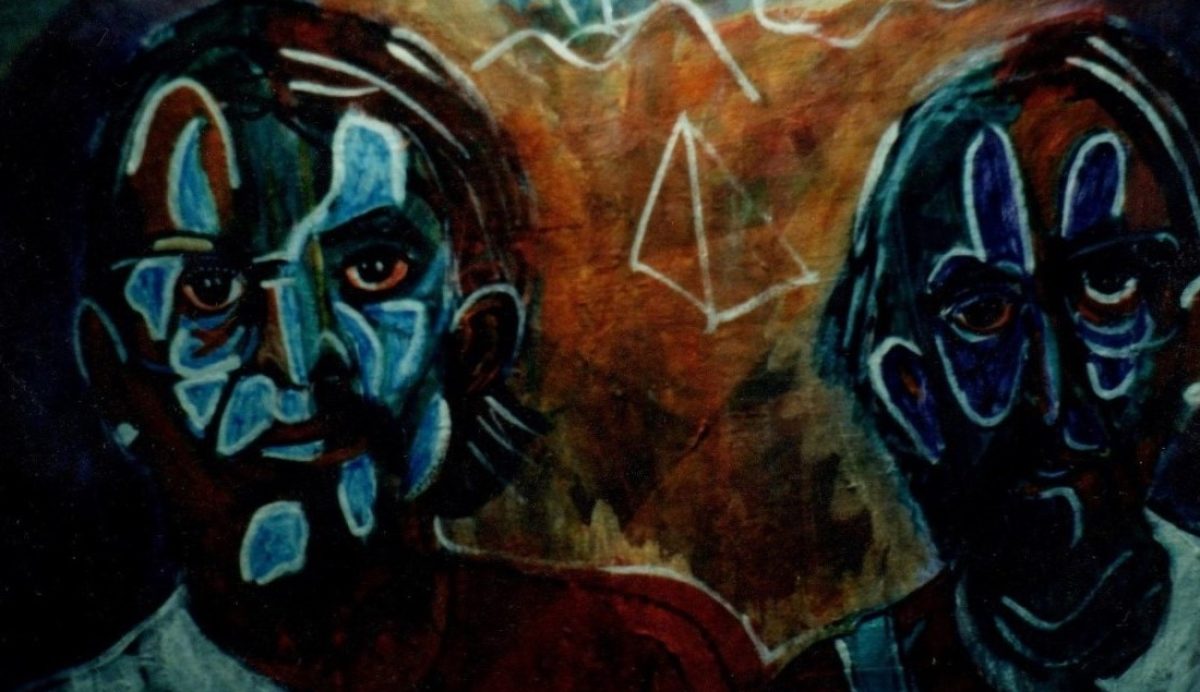
BLUE HUNDRED NOTES FOR JULIO


              Evening moist bites on dry bed lips testing the initials
              of youth dew kiss still cling sharper than the first search party
              mapping curve mound signs; or spring tide swell moon up
             
on the sea wall  ̶  permit at last to storm.

              On air brushed island bicycles, cow amble and cart
              in our path, we lost ourselves in Walcott-like land tie dyes;
              prince and princess, never more crowned, cool valleys
              like Marley's, never more owned. Valve insert keys golden,
              our kingdom full come. 

              The morning you disclosed your ovaries contained no eggs
             
designed to child; straight backed away  ̶  your ten o'clock intern
             
ship call [On the Rayuela Périphérique: * Even if Heaven is
              close by, all life in front of one.*]   
                                                                  Did you know then who you'd
              become? your hands scrubbed in would people house wife smiles?

              I'll go happy parts of us clasped to my chest rare coins on eye
              blinds open (nose holding casket scents).


              I'll clutch
these strips, not yet expired, like magnets on
              the chance
there's the same swipe system for the paradise side:
              a rainbow One source blues stop @ "Bird & Miles"
  ̶  a pint round
              about midnight for Julio  ̶  as hip hop tattoos sneak a peek.

              Ripe plum pluck and good luck! risks of innocence distinguishing;
              Fellini's FIN.
                                                                  < Yo, corbeau! head red 
              that garden lizard's fire fly snaps, the tree climb pause to pose,
              Eh-eh, what became of,  
                                                                             
                                                                               – W.W.


                                        ̴  Ça va Julio Cortázar (1914 – 1984)  ̴


                    COCTEAU


                    I:
                 

                    My taste for moment-to-moment death yeasts
                    the liquor of life that waters the taste.

                    This tongue is ghosted by my brandy's ice-
                    dry vapour drifting in and out of being.  


                   II:

                   Now I am a stone in a running river,
                   split by the sun into a thousand moons;

                   now the river drained to a widow's bed,
                   a tongue of sand clogged with a million stars.


                   III:
 

                   My house is all windows of seamless glass
                  
with soldiers drifting by them, like stray clouds.

                   On its walls, I'm a shadow with ten eyes
                   whose target is any, whose aim is all.


IV:

                   From branch to branch of this flowering tree
                   I hop, a bird who has traded his wings

                   for a hundred songs from as many beaks:
                   fickle to each branch, faithful to one tree.

                  (from "Scratches On The Air" by Brian Chan)


WHEN GARCÍA MÁRQUEZ RULED THE PAGE


Gabriel García Márquez set ablaze a rage to read among many students of
literature at the University of the West Indies (Mona) in the late 60s -70s.
Currents of shared interests were strong though problematic then between                      the islands of Jamaica and Cuba; students and scholars (in the Dept of                              Spanish) immersed themselves in the “kingdoms” of Alejo Carpentier, the                          Casas de las Americas; and the Latin American giants, Octavio Paz, Mario                          Vargas Llosa, Carlos Fuentes.

The Márquez brand new world fiction offered points of transition to students                    in the Dept of English, enhancing our conversations about life and                                    politics; and  what we considered the ‘Latin American connection’. By                                comparison course studies in English Literature felt dreary; they did not                            offer novels of 500+ pages, or characters still active past 200 years. No                            heartless grandmothers mothers striking bargains with virginity chips;                              no vultures pecking, fragrant omens, those vines of erotic hunger in                                  our Caribbean vegetation.

The weird behaviours and sinuations in the Márquez novels captivated us:
the gypsies and butterflies and firing squads; the participatory role of “time”
as unforeseen events unfolded; that general in “The Autumn of The Patriarch”
who “governed as if he felt predestined to never die.”

“One Hundred Years Of Solitude” (1967) was perhaps our first serious                                 encounter (after the arrival of Wilson Harris’ fantastical “Palace of the                               Peacock”, 1960) with loves and affairs in the soup of the surreal, with                               colonels and rulers in the rose garden of the “phantasmagorical”.


It should be noted, though: for many young readers in the 60s/70s in George-
town, Guyana, his fiction did not quite match the compelling, dreamlike
imagery in the  work (in translation) of Jorge Luis Borges. And for those who
aspired to be writers, García Márquez came close but was not quite the                            genius considered a literary god hovering over our scribblers’ ambitions: the                      other Argentine writer, Julio Cortázar. 
 

It remains something of a mystery why in those years of marvellous books                          we chipped to the grooves in “Hopscotch” (1966) more than we did to “One
Hundred Years of Solitude”  ̶  their authorial techniques and preoccupations,
Macondo and Paris, like planets apart.
                       
(Maybe, “burning outward from within”, we too were “looking for the key”, as
Gregorovius put it; our pursuit of “perfect freedom” in those skinny days                              guided by lumens from the jazz cooled “conversation among amateurs” in                         Cortázar’s  virtuoso novel.)

Still, in the courtyards of the imagination García Márquez ruled; his torrential
word flow released shivers of discovery. And now might be just the right
moment for generations new and old to dust off and get acquainted with his
“magical” interventions for political dysfunction and bloodline alibi in our
faster start run times. A toast, if you like, to the good pre-digital days; to
the ficción that renewed our subscription to real worlds.

My favourites  ̶   the shorter pieces in “Strange Pilgrims”, “No One Writes To                        The Colonel”. Then, books I hadn’t quite got around to, like “Memories of My
Melancholy Whores” (2004), which appeared and surprised many who couldn’t
believe that despite (rumours of) declining health García Márquez was still
writing.      

                  – Wyck Williams


                                          ≈  ≈    In mem Gabriel García Márquez (1927 – 2014)    ≈  ≈  
Allez, pépère, c’est rien, ça!”