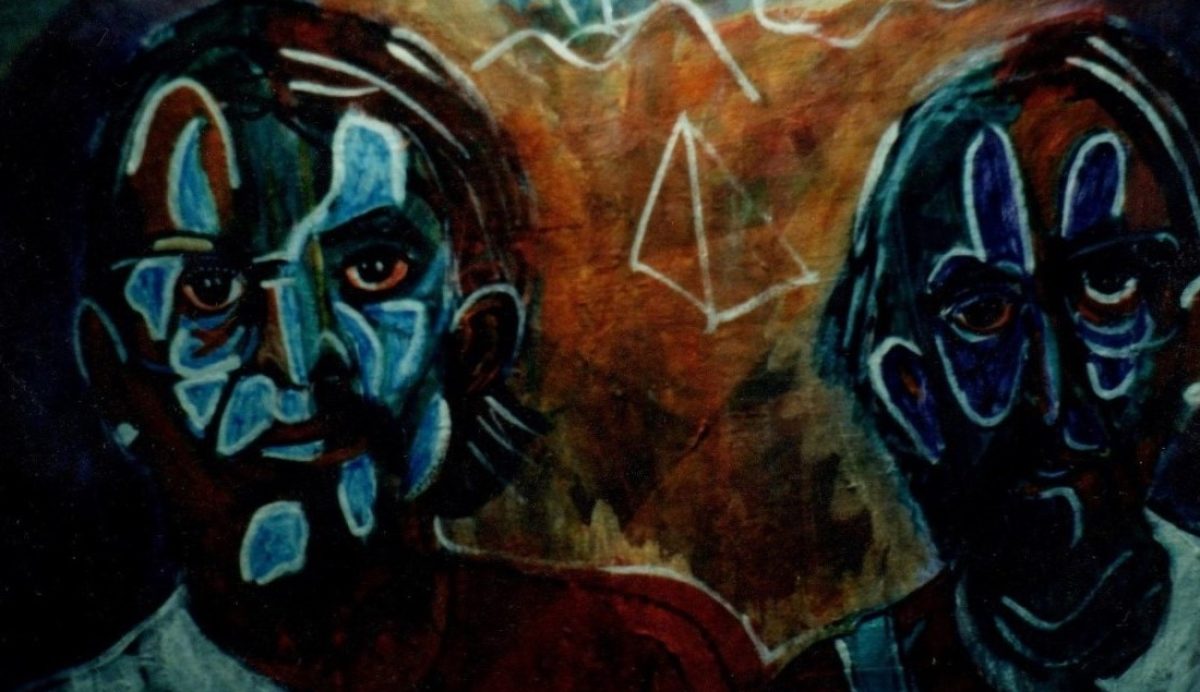
wan gowtu ati
a wan d' e taki
a mindri wi brudu
lek’ wan oloysi f’ a ten
awansi dede e kon
- Johanna Schouten-Elsenhout
from “Gowtu Ati”/ “A Golden Heart”
At the Piarco International airport, Trinidad, it’s getting harder to tell the
purpose of travel for outbound passengers. Used to be you could gauge
intention by the measure of bundled support and sentiment in the lobby:
families huddling, wishing the traveler safe trip, whether the flight is for
leisure, business or golden opportunity. Airport security procedures now
interrupt departure gate rituals for everyone. Besides, the world and its
transports pour in through multiple electronic inlets, stripping travel between
island and continent of that intuitive leap overseas.
For travelers coming in to the island there’s a welcome stimulus in the form
of the “Arts & Travel” magazine found in the pocket of the cabin seat.
Caribbean Beat has been around for awhile, but its expert glossy packaging
might tempt visitors not to leave it behind as they disembark; and its wide
spread of content (art, literature, cuisine, music, environment) reflect the
seriousness with which editor and contributors embrace the Caribbean as
home.
Local newspapers, available for en route travelers to keep updated,
deliver commentary from tough, vigilant writers; like the columnist
Raffique Shah – clearsighted, grounded in experience, spiked with humour.
In that distinctive Trini word tradition, blazed by (the late) author Samuel
Selvon and (the late) columnist Keith Smith, Shah, who values truth, comes
across as a “mutineer” – against resident pomposity, vapor, rant.
Glimpses of ordinary life on the island might get your attention, as in this
paragraph, done with steeups and style (by Vaneisa Baksh, Trinidad
Express, 5/9/12): “On this hapless Hollis Street, a car has been
abandoned for years. At the corner with Bushe Street, a major thorough-
fare for those going to the Bus Route and the Aranjuez Savannah,
another lot of land has been left to become a garbage dump overgrown
with bushes. One day as I passed, I saw that someone had dropped off
four toilet bowls, lined them up like thrones looking out at passersby,
jeering it seemed, at the crap we have to take.” V. S. Naipaul-lite you
could say.
≈☼≈
So where and what with its born free coconut palms is Surinam these days?
As its colonial destiny took shape, the land shared contours with adjoined
dependencies, forming a triplet of Guianas (British, French, Dutch). The
structures and dispositions laid down in the colonial period could not have
been more varied. The Netherlands granted Surinam its independence 30
years after territories in the region gained theirs.
Unlike Trinidad, it seems frugal with humour, though advanced in
courtesies; and just as unrestrained in costumed (Arrival or Abolition) street
celebrations. Once regarded as a country of placid order, easily overlooked,
Surinam, in recent years has begun to reconfigure its relevance and position
of influence in the region.
Paths of development are uppermost in the minds of “progressive”
individuals you might encounter in Paramaribo. They’ve kept good
neighborly eyes on French Guiana, still a dependency; on Guyana, stuck
with delusions and foul play stench (awaiting cleansing agents or satire).
In Surinam, which offers surfaces of a benign multi-ethnic getting along,
contrasts have yet to sharpen into the identity issues that often uncover
fearful assumptions.
You might detect, however, a new stridency of tone among the
“progressives” when they speak of the former colonial power. They sense
a patron-saintly readiness from The Hague to assist, and at the same time
a wish to leverage the inequities of old relations. They would move step by
step to decouple Surinam’s destiny from Dutch language and history, relo-
cate its future nearer the Caribbean and Latin America, close to those far
nations willing to invest. New links would introduce alternatives for tertiary
education, trade and economic partnership, vacation, language, romance.
Distrust of the shadowing Dutch canopy, a readiness to cast off in “truly
independent” directions, could exercise public energies across the land for
generations. Nothing is certain.
In the meantime, new “human capital” has swarmed ashore drawn to the
bells and the banners of “opportunity”: among them, opportunists, washed-
up carriers of inflated account; merchants of the cheap; oil riggers in search
of bullion; big shippers, high flyers; bold enterprise, new enemies; and an
assortment of terrestrial “others” who protect their interests with potent
hardware and software. All eager to help shape the way forward, all set
to rebrand and market.
Young Surinamese, working or not working, appear indifferent to all this,
the fables of “progress” made flesh. Could be they’re not "plugged in", not
mature enough to grasp or care.
At times clouds of speculation and rumor hover. Folks will assert – though
“it cannot be independently verified” – that the Americans plan to build a
new embassy (or watch tower). On acreage viewed as swamp land. With
foundation supports elevated 3 metres. Why there? What do the Americans
know about the land that the locals don’t yet understand?
≈☼≈
Dya mi bribi ankra mindri friman gron
ini mi eygi masanga
pe m’ e prey boskopu dron
a mindri den loweman bậna
dyaso mi ati doro man
- Johanna Schouten-Elsenhout
from”Masanga”/ “The Bush Cabin”
You might also find and enjoy the company of residents with different
passions; someone like Mr.Grauwde, a much travelled, urbane man with a
knowledge of wines and restaurants and citizenry in far-flung capitals;
and an appreciation of almost forgotten Olympic champion performers,
their special moments of glory.
Like Hasely Crawford, 1st champion for Trinidad, who came out of nowhere
to win gold (1976); who was honoured with a stadium and a postal stamp
and a kaiso ("Crawfie") in his name, but never repeated the success; and
Canada’s Ben Johnson (in the 80s) whose shoulder muscles bulged with rotor
blade effect, propelling him up and away from starting blocks; and the way
in his heyday (in the 00s) the toes of the American Justin Gatlin peck-
pecked the track like a panther’s as he raced to the finish.
Our much loved legend is Jamaica’s Merlene Ottey, an intense, coal-glowing
presence on the track; winning bushels of medals in the 80s and 90s, but no
crowning glory; cast off as an “aging icon” in 2000, only to recalibrate her
goals, “globalize” her passion and identity (new citizen of Slovenia); and
continue the pursuit of triumphs that eluded her. A fine, fierce champion,
you’d have to say, of choice and individual liberty from the Caribbean.
Ardor and dedication of a different sort you might encounter in the person
of D. France Oliviera, a Surinam resident educator, also widely travelled,
committed now to restoring and raising the profile of a Surinamese poet
barely known in the region – Johanna Schouten-Elsenhout. He has edited,
translated and written an introduction to what he considers her best work,
a book of poems, Awese, “Light In This Everlasting Dark Moon” (2010).
With little more than a high school education, Johanna Schouten-Elsenhout
(1910-1992) was well-known in her day as a stage and radio personality.
Her work was written and performed in Sranan, the Surinamese creole
language. Her fresh emergence in the region as a poet-performer invites
quick comparisons with Jamaica’s Louise Bennett (1919-2006); though there
are darker themes, grey hues of perplexity and resignation – with death or
“Lord Jesus” or the Awese felt as passageways of comfort towards
emancipation.
Still, D. France Oliviera believes that anyone wondering how and why
Surinam exists could start the search for answers in her moonlit (if not
technically accomplished) lines – like these from “Gowtu Ati”/ “Golden
Heart”: “A golden heart/is one that speaks/in our blood/like a clock shows
time/even when death strikes.”
Much like Jamaica’s Merlene Ottey, away and running, reinventing her own
destiny (and, too, the glamorous upgrade of the Trinidad-based Caribbean
Beat magazine) Oliviera’s tribute to a Surinamese poet sorting the nerve
ends of her tattered time and world must work its way through capricious
winds, sucking undercurrents; the sighting and promise of tangled destinies
ahead.
-W.W.
 FARJOURNEY CARIBBEAN