In the opening pages of Oonya Kempadoo's new novel "All Decent Animals"
(2013), the central character, "of mixed-race complexion", Ata, introduces
herself as "a nonbelonger. Unrooted in place and race and in herself". We learn
little about her island roots, she's so eager to get going; but she tells readers
she has walked away from "her village cocoon of books and dreaming"; she is on
the move, her new port of entry, Trinidad & Tobago.
She is a serious traveler, not exactly running away from desperate conditions on
her island home. Her aim is to give her life _________________
fresh purpose as an artist. "Practice and
apprenticeship" in some meaningful creative ALL DECENT ANIMALS
enterprise will get her there. by
In some ways her travel beginnings might OONYA KEMPADOO
remind readers of Saint Lucia's Derek Walcott's Farrar,Straus Giroux
nonbelonging ("no nation but the imagination"), New York, 260 pgs
and his later adoption of Trinidad as a place to ____________________
invest working ambitions. Here and there, too,
Ata pins asterisks to V.S. Naipaul's Trinidad birth place, and leaves footnotes
(like precedents) to "The Loss of Eldorado: A Colonial History" (1969)
Precisely when the events in the novel unfold is uncertain, until near the end
when a single comment ̶ "Did you hear they really going to hang Dole
Chadee?" ̶ offers a clue. Chadee, a reputed drug lord, was convicted of
murder and hanged in Port Of Spain in 1994. Had Ata made her move, say, in
the new millennium times, with the carousel of literary events across the
islands (like the Bocas Lit Fest in Trinidad), and cultural extravaganzas like
Carifesta, she might have found a community of cherishing conversations and
sites.
Unlike, say, the migrants in author Sam Selvon's fiction of 1950s London, Ata
is no stranger to Trinidad, and will not feel alienated and lonely. "All Decent
Animals" is packed with familiar markers of contemporaneity: politicians
(Patrick Manning, Basdeo Panday), kaiso performers (David Rudder, Mighty
Sparrow ), notable achievers (Brian Lara).
The "arrival" of these famous names in modern West Indian fiction could give
pause for celebration among some readers. Kempadoo might have missed out
including resident "writers". Perhaps they were too few or unaccomplished in
1994 to warrant inclusion.
There is, however, abundant island sentiment ("Trinidad sweet, boy";
"Singapore of the Caribbean, my ass"); and local commentary, from the
unavoidable airport taxi driver, Sam, who brims with taxi ride insight ("Every
day is the same nonsense, yuh know") and caveat ("Where you going ̶̶ is up a
hill? because my car does cutout on steep hill"). Sam plays an important role
shuttling her between the economic and class dividedness she enters.
Kempadoo's Trinidad (Port Of Spain) is presented in lush recognizable strokes:
abundant oil, "fete after fete", fellas, city pretensions, the hills, the South,
Panorama. Though some scrutinizing agency is certain to complain that that
quiet elephant, their ethnic "presence", standing apart in the room, is barely
acknowledged amidst all that happens in the novel.
Ata arrives as carnival preparations are in full swing. Determined to reject
"alien European attempts to draw out the talent in her hands", she walks
"straight into Camp Swampy", a carnival costume center. Years later (we leap
forward in one sentence) she will move on to a drawing board in "Roses
Advertising" art room. She will spend the rest of her "apprenticeship" there.
Living on the outskirts, in the non-carnival part of the town, is Fraser Goodman,
a "returnee" from England, an architect "from good middle class Trinidad stock".
He throws parties that provide the milieu for the mingling of expats, profess-
ionals of diverse race, persons of local stature; and for liaisons and insider
chat; that is, until he falls victim to the Aids virus.
It is at one of Fraser's parties that Ata discovers a love interest. The relation-
ship starts with suspicion, then cautious flirtation on Ata's part, but in
audacious quick time the romance blooms; then sails off ̶ on a "fake honey-
moon" trip to St Lucia, staying at once luxurious hotel overlooking the sea; and
a trip to the south of France, the landscape of Pierre's childhood days. Fast,
swinging times for our island girl.
Pierre, the boyfriend-lover, had been sent from HQ in Geneva as a UNDP
representative, his mandate (when he's not romancing Ata) to meet with local
representatives, review draft reports, like a paper submitted to him on
Trinidad's "Millennium Development Goals".
His observations on the local reps (they're fond of "conferences" and the
refreshments served after) are just short of UN charitable; but Ata provides an
emotional link to the island. We learn of the strength of "their love, [their]
compatibility in bed, in taste, humor and intellect" .
It gets to a point where Ata reports feeling ostracized by her disapproving
"Afrocentric friends"; and Pierre, as spiritual guide, starts thinking maybe Ata,
"his surprising love", could do a lot better, engage brighter suns, by rejecting
the "prancy, peacock island" of Trinidad, and making a career move (with him,
since his contract is up for renewal) to the art capitals in Europe.
≈ ≈ ≈ ≈
Though not evidently "conflicted", Ata soon loses sight of her original purpose.
The novel zips along with nervous excitement, perhaps to reflect her off line
speculations, as well as the hectic Carnival season. Then Fraser, the Aids
victim, relapses and is on near-death bed watch; and Ata finds herself "spinning
from one thing to the next". Readers are pulled along by hurried, often sketchy
segments that cut back and forth in an effort to capture the disarray of
intentions.
Trinidad's vibrant carnival scenes, the beauty of island landscape, are
rendered in images of appropriate colour and exuberance. The
characters in this her third novel seem more grown-up and unsettled,
with a lot more on their minds (Kempadoo is less interested in
"complexity").
Sexual arrangements are shown with a decent restraint, 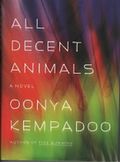
maybe not enough to please the sacred hearts of island
readers. Very much present, though, are Kempadoo's
snapped silhouettes of underclass shameless grips, as when,
for instance, Ata stumbles on a copulating couple near a
pan yard: "the woman's head, bowed, bumps on the
cutter man's shoulders as he pounds into her."
Eventually, as her "apprenticeship" in labour and island
love moves around, readers might start wondering: what's
to become of the "unrooted, nonbelonging" Ata? Has she
lost the focus of her creative pursuit?
Towards the end of the novel she wakes up one day to discover blood on her
leg. She's been seduced, bitten. She assumes it's the work of an island spirit,
maybe a Lagahoo ("he does bite woman leg and suck blood"). Several pages on
she makes this startling disclosure to Sam, the taxi driver: she has started
writing ̶ "it's almost as if he [the Lagahoo] is in me."
So for anxious readers it seems settled: Ata has been smitten: "this is what she
was meant to do with her hands ̶ write".
Some readers might be jolted by this divine-like intercession straight out of the
vampire warehouse. Others, familiar with local folklore, might sigh and pause
to consider: after all the flirtations, the tamboo-bamboo of mind and body,
our girl, Ata, seems on the verge of going home to her village beginnings; or
rather, staying home ̶ with her "books", but dropping the "cocoon" and the
"dreaming".
Was it worth the effort, you might ask, following her around, listening to her
heart's pan beats, finally to confirm her creative repurposing?
Oonya Kempadoo's first novel, "Buxton Spice" (1998), won (almost smothering)
praise and admiration for its innovative use of island Creole idiom; it's close to
the style and cadences of emigrant author Sam Selvon, but more free-spirited,
with fresh pulse. Then there's the flow of energized scenes that bore witness to
youthful desire and curiosity.
"All Decent Animals", very much an intimate book for the islands, starts off
captivatingly (in the sentences there's an urgency to succeed) but the novel
gives up on the big frame, the last lap finish, and settles for a latticework of
mini-scenes, switching situations fretfully; with spikes of intervening calamity
(murder in the the taxi driver's family, the intractable Aids issue of Ata's friend;
Ata's lover, Pierre, who surprisingly goes missing, prompting a police investi-
gation).
It's as if the author had in mind asking readers to assemble the bits and pieces
into a meaningful "literary" pattern - the characters stepping out of one
dimension - but then decided abruptly to leave things as they were, the tableau
fading out in heart-tested inconclusiveness.
All said and done, at the heart of the storylines ̶ the unfurling of personal
freedom, the belonging/"migration" theme ̶ lies Kempadoo's concern with the
fulfillment of ambitions at home, not "abroad"; an inquiry played out on a
canvas of inter-island adventure, romance and misfortune; in keeping, perhaps,
with the new millennium passage of "Caricom" citizens, moving freely from
island to island in search of fresh start opportunities, or a safe haven for
retirement.
The question for devoted Kempadoo followers: will Ata, her newest creation,
follow the V.S. Naipaul post-Empire trajectory and eventually beat a path to
Europe; or will she make the islands her permanent home, without bitterness
and regret; sharing good writer fellowship with, say, Trinidad's senior author
and dragon-player, Earl Lovelace (who doesn't get mentioned here)?
It all depends on how serious and penetrating the bite on Ata's leg was, that
tell-tale mark of emancipation left by her mysterious jumbie-muse.
In the meantime, the author's loving and much-loved cast of rooted island
characters can only stand by, beguiled and sweating; so ready to chip again in
her band.
– Wyck Williams
 FARJOURNEY CARIBBEAN