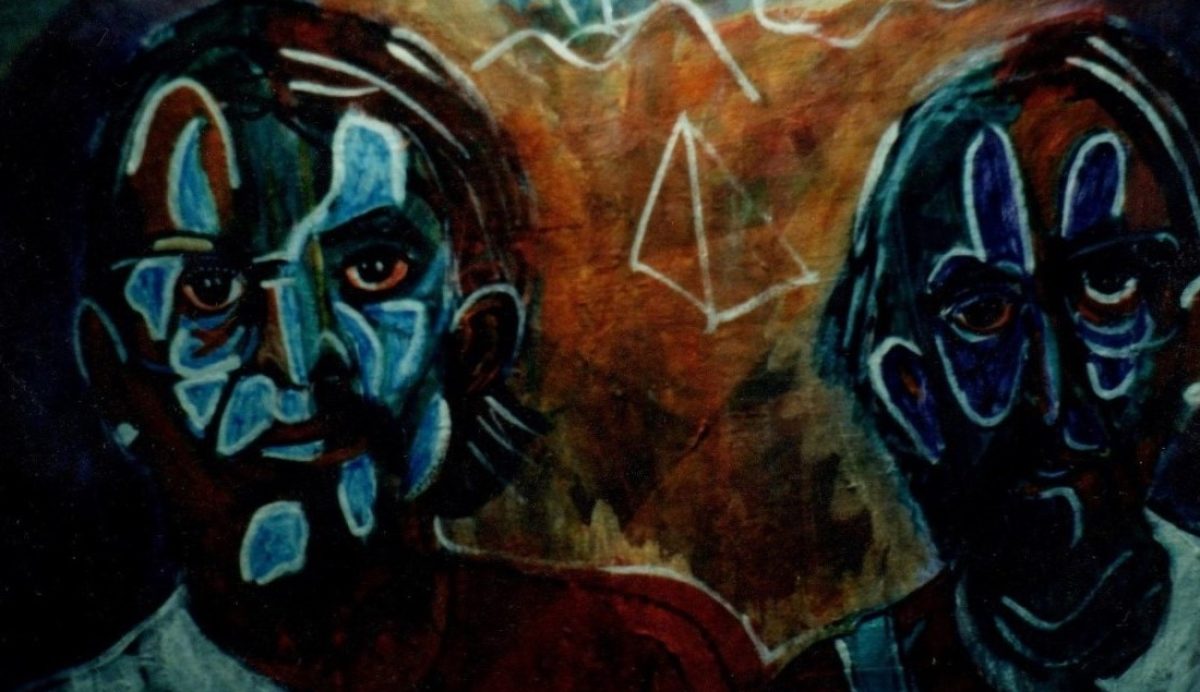
When he entered the University of the West Indies (Mona, Jamaica) in
September 1968, his name was Michael Hutchinson; from a privileged white
family, a former student of Harrison College, Barbados, one of the island’s elite
high schools. When he returned nine years later to his island home he had
changed. He was Ras Ikael Tafari, lush beard wearer of his new faith; and fierce
believer in the prophetic eminence of Haile Selassie I.
He would join the faculty of Social Sciences UWI (Cave Hill, Barbados) as
lecturer. From his campus base he would become active in Pan African affairs,
joining the Pan African Commission in 1997. In 2004 he was appointed its
director. He died in May 2008.
Had he chosen a different island campus (say, St Augustine, Trinidad) or Faculty
Medicine) he might have been sufficiently insulated from events and tempta-
tions during the Walter Rodney street upheavals in ‘68. So volcanic was that
event it would take many years for the fallout of cultural values and
assumptions to resettle.
A rearrangement of social boundaries between blacks, browns and
whites was in full swing in the island in the early 70s. Many
students, carrying the heaviness of parental expectations, elected
to rise above the turmoil. They stayed focused on tertiary aspirations,
arguing, This is not my island; no need to get involved. It seemed a
rational, commensense approach. It was adopted by, for instance,
many Indians from Trinidad, many blacks from the Bahamas.
Ikael’s immersion in the Nyabinghi faith ̶ or how he became
“radicalized” ̶ was gradual. The first signs of inner transformation
were the changes in his features: from a clean-face innocence to
facial hairness and marijuana’d eyes; his general appearance
roughened-up as if to blur his distinctive island origins.
His language and modes of communing slowly altered. The tools of academic
discourse were put aside or interspersed with the messianic I-Words of Rasta
I-Manity. At times a self-conscious smile played on his face seeming to question
what he was doing; how he was entering himself, seizing the moment on the
island.
≈ ≈
” My whole life changed…when I went to Jamaica,” he would say later. In many
ways those were extraordinary post-Walter Rodney days. Youth culture had
been at the forefront of rebellious activity in European capitals (Paris in ’68).
Some of that youth optimism carried over to the 70s in Jamaica where praises to
‘de youth dem’ formed part of an ascendant reggae romanticism.
At the same time a unique confluence of brilliant teachers, students, pioneers
in thought and creativity had emerged in Kingston; young men and women in
the prime of their intellectual & creative life: among them Vaughn Lewis,
Kamau Brathwaite, Rex Nettleford (professors); Owen Arthur, Bruce Golding,
Ralph Gonsalves (students) Bob Marley, U Roy, Count Ossie (music pioneers).
With minds & talents functioning at their highest capacity, the campus was
bright with ideas for changing the course of Caribbean history and politics. Few
were aware of the roles and destinies they would later be asked to fill.
Among his friends Ikael encouraged a kind of introspective “reasoning”, a variant
of Walter Rodney’s “groundings” with the underclass. They were in effect inter-
personal (I & I) “conversations”; confessional at the beginning, speculative
often; filled with disruptive insight and hypothesis.
Listening. you sensed his anxiety about his blue-eyed identity, the “sins” of his
privileged upbringing. He worried, too, about his postgraduate role in an
intellectually unaccommodating region – how would he fit back in? Jamaica
offered a laboratory for experiment and redefinition. After Rodney, “conscious”
students pursued the wayward possibilities for (self) discovery by venturing
outside, into the wards and valleys of Kingston.
His conversations gave early indications of what he would later become: the
good shepherd of the Nyabinghi, its philosopher-scribe. Not just giving
intellectual validation to the faith, or working in an advocacy role (as trade
union rep, or academic housekeeper). He believed the Ras had the power to
transform & rebuild the region’s human resources after the depredations of
plantation. “Rastafari is the most important consciousness to have arisen in the
20thcentury.” he’d said. The House of Nyabinghi would be his psychic fortress.
Tiny ironies caught our student attention. Though the island “masses” listened
to the proactive message in Bob Marley’s Get up, Stand up, and wept when
they remembered Zion, their hearts ̶ believing deliverance would come from
above, not from abroad ̶ felt comforted singing along to the frustration and
hope in Max Romeo’s Let the Power Fall on I.
Our minds turned often to issues of island sexuality. How to explain the nexus of
the unreflecting, carnal male, the luscious women, batty bwoy repugnance?
There were readily available theories linking behaviours to ‘persistent poverty’,
ignorance, unemployable rude energies, the groiny power of the powerless; or
the island’s peculiar legacy from the plantation, its testosterone blessing
and curse.
Whatever the cause, Ikael was confident self-destructive practices and norms
could be changed, communities rehabilitated; change would begin when
islanders looked to Africa and embraced the transforming values and majesty of
the Ras.
≈ ≈
In 2003 there was news he had launched a book, Rastafari in Transition: Politics
of Cultural Confrontation in Africa and the Caribbean (1966-1988) Volume 1.
He talked about the unfinished nature of “my work”; the dry interest shown by
an old-thinking UWI academy. He issued apocalyptic warnings: “We are in the
last hour of time. Look at Daniel 1, read from verse 36.”
Then came his appointment in 2004 as Director of the Commission for Pan
African Affairs ̶ “I have waited a long time in my life for the opportunity to
make this contribution.” ̶ and the trust placed in him by the Barbados Govt.
The appointment was met with disquiet even in Rastafarian circles. Angry
messages questioned whether a white Barbadian face was “truly representative”
of Pan African affairs in Barbados. (In 2008 it was reported he’d been “fired”
from the position.)
Ikael spoke of death back then with the coolness of indestructible youth, as if the
lining of his lion heart would ward off the encroachment of mundane infections.
(Statins and cholesterol were not yet a conspicuous part of the vocabulary of
physical wellbeing.) Belief in the power of Jah, in the moral universe of the Ras
would form a natural mystic firewall, unbreachable by the diseases of Babylon.
It is tempting to consider his state of mind in his last hour on earth. From all
accounts he had gone to Trinidad to deliver a lecture on African Liberation. At
some point he complained of feeling unwell and returned to his hotel. He was
found unconscious in his room, and pronounced dead at the hospital (apparently
of heart attack.) It is difficult, then, to imagine the conversation with himself as
he waited for that gathered cardiac storm to pass; as he slipped from “conscious-
ness” into that silent zone (or Zion) of the hereafter.
He was an extraordinary individual in a time of extraordinary events. He dared as
student to leap into realities outside theory & textbook, mastering the
knowledge he found there. He seemed determined to redirect the narrative of
his life, to construct a new persona fusing elements from the African continent
and his disassembled island psyche.
Those who joined his conversations will remember the way he showed up after
days of island trod, looking loose, street-weathered, the blue eyes ablaze with
new I-World “visions”; his metamorphosis in fevered progress. Sceptical as some
of us remained, the conversations helped adjust our thinking about the world.
His evolving faith-based sureness of self threw light on roads not taken, the
labours of One Love gone now.
It was good and pleasant to know him. In those seminal student years he was Lion
of the void. Yes, I.
(A version of this post appeared elsewhere in 2008)
 FARJOURNEY CARIBBEAN