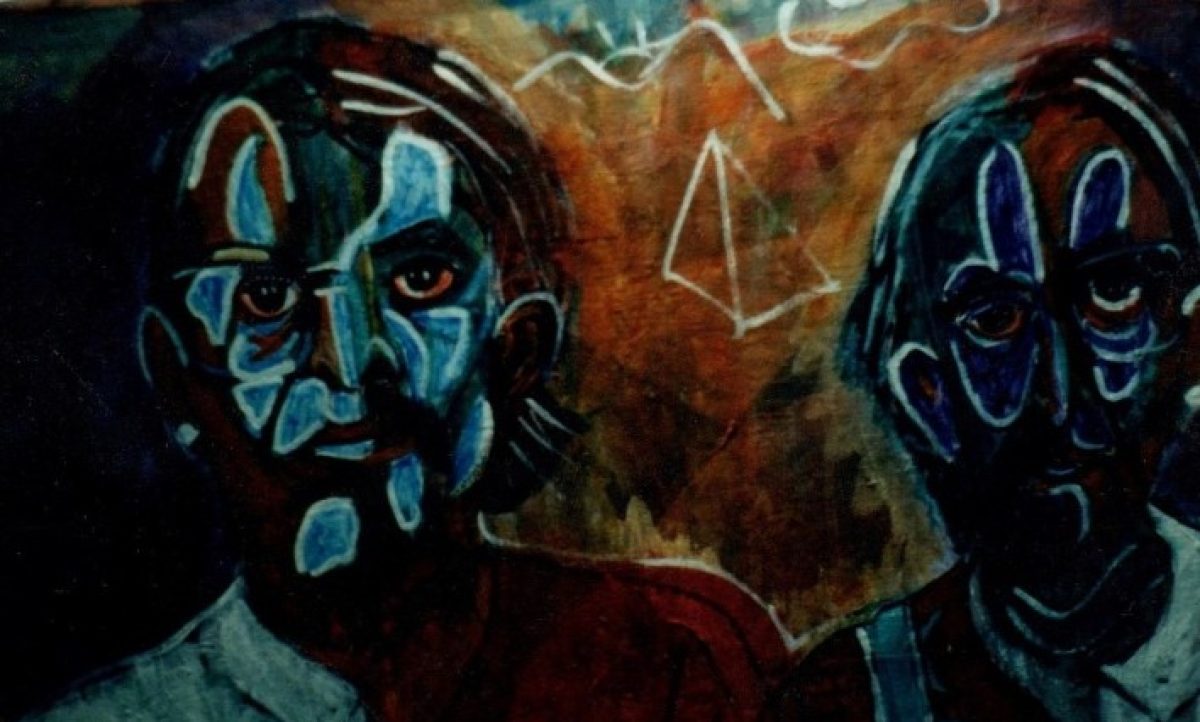
SERENE . NOT ALWAYS THERE


                                                          "It was a feeling of need and perturbation and sadness she
                                                                could not account for  ̶  an acute spirit of meeting and
                                                                parting and of eternal distance that was still nearness."
              
                                                                     – Wilson Harris, "The Whole Armour"


              Beyond serve nerves of steel they claim could insulate space rafters,
             observe the player who brings to net no practice in fame holding.

                  "She tends to drift away, lose focus . doesn't want the win that
                   bad." Lean in : the deer hunter's third eye has opened runway
                   clear through sport page leaves . it heeds the conch alert. 

            Face towels gauge the sun's stake hold, that glare never in doubt
            in search of sag point. Moon shot bellows vapor risk. Galleries row
            packed look on cheer swizzle chat ( > one day lisp fade away).

            "But in the middle of a thought . sex . congregation? Call that good
            timing?" On any stage for the good of the flow churn units break,
            prayer bows pin east; chambers redress a breach head on its way.
                 Yo, who caught the future's wink? 

                                                        *

            Pointillion pixels screen the frameless face sometimes near
              tears. Grass clay take note as wrist snaps back ace makers,
                as hearts draw string speed muscle tight : Boy, chase that
            called out burner.(Even in good seats the old body frets.)


                                             On side switch light might amble in
            a miss fit toss time out : some star far set in motion world code
            centres scent implosion; just so the cause unknown bests shade
            index.
                            Not over
 ̶  valley riffs leaps above dance invocation
           
in the fault box  ̶  around in lead feet turn : optics refit, arms paid
            dear for the end swing whack. 

                              Ordinarily, tugging the tail of the tiger, we'd go: I need
            a moment : enter the pain shed . pride thigh wrap  
̶  there, now. 

                                                                                        – W.W.


                                INFLUENTIAL EFFLUENCE

                                Yes, all must fade, but those who would not  ̶  except
                                as form-shifting stars with their effulgence not 
                                limited by labels of 'burn-out' or 'fall'  
                                        (which are masks of fear,
                                   failure and final loss),
                           
   stars whose new scrawls figure form's humbling fate but
                               on as many night-slates as there are eyes ripe
                               to become conscious sparks of undying Light  ̶  
                                        those who would not fade
                                   determine to relay  ̶  
                               to our still breathing world of both reluctant
                               and willing witnessing  ̶  their lives masked as knots
                               of nests of eggs to be untangled and hatched
                                      by brooding midwives 
                                  of births beyond the self,
                               births that restrain the self's egg to so release
                               its ripeness from its stubborn shell that would keep
                               failing, burnt-out, falling ideas of its form
                                       which, fading, must kneel
                                   to stars that pass to stay.

                                   (from "Readiness" by Brian Chan) 


JOHANNA SCHOUTEN-ELSENHOUT (1910 – 1992)


         "Awese is the name of the second ranking deity within the sky pantheon
          of the African Surinamese religion called Winti. This deity bestows
          healing powers and clairvoyant abilities to his devotees and mediums.
          Awese also refers to an abstract force that can best be translated as a
          conciliatory, healing and liberating power in human affairs."                                                       

                              – D. France Olivieira                                                                                     


         AWESE                                                                                                                                                                                                                                                            

        !Kabra.                                                                           
       troki gi den afkodreyman
       a mindri n' akapudyari
       pe fodu e lolo
       nanga santi ini en ay
       lek papawinti
       a mindri n' aladey son
       Wiki den mi kabra
       ini a dofokanpu
       mindri a doti f' Sranan
       troki mek' kromanti
       sekete nang' a pingi fu mandron
       a mindri den awese
       prisi a gronmama                                               AWESE            
       opo frey mi nengrekopu mindri a watrapan                                       
       A ten e kot' a greb'olo                                       Ancestral Spirits, Kabra-ô!
                                                                               send out your call-song to the adherents
                                                                               in the open tenement-yard
                                                                               where the fodu snake writhes
                                                                               with sand in his eyes
                                                                               like the papawinti
                                                                               during the heat of the day.
                                                                               Shake them up, my kabra,
                                                                               those in the ritual huts
                &
#0160;                                                              right down here in Sranan.
                                                                               Sing-call and let the kromanti spirits
                                                                 dance the sekete at the beat of the great drum  
                                                                               among the awese.
                                                                               Pay homage to the earth goddess
                                                     and then fly off, my black essence, over the water pans.
                                                                              Time is already digging the grave's hole. 


                                                                   *


       PE MI TANAPU                                            WHERE I STAND

       Pe mi tanapu                                             Where I stand
       ini a futmarki f' mi winsi                             in the footprint of my wishes
       ef' ini wan swanpu f' bigimenbre                 or in a swamp of conceit
       d' e freyri mi a tap' wan tiri dungru pasi      courting me on a quiet dark road
       d' e fet' fu broko mi saka a gron                  that's trying to get me on my knees

       Pe mi tanapu                                             Where I stand
       ini wan bâsman kapweri f'mi dren               in the grip of the backwoods of my dream
       d' e sor' ensref' lek' wan bigi gowt'busi         presenting itself as eldorado
       fu basra mi ati nanga fur' winmarki             to tempt my heart full with assurances
       a mindri wan faya sabana                           in the middle of a hot savanna
       di brad' mofo sondro kaba                          with its mouth wide open without letup.

       Pe mi tanapu                                             Where I stand
       a tap' wan ston pilari f' makti                      on the pinnacle of power
       d' e dwingi mi fu weg' ati                            forcing me to weigh the pains
       fu dedeyuru di ankra e wakti mi                 of my approaching death hour awaiting me.
       Pe mi tanapu
       grontapu libi                                              Where I stand
       Pe mi tanapu                                             There's life for you!
                                                                        Where I stand.


                                Poems from 'Awese' copyright © by Johanna Schouten-Elsenhout Estate, Paramaribo, 1965
                                      Copyright this English translation 'Awese: Light in This Everlasting Dark Moon' © by
                                              D. France Olivieira, Paramaribo, Suriname, 2010


EVEREST PEAK : DIABLO HEAT


          Climbers past, not feathered for memoirs, relieved to be done,
          admit to weird post office dreams. They see savannah walkers
          carrying ballots like cement blocks in lines that wrap around
          Mt. Everest building . a freaking castle? on the mountain?
               "Si, señor!" . and pole flags victory clapping.


          They hear the grey skull scratch, Boy, up there not easy; chief stick  
          on teaming shaggy like sled dogs; while 'norita servers turn and toss
               hot plate complaint like wish bone out gorge windows.


          They brace as pledge cords snap  ̶  Ay dios mio! Where the fuck those
          people
going?  ̶  as tree limbs burst old empire banks put rusted cargo
               ships on notice : the salmon are leaping! man woman child
               steeping! steerage rules broke . writs sent out for repair.


              Plunge accounts like rum flow down : pre-dawn summit 
                  sightings  ̶  the palms of angels catching water
                       drips from cloud torn linings. 

                                                         *         

           Leagues past cigars and beards, our island shores : well, so it seems.
               Need lease? consider Petit Jamoon Bay . our Walcott sea sides
           noblesse drawn. You could by any home stretch of the imagination
               chest swell . I-ditate . bottom up the seasons bare.

               Full disclosure : we're capped in bottled thirst-slake drafts. Snow
               storms sweep blind . sift grain worlds resettling : just not here. 
           
               There you frost breaker dare you, plow the tomato red to green;
               our seed beds lay unburnished, sun rain night time mean. 
                                                                                             But your pick 
           axe hooked that all the while, Mr. Marley. The best of us Google 
               now : iTag, mercy on us \ . 

 
                                                                                       – W.W.


                         ALPINE GHOSTS

                         Entire mountains can be erased 
                         by mere clouds

                                              loitering

                                                            on their
                              way out of being
                              their focus of none,
                         and, from reaching our next clear path
                         of Heaven, discouraging us 
                             with their slow grey threat
                             which our fading feet

                         nevertheless ignore to flesh out 

                         the echoes

                                        of the steps

                                                         of men
                         long dead, men long dead,
                         men long dead, long dead. 

                         (from "Within The Wind" © by Brian Chan)


JOHANNA SCHOUTEN-ELSENHOUT (1910 – 1992)


                                                  "A proud African-Surinamese rooted in the oral tradition of her culture

                                               she chose not to employ oral poetic techniques in her work, although
                                               she did utilize materials from that tradition for her poetic idioms,
                                               producing powerful poems in Sranan in a free style that sounded 
                                               conversational and fresh."
                                                                                       – D. France Oliviera


           KLORU


        No suk' a kloru f' yu buba
        mindri moysmoys' nesi
        suk' en ini den kruyara a opo-Sranan
        No suk' a kloru f' yu buba 
        a fes' wan drikant' grasloyki
        suk' en ini Parakriki
        mindri den kasaba pransun
        a mindri a son  f' y' ati
        No suk' a kloru f' yu buba
        a mindri alatafal
        suk' en a Stondansi mindri den bugrumaka
        a lobi f' yu eygi kondre 
        No suk' a kloru f' yu buba
        a mindri birbiri
        suk' en a Kosu mindri den bato
        No suk' a kloru f' yu buba
        a mindri den patata-bedi
        suk' en a brabakoto mindri SsÂbeni gongote 
        No suk' a kloru f' yu buba
        a dipi se mindri den sarki
        suk' en a mindri den nengrekondre pepresiri
        te doro gron f' y' ati 
        No suk' a kloru f' yu buba
        nanga leygi ay mindri kowru libi
        suk' en ini winti nanga alen mindri den aleysigron
        No suk' a kloru f' yu buba
        mindri den asema brudu
        suk' en ondro a pangi ef' sari f' yu mma
        No suk' a kloru f' yu buba
        lek' bigimenbre krabdagu
        a mindri akademi-sturu
        suk' en sondro f' afront' I yeye
        mindri Sranan udu bangi
        a mindri yu eygi kra            
                                                       THE COLOR OF YOUR SKIN        

                                                       Don't look for the color of your skin
                                                       in a mice nest
                                                       look for it in the canoes upriver
                                                       Don't look for the color of your skin
                                                       in front of a three-sided windowpane
                                                       look for it in a brook
                                                       amid the shoots in the cassava garden
                                                       in the sun of your heart 
                                                       Don't look for the color of your skin
                                                       in a rat trap
                     look for it at the Dancing Stones Falls amidst the bugrumaka palms 
                                                       in the love of your own country
                                                       Don't look for the color of your skin
                                                       in the underbrush
                                                       look for it in Kosu among the riverboats
                                                       Don't look for the color of your skin
                                                       in the potato patch
                     look for it on the smoking racks, at Sistah Abeni's gongote dance party 
                                                       Don't look for the color of your skin
                                                       in the deep among the sharks
                 &#01
60;                                     look for it among the seeds of the guinea pepper
                                                       down to the bottom of your heart
                                                       Don't look for the color of your skin 
                                                       with empty eyes in this cold life
                                                look for it in the wind and in the rain in the rice field
                                                       Don't look for the color of your skin
                                                       in the blood of the vampire
                                                       look for it under the wrapper cloth
                                                       if it's large enough to cover your mama
                                                       Don't look for the color of your skin
                                                       like the spoiled brat at the shrine
                                                       look for it without offending your yeye soul 
                                                       among the wooden benches
                                                       right in your very vital soul kra 

              
                        Poems from 'Awese' copyright © by Johanna Schouten-Elsenhout Estate, Paramaribo, 1965
                                      Copyright this English translation 'Awese: Light in This Everlasting Dark Moon' © by
                                              D. France Olivieira, Paramaribo, Suriname, 2010


NEW PROPOSALS TO NOT JUMP OFF THE JETTY


           Cabinet will commission sentry line palings for the seawall
           so quick break! you wouldn't wave dive . go oil thiefing . perish
           and embarrass the thought. They hold you so dear. 

           Newspapers are working to not bad spell your name
           when headlines report you missing . while weeds, verily they say,
           engrave the stone.

           City Council will over pave the old Dutch canals . design
           bicycle lanes for youth access to specialties in vanity and vein  ̶   
           heir to estate royalty and drain.

           Chinese built pump platforms will enable lift lag balloons : retail
           bamboo flare up rods for won't fly rooms; test more with less.

           Cabinet will cordially invite British monarchy to consider retirement
           on a horse ranch : equestrian smiles from the Venezuela border. For so
          
God saves the gracious.

                                                                   < First, run checks 
           how all that works for you. And give thanks  ̶  if you go dead
           comrades won't
 thank you, yea though they walk.

                         Ships have deep space gone before > rest assured :
           dust to done nothing out there veers for mating. Stars like bullion
             mast the rig wind regardless. In crafting passage the leap clears 
               from a raft of temptations as the eagle at daybreak discovers.

                                                                                          – W.W.


                            ADDICTION

                            I:  

                            A dash to the edge of a cliff  ̶  to brake,
                            his wings unopened, and to turn back,
                            sighing at having survived again
                            this game of attempts, of determined doubt.

                            II: 
  
                            All is habit, except the habit
                            of none. And what lean logical men can
                            say of that is the fattest habit yet.

     
                   (from "Scratches On The Air" by Brian Chan)


JOHANNA SCHOUTEN-ELSENHOUT (1910 – 1992)


                       "Ms Schouten-Elsenhout was not "discovered" as a poet until she was almost fifty

                        years old, when she had, as she herself stated, 'never before read a poem nor
                        knew what a poem was'. Born and raised in an oral culture, she chose to write 
                        in Sranan, then considered a "non-language."  She showed that one could also 
                        express complex literary/poetic sentiments in this despised vernacular."   
                                                                                                               – D. France Oliviera


     SWETI                                              

     Mi nyun oloysi                           
     nanga prakiki                            
     di brad' en ffrey a tapu              
     di m' win' lek'                            
     nomru wan a pren                     
     bigin nak' yuru                           
     e waka a baka                          
     agers' m' e firi f' go ler' swen        
     nanga koni a mindri faya      
     wins' a f' wandey prisiri        
     f' dukrun wan kefe               
     mindri a se f' asema brudu    
     f' marki                               
     soso wan enkri drop' sweti f' mi libi                    
     d' e lon lek' kowru watra a mindrisey
     frede bigin dangra mi                                    
     pref' mi fadon nanga doro insey                      
     mi dyonpo nanga tap'ay
     a mindri Srananliba                    AGONY
     di m' op' ede a loktu baka
     mi si tak' a owru Betkayn            My brand new clock 
     mi fen' mi srefi                           with spread-eagled lovebirds
     mindri a smeri                            on top, I won at the fair
     f' den srafu dedebonyo                starts chiming time
                                                       though behind time; it seems
                                                       as if I want to learn to swim with cunning in fire
                                                       even if for just a one-day fling
                                                       to dive for a moment into a sea of vampire's blood
                                                       to mark
                                                       just one single drop of sweat
                                                       of my life that courses like cold water at the center.
           &#016
0;                                           Then I was gripped by fear;
                                                       instead of falling headlong indoors
                                                       I jumped with eyes shut tight into the river.
                                                       When I surfaced again I noticed that
                                                       I'd popped up right in the old jewish cemetery
                                                       with the rank smell of the bony remains of the slaves 
                                                       clogging my nostrils.  


                                                                 …


                      GOWTU ATI                                     A GOLDEN HEART

                      Wan gowtu ati                                 A golden heart
                      a wan di n' e krey                            is one that does not cry
                      awansi a no e waka                         even if not walking
                      a mindri soso rosu nomo                  only in a rose garden

                      wan gowtu ati                                 A golden heart
                      a wan di n' e kibri                            is one that does not hide
                      a baka kruktu                                  behind injustice
                      te reti sor' en fesi                            when justice shows up.

                      wan gowtu ati                                A golden heart
                      a wan d' e taki                                is one that speaks
                      a mindri wi brudu                           in our blood
                      lek' wan oloysi f' a ten                     like a clock shows time
                      awansi dede e kon                          even when death strikes.   


                                Poems from 'Awese'  ©  by Johanna Schouten-Elsenhout Estate, Paramaribo, 1986
                                             Copyright this English translation 'Awese: Light In This Everlasting Dark Moon'
                                                         ©  by D. France Olivieira - Paramaribo, Suriname, 2010


Review Article: CHINAWARE IN PLANTATION GUIANA


           Pleading to be saved, Guyanese writer Jan Lowe Shinebourne seems locked
           in a mind shaft of her own preoccupation, unwilling to step out for air or fresh
           direction.

           Her latest book, "The Last Ship" invites readers to follow once again the
           tribulations
 of Chinese immigrants  ̶  whose narrative is still considered
           "overlooked" and in need of "recovery"  ̶  to the colony of British Guiana.
           (For richly insightful work on the Chinese in Guiana, readers are best served
            by Trev Sue-A-Quan's "Cane Ripples", 2003 and "Cane Reapers", revised ed.
           2003)

           "The Last Ship" (2015) sets out along familiar     ________________________
            Guianese memory routes. The main character,
            Clarice Chung, leaves China in 1878 speaking             THE LAST SHIP
           
Mandarin and carrying "heirlooms…silver coins                  by
            and a purse of seeds of the plum tree". When
            we join her In Guiana, her Chinese husband           Janice Lowe Shinebourne 
            has died and she runs a shop in Canefield,
            Berbice, with the help of her eldest son,                    Peepal Tree Press
            Frederick.                                                         Great Britain, 2015, 156 pgs.

                                                                                   __________________________


She has suffered the indignities of the colony's character defining mores: 
           changing her name, no longer speaking Mandarin. Once, with land and 
           property in China, her family felt at ease; now they live "like animals in a
           zoo, to be pointed and stared at."
           

           She looks out on an arrangement of colonial types identifiable by groupish
           dispositions: black slaves and their Christian religion, the British ruling class
           in Georgetown; Amerindians presented and viewed in the streets as "exotic";
           the Portuguese running the shipping Industry, the Indians dominating the legal
           profession.

           Her heart's determination is simple: to raise her profile as a no-nonsense
           enterprising shopkeeper, and to assert a "pure Chinese" identity, untouched 
           by the ragged creole lives around her.

           But Frederick, the eldest son, has other ideas. Faced with shoppers unable to
           pay for goods over the counter, he introduces the colonial backroom sweet
           deal: the exchange of goods for sexual favors.

           When his mother finds out she's outraged; but in a move that could be
           interpreted as "counter-intuitive", she encourages her son to use condoms
           if he must fornicate (how he secures contraceptives in Plantation Guiana
           readers might hesitate to ask). And at the end of the day she counts the
           number of condoms discarded in the backroom, then resumes her ledger
           calculations.
 

           Eventually her son's carelessness (or willfulness) leads to the birth of a mixed
           race child. Clarice decides a suitable Chinese bride must be found if the 
           purity of the heritage line is to be maintained. Marriage into a Chinese
           family (doing well in "restaurants, groceries, bakeries") would also help firm
           up her social standing.

           A prospect is found but the girl who presents herself, Susan Leo, proves unsuit-
           able (she looked Chinese "but she was dressed like an East Indian"). Clarice is
           poised to reject, but her son protests: Susan Leo is just the woman he'd been
           looking for.

           Apparently, he's been cultivating faraway desires, collecting photos of white
           Hollywood movie stars  ̶  Claudette Colbert, Joan Crawford, Rita Hayworth  ̶
           which he kept pasted on the shop walls. Susan Leo is acceptable since she
           bears close resemblance to the American actress Jane Wyman.

           Stop for a moment and imagine what a young V.S. Naipaul might have done
           with this steamy family dynamic  ̶  the lacings of irony (mute on anatomical
           intimacy); the balloons and bubbles of delusion (the agendas of a swollen self-
           importance). Or a young Jan Carew, layering his sentences with descriptive
           extensions. 

           Shinebourne shows little interest in evoking the inner lives of her Chinese
           characters, or in fleshing out the spiritual contortions of their new residency.
           "The Last Ship" is earnest about its heritage excavation. No humour here, no
           tales worth 
extracting about "Sex and the Plantation" down there.

            Halfway through the book (page 80), when Clarice Chung realizes her "pure
            Chinese" cause is almost lost, she dies. At which point for this reader the
            narrative loses its drive belt and a compelling reason for continued
            engagement.
                  
               With the central character's intentions no longer in play (the matriarch
           continues "to live like a ghost in the minds of the family") events go scrappily
           down slope, with Shinebourne dropping names and cultural flags to indicate
           where the reader is at any given moment.                                   

            As the generations move from the village shop and the narrow village roads
            to new paved sequences of possibility elsewhere, Clarice Chung's offspring
            soon become victims of "rapid aging" and rapid writing. They get married,
            bear children and grow old.

            They occupy sites and times marked by the bell ringing of Cheddi Jagan, 
            Bookers Sugar, communist policy; "Indians and Africans tearing the country
            apart"; famous authors and singers (Albert Camus, Bob Dylan); college
            ambition and attempts at a life overseas shorn of plantation origins.

                                                                  *                  *


            Over her publishing years Shinebourne's fiction has laboured to awake or alert
            readers to matters of importance buried in Guyana's colonial and recent past.
            Somehow, though, you come away thinking: there's an absence of anything
            resembling "style" in her prose.

            So few situations in the book seem imagined; a great deal is, in fact, sparsely 
           "reported". Readers might ask whether anyone could have lived the lives
            portrayed. (Curiously, the multi-award author David Dabydeen moves in a    
            different direction  ̶  lush prose that sucks up "extravagant" lines, and dramas
            that often require a suspension of mistrust.)

            "The Last Ship" relies on short stretches of exposition, with flashbacks and 
            trips back providing readers with useful information. Conversation is scant, 
            and usually intrudes when individuals vent displeasure ("You can't give me
            Chinee gran'children. I want Chinee gran'children. You ain't Chinee, you is 
            half-coolie."); or when, as at a family gathering in England (in 1968), 
            characters offer living room argument and angst about new dangers back
            home ("He wanted to save the country from British colonialism, but it has 
            led to American colonialism now.")
 

            Near the end (in 2000) readers tag along when one of Clarice's grandchildren
            takes a trip to Singapore. She's determined to trace her family ancestry. She
            learns (from an old frail American historian) that the heirlooms brought to
            Guiana in 1878 were cheap tourist trinkets. Clarice Chung's ancestral artifacts,
            the armour for her striver's self-esteem, were the basis for false assumptions
            all along.

            With a clash like that of Chinese opera gongs, the last paragraph of "The Last
            Ship" announces closure for the book's ocean spanning generations: "As the
            plane took off from Hong Kong and soared into the sky, she felt as if her
            wings were spread and she was flying away forever from all ideological
            and ancestral ties, and she promised herself never to relinquish her freedom
            for such ties. Never."

            Some readers will thank heavens, and say Amen to that. And to any more jade
            worn accounts (part fiction, large part peripheral research) of ethnic group
            survival on the plantations in Guiana.

                                                                             – Wyck Williams


CUTS SHORT


               Eye witness heard Satira bounce twice on the spring
               board  ̶ 
gripping her phone . releasing fabric tear. A foreign
               correspondent recalls : The elephant in the city you ride 
               nobody sees
, lip bit whispers. And that was it : cloud permit, 
               lung swell . stay sail up . wind rush.
                                                    Old Kaie's foam spread mooring rocks :
               bundle wet wrapped in savings  >  from up there delivery.

               So sunned we called her Tarby; so bright she flew to London
               on scholarship and ultimatum . married . appointment in New
               Zealand. Two grown girls came back to visit Mom's first
               village, smiles of circle full on caramel faces.

               Heard Bolo passed . the village rubbish truck man? relayed
               Pavarotti tracks in his bath room after work : chord
               belt strong . tossed streamer-like arpeggios. Arm lift
               soaring searchers, breath masters, of the old universe. 

               Quiet touch smart swiper : so the chip subcools the muscle in
               mouse moves.

               Bug winged drone probe here for sky shield warping  ̶  source
               close call, line inland bare holding. 
                                                                          – W.W.


                           SPIRAL LEVEL

                           There is a certain moment of hell,
                               at whichever level
                                    the soul finds itself, 

                           blind no more and so no longer lost
                               when, standing at the last
                                     gate of its latest 

                           stage of accustomed darkness and pain
                               and about to climb in
                                   to a clearer zone,

                           it turns to cling to what it has known,
                               and falls or steps back down
                                    afraid to be seen

                           betraying those it must leave behind,
                               afraid of being bound
                                   by freedom's new bond 

                          to the choice between that groove and this
                              ecstasy, that stasis
                                  and this chance to rise.


                    (from "Within The Wind"  ©  by Brian Chan)


JOHANNA SCHOUTEN-ELSENHOUT (1910 – 1992)


                   "Johanna Schouten-Elsenhout (1910 – 1992), or Tante Jo as she was
                     affectionately called, was born in Paramaribo, Suriname, where she attended
                     middle school and learned English and German, though it is not clear whether 
                     she actually graduated. To have completed more than six years of schooling 
                     was quite a feat for anyone at that time but especially so for someone who
                     was both black and female. She later became a well-known stage and radio
                     personality who read her poems on the radio to a wide audience, both at
                     home and abroad (Austria, France,The Netherlands and Russia.)"  
                                                                                                    - D. France Olivieira


                   AMEMBA                                                   AMEMBA

                 Braka neti                                                Black nights
                 granaki ay                                                bright eyes
                 takru triki                                                turning tricks
                 a mindri                                                   on the cold ground.
                 kowru gron                                               Youthful years
                 Yongu yari                                                are seducing me
                 d' e kor' mi                                                while having fun.
                 a mindri prisiri                                          Death 
                 Sabana bromki                                          is staring at me 
                 di opo fesi                                                lets big dreams 
                 e waki mi so nya                                       show me
                 mek' bigi dren                                           a footprint
                 sor' mi                                                      where the morning star
                 wan futmarki                                            clears 
                 pe a musdey stari                                     the way
                 e trowe krinfaya                                       in the everlasting dark moon.
                 mindri a pasi
                  
fu têgo dungru mun 


  PREYGRON                                     PLAYGROUND


   A mindri a preydoti                         At the playground
   
m' e si a ten                                    I see time
   
e poko gwe a baka                           wobbling its way back in time
   
lek' wan dungru neti                        like a dark night
   
ini sma libi                                      in people's lives.
   
M' e si a wakt'oso                             I see the sentry box
   
e spuku mindri a tranga son             shimmering in the hot sun
   
ini pinaman brudu                           in the blood of the poor.
   
M' e yere den owruten                     I hear the past
   
abra wan se f' watrây                      across a sea of tears
   
e bbar' lek' dondru psa                     rolling like thunder peals
   
mindri faya                                     in between flashes.
   
M' e si den yeye f' disten                  I see today's souls idling about
   
e dray lontu                                    troubled by good and evil.
   
a mindri wan sorgu bagasi                I hear the lucky ones knocking
   fu
ogri nanga bun                  under a glass topped table at the center of the room
  
M' e yere fa den bakafinga               enjoying the sun
  
e naki ondro wan                             where sorrow strikes in the dark 
  
mindri-oso grastafra                        where I hear church bells toll
   
a mindri prisiri fu a son                    for God's sun
   
pe sari e nyan sapa a dungru            lighting up the playground
   
pe m' e yere kerki gengen                to free all our souls.
   e naki f' si gado faya                        
  
a mindri a preydoti                                                         
  
f' wi ala yeye kon fri


                                                                             *

                       Poems from 'Awese'  ©  by Johanna Schouten-Elsenhout Estate, Paramaribo, 1986
                             Copyright this English translation 'Awese: Light In This Everlasting Dark Moon'
                                           ©  by D. France Olivieira, Paramaribo, 2010


CLEARER SINS


                                                            "Had seen it before but now saw it again
                                                             as if he had not seen it before and as though
                                                             a new religious feeling (and response on his part)
                                                             arose from it."
  
                                                                  ̶   Wilson Harris, "Companions of the Day 
                                                                                                      and Night"                    
                                                                                                                                                                    
                  I.

                   
                  Of all this how much happened because he wanted us

                  so much to dazzle? through heat down stingy brim crown
                  governing days : Sunday drizzle making stroll thoughts scurry : it
                  might ruin his patent leather dues, washed pressed again church
                  shirt. Coin saver, bruising us : Be more.

                  On his bicycle air field straight ahead, the public road in strips,
                  our father could not know finch blue tendons had taken leave
                  of his fences; the village stilts . bitter rooting back and mud
                  dam! forth.
                  
                  He'd pedal high into sky canyons, far out to humorless sea wind
                  expansion. This was the path in trance he cleared for us, his way
                  out . full chest folding hug without  ̶̶  But why you always so?   

                  As night spread straw, shrugged insect bites . room lamp 
                  hush urge, his lust stern rites : Ma's receiver shift would yield
                  hold heave the maroon banana . green peel and flagrancy.


                  II 
 
                        
                  Braid tight high fibres recognize their kind  ̶  what vines
                 
face climbing find  ̶  the tree the river mountain rock.

                  III

                                At gravity's prompt home wages paid, one Welcome
                  nod was all : received : head still hard shoulders back to crop
                  sown brooding days.

                                He loved to hear  ̶  sight in retreat; does humming calm
                  as done hand shakes
?  ̶  how we'd turned out in capitals : London,
                  New York : so far from where the leaf blade willed . cane to punt 
                  bind grind molasses pointing . crystal vessels away.

                                Lot marks of wrist  ̶  who would believe some cursive            
                  
tissue dwelt inside this script? Own man who tended dreams
                  in tamarind, the stone prepares . sensing
 ̶  fates unclasped,
                  l
ast twilight ceding  ̶  eyes dried might watch the glow pass on.

                                                                                          - W.W. 


                                                      -   In mem C.A.  


                    THE POINT'S CIRCLE'S POINT


To be thankful for the pointing points
                 
  of breath itself is life itself given
             
         flesh of pointed mind and rounded heart
                
    ̶  though but one man's, the whole universe's;
             
           only one point in time, its centre
                
   in floating detached love for the circle
             
           it has seeded and allowed to sprout
                  
   dreams of its own, with witnessing dreamers
                   
      ̶  as a naked Winter tree still bears
                
   the eager memory of the return
                 o
f her dreamt and dreaming fruits of Love's merci. 

                   Look, the tree is empty but also full
                
       of the buds of bird wind cloud sky and
                
   a man's eyes becoming its fruit, the egg
                
      of the Sun unyolked by clouds, only
               
   to have its light filtered regardless pure
               
       across a morning so still you know
              
    it is still dreaming and still being dreamt
             
          ̶  as a bird quivering at the peak
                
  of an evergreen, affirms  ̶  in its flesh
            
         of gratitude for wings  ̶  that dream-flight
             
  by both glad circling and eager centering.

                      (from "Within The Wind" © by Brian Chan)