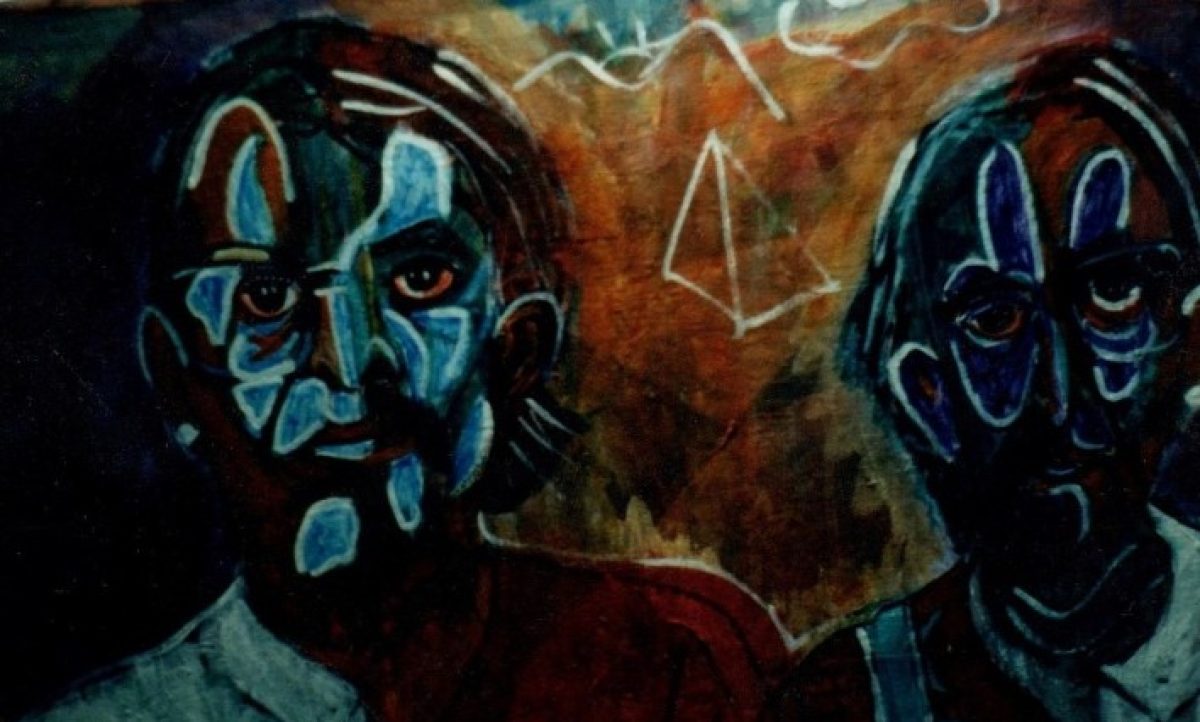
RIVERS MATING UP YOUR STAIRS

                                                                                      "You rock so, you rock so…
                                                                                        You come so, you come so…"
                                                                              
              – Bob Marley, "Lively Up Yourself"


              First time, before Sparrow's kaiso jams in the 70s,
               Jagger's pelvic rocks in the 80s, the sexual
                revolution spoke: near Hosororo: an Amerindian
                 maiden standing at water's edge, arms folded as if
                  waiting for traffic lights to change in a city of chrome rush, domes:

              across the river a young man, thin blade sharp; from Georgetown
                with its movies, bicycles, radio songs; fabled differences
                  now so near. Besides, not much to do: look after brothers
                    household chores, and mother grocery shopping in canoe;
                      saronged in tree leaves body urging, Come! 

              No ferry, paddle, choice but strip to briefs, go
                test my diving chops – the river half a street block wide,
                 suppose I drowned!
– arm over arm, runneling cross tide
                  and deep. Her calves & knees flashed, Hurry! not much time;
                   camoudi-like her mother from upriver might slip home.

              And that was it: ashore, half naked; assurance, longings bared.
              Sorry, no sweet man up details for you. Bet you're curious
              how we did it in the hammock;
              how I ignored forest muttering; stretched, released my new bowstring.

              Alone I had to swim back to the first far side,
              not the streaking eel this time, scared stranger again;
              only laced shoes, clothes folded on the river bank
              as evidence, had I not returned, I was there. For sure
              as tiaras from heaven she'd never tell; she'd swear
              she never saw that floating river swollen body before.

              In cities of seasons, stony trails to gold, women have been inlets
              streaming since, mate. Hand upon heart, I hail amazon waves.
                                                                                                   -W.W.  


                        A MOMENT

                                            is a blank ice
                        rink waiting either to be
                        skated over or to melt.

                        Afraid of what these blades might
                        groove blind beyond erasure,
                        I remain at ice's edge

                        till you emerge like a deer
                        out of a forest of black
                        to startle me with the light

                        of your eyes and the caress
                        of the song of your silence,
                        promise of water somewhere

                        flowing and flowing and flowing.

                    (from "Gift of Screws" by Brian Chan)


XXVII: CROSSING GUARDS

        At first there was a white crossing guard, a bespectacled woman in her sixties. She was
    quietly efficient, unsmiling; stopping traffic with one gloved hand, waving the kids forward 
    with the other; always businesslike and correct. She just assumed everyone would be law-
    abiding at the sight of children at a zebra crossing.
       Suddenly one morning she was gone, and in her place, a black crossing guard – younger, 
    brisk, her blue pants tight around her bottom. And her manner was decidedly different.
       She had a police officer's notepad stuck in the hip pocket of her blue trousers, conspicuous 
   and ready to be whipped out; and a ballpoint in her white gloves. She glared after motorists  
   who sped through green lights, as if speed by definition was inconceivable at her intersection.
   She was as concerned about the safety of her young charges as the white crossing guard, but 
   she brought something else to the job…community spirit.
       She waved to bus drivers she recognized when they drove by; she waved and exchanged
   words and laughter with young women hurrying to work; she had motivating words for kids
   walking too slowly, who might be laggard in the classroom. She apparently knew some of the
   accompanying mothers, and sometimes got so distracted, so absorbed in a story or news, she
   forgot about traffic at the zebra crossing.
       A car speeding through the intersection would summon her back to duty; she'd step back
   out on the roadway, squint and stare hard after the car, trying to catch the plate number.
                             (from "Ah, Mikhail, O Fidel!", a novel by N.D.Williams, 2001)


XXVI: JUDY WEINER


    She'd sit in her car, the windows rolled up, waiting for the lights to change; and she'd stare 
out as the Bronx streets seethed around her. The October wind sent litter swirling up on her
windshield. Sometimes subway cars rumbled overhead and the whole earth shook. She'd grip the
wheel as a delightful formless thrill passed down to the pouch of her stomach.
    The students she taught lived around here; she recognized the street names on their attendance cards. She'd never once seen any of them walking by, but her head was heavy with agitation: this was where they lived, where they disappeared to at the end of the day, into
these blocks of cross streets with their congested sidewalks and double-parked cars; the aimless wandering and defiance of authority; stop signs, fire boxes, mail boxes smeared with wiggly graffiti; too many heavy-thighed women; too many children clutching junk food wrappers; the young men hanging about or swaggering off with that carefree rolling gait.
    And yet it could be a decent livable place if only they'd get a grip on things, clean up the grime of drugs, get those guns out of criminal hands; get those kids, her kids, back in classrooms.
    Her grandfather grew up in a rough, slummy neighborhood like this. He was a striver, a man of
grit and boundless optimism. You had to believe things would change if you wanted them to change.
    She
sat stiffly and close to the steering wheel, a little smile on her pale face, the open friendly smile of a stranger passing through.
    After what seemed like interminable minutes the cars ahead of  her started moving; she knew she'd be late clocking in; she didn't see the sense in worrying about it. She drove a late model Japanese car. It was difficult every month making the car payments, but she considered it a sound investment. No chance she'd break down anywhere in the Bronx. 
                  (from "Ah, Mikhail, O Fidel!" a novel by N.D.Williams, 2001)


POEMS FOR JOY IN MERRIMAN (& BICYCLE DAYS)


                                                                                                         ..memories…like fallen apples…lose
                                                                                                            their sweetness at the bruise
                                                                                                            and then decay.
                                                                                                                   
– Philip Larkin, "The North Ship"


                                                                    Gone from
                           her desk where news reports claim she collapsed
                           one morning, missing clues to really what
                           happened? some stealthy lesioned illness
                           on gurney to pharmacy? not hospital ward 
                                                                                           and get well
                                   cards so faraway we didn't have to worry, e-wonder
                                   how she's doing day to day, tear up on visits;
                                   sparing us that drawn out, draining fear – just braps!
                                   announcing: heart or lungs have stopped

                           
                                                      (the other
news
                           lets you carry on imagining she'd simply paused
                           out of breath, as on a country hike, say on the trail
                           to Kaieteur or heaven's caves, gasping
 Go on,
                           I'll catch up!)
so, stunned, you

                                                                                   grab a death
                                   tie and start back to Georgetown bicycle days
                                   (the talent! desire kept under, futures waving!)
                                   leaving touch slides mobile holds and apps;
                                   leaving NY showers flowers sunbursts on the way;

                                                                 back paddle over sea
                           lanes combed & cached in her lighthouse lamps;
                           for, looking out, she always asked for Horton
                           Kayume, Seelo – names like faces altered
                           through marriage and migration; loves sewn
                           close to her school heart as we scattered for careers.

                       Well, so much
                       for bonds of youth preset to expire; passovers to
                       new times of "Who?  Who cares?"
                       new loyalties forged with lead dog, head scarf, fear; brand
                       preferences, now tattoos, now same sex;
                       now the days are over.

                       Look out, old friends,
                       for notices in newspapers, someone halting
                       bicycle joys on streets of your youth; that lone faith keeper
                       still there; ambassador at post through a breezy despair.
                       And check the letter columns.

                       With luck
                       a fellow worker, close pall bearer, will swear
      &
#0160;                such constant goodness never comes back. Not a whiff, though,
                       from a city stink with drains clogged leaves of stricken spreadsheet sores;
                       villages stuck in rigor mortise (dwarfed homes on Victoria's stilts)
                       and the mounds of wilderness you pass to Joy's burial place.   
                                                                                                              -W.W.


                          SPEECHLESS
 
                          I love the lovely idea
                          she lives of herself; she is
                          balance embodied, that's all:
                          there's no more to be said.
                                           (from "Gift of Screws" by Brian Chan) 
 
                                            In Memoriam Joy Merriman-Duncan 


NY SLIDE XXIV: OFF THE HIGHWAY, THE FLOW IS GONE

            Whatever the route taken, all highways and expressways eventually give way to the 
             local streets in the Bronx. Even Mrs. Helmsclaw (English) who had been teaching for
            seventeen years confessed to twinges of anxiety once she came off the highway. The
            streets assumed the strangeness of foreign territory. "I know it's irrational. I've
            travelled these streets for years. I still get a little nervous coming in."
                Pressed to explain what she meant she talked about the narrowing of access; the flow
            was gone; in its place, a sense of life at the mercy of forces beyond her control. On the
            other hand, going home began with an almost desparat dash, a straight line of unstop-
            pable intent to the exit road; then you accelerated with relief onto the highway, free to
            chose your lane, your speed. "You know what it is…? It's like coming into any community
            for the first time…fear of the unknown, is what it is." 
                Coming from a different direction, Judy Weiner would have agreed. She came all the 
            way from Yonkers and she took the Bronx River Parkway. She was almost always late,
            but was spared any embarassment since she worked in the Special Education department
            and had to have a teacher's aide with her in the room. The aide, Mrs. Contreras, was 
            always punctual and covered for her; she got the students on task and kept them         
            occupied until Judy Weiner showed up, all flustered and weighed down with books, bags
            and an air of having survived a tumultuous journey.
               "I'm sorry, I got held up," she'd say, peeling off her coat. "Everything was moving so
            slowly…I couldn't find anywhere to park. I dropped my keys in the snow. I thought I'd
            never find them…I was beginning to wonder how I'd get home…O my God, it's hot and
            stuffy in this room."
                                              (from "Ah Mikhail, O Fidel!" a novel by N.D.Williams,2001)


NY SLIDE XXIII: MR. GHANSAM


       When Mr. Lightbody asked what his first name was, it turned out to be an unpronounceable
   mouthful.
      "Sat…what?" Lightbody's face was a friendly grimace of incredulity.
      "Satyendradat," Mr Ghansam repeated.
      "Howd'you spell that?"
       Mr. Ghansam spelled his name and Mr. Lightbody screwed up his face and made a credible
   attempt to sound out the syllables. Finally, giving up, he said, "Listen, why don't we just call
   you Gandhi?"
       Mr. Ghansam laughed quickly. These aggressive Americans! This quick desire to abbreviate
   everything, making foreign-sounding names simple and controllable. He wasn't as nimble with
   rejoinders to their frequent jokes; but right then under the circumstances he felt the right
   response was to be the team player.
       "Gandhi!" he said.  "Well, at least that's close to Ghansam. As long as you don't mistake me
   for the Mahatma."
       "Mistake you for the great Mahatma? Naaah! I promise you that won't happen."
       When he got home he told Mrs. Ghansam what Lightbody had said. She was not amused.
       Once they'd settled into the carpool routine Mr. Ghansam sat quietly but attentively 
  through the ride, letting Lightbody, Meier and Brebnor do the talking. Even when it was his
  turn at the wheel he let them talk, the fixed smile on his face suggesting the open friendliness
  of a man from a distant culture, not quick to take offence. Besides, as he reminded Mrs.
  Ghansam, you learn a lot when you  listen to these Americans. "They like to expound on
  subjects they know absolutely nothing about."
        Mr. Lightbody had this habit of donning a NASA Eagle cap the minute he got into the car for 
   the journey home. "Why do you do that?" Mr. Ghansam asked him one afternoon?
        "Do what…you mean the cap?…I don't know. I put this cap on my head and rightaway I feel 
   I'm a different person…I feel transformed…like I'm not a teacher at the John." Mr. Lightbody's
   name for John Wayne Cotter H.S. was the John, or sometimes the W.C." "No seriously, at the
   end of the day you want to feel…like you again…like you've dropped a big load off your mind."
        And Mr. Ghansam smiled as if he'd sneaked a peek into Mr. Lightbody's soul, and now could
   claim he really understood the man.
                                                       (from "Ah, Mikhail, O Fidel!" a novel by N.D.Williams, 2001)
      

POEMS FOR GENERATION 2000 (& CALL WAITING)


                                                                            "Each day we die a little death beneath the sun."
                                                                                                – Denis Williams, Kyk-Over-Al (1949)
 

                         Everything sweet, waits to welcome you
                         gyurl, gyal
                         bai
                         bannas
                         home.

                         Weathered white old timber houses await the colours of fire
                         as champion hose & hydrant
                         wait
                         for water. Last season
                         bodies of innocence "massacred" piled up on the front page, 
                         soft 
                         loved faces
                         closed, limbs like chopped cane bundled for loading;
                         like on Nazi death camp wagons, though not like Uganda. O,
 

                         the other day young girl turn back, take one flying leap into Kaieteur.
                         Fisher men losing boats to pirates with skull &
                         crossbones &
                         night 
                         splintering pistols.
                         Rice fields waiting for flood, singing insects for blood.
                         Old estate cane fields spread flat 'til
                         swank hotel & casino hoist up like hiphiphooray! on their back.

                         Store fronts waiting for plate-glass reinforcements; we have escalators
                         now
                         everybody thiefing.
                         At the windows of high wind-wrapped buildings you could see 
                         below rusting 
                         corrugated roofs which does look real bad.  O, 

                         Ministers promise to "commission", "fast track", "task team" stagnant
                         villages if only on fours they behave; pour in
                         millions and billions more millions
                         like syrup 
                         like red ants over dry mud
lake. 

                         Roadways built by the Dutch for walking
                         barefoot cycling   
                         & Land Rover
                         leave only grass verge, 
                         watch out for headless horsemen mummifying wheels escorting sirens.

                         At the stop of forest felling greenheart men wait for river apparitions;
                         and hydro (with Ph.D) coming like snakeinyuhgrass.
                         River ferries waiting for spare revenue, the bathrooms smell 
                         of pink hibiscus. Gold men done
                         lose
                         their diamond
                         whores and hammocks to stakeholder designs;
                         they must stay awake for poachers and border movers. 

                         Teachers waiting for letters of acceptance, leaving school chil'ren
                         one
                         O level
                         away from the "braid hair criminals" > the penal colony. Athletes
                         files
                         and grandparents slipping away like bourgeois habits,
                         so animals gardens dreaming language suffering real bad.  O, 

                         Regions 4 3 2 1 lost their place names & memories; they wait
                         to be inducted into the Hall of new paradigm shifts.
                         Robes of theory and sermon, you think, would protect women
                         during power cuts
                         & power
                         demands; 
                         the truth like lonely nipples hides from power;
                         the truth waits in the body's every folded crevice. 

                         Le'me stop: we
                         not supposed to see or call evil,
                         give the country bad name.
                         
O, wait:
                         latest 
                         climate report
                         calls for periods of tribe entrenchment, thinning hair, dogma screws, shut
                         up
                        
about race -  
                         sustainable darkness, right! all over the land. 
                                                                                                  – W.W.


                         EVENING DROWNED IN A DRY SWAMP

                         The flat quarrel of frogs belching between gulps
                            of rain slapped down by a sky the very mother
                         of indifference, an unerasable grey,
                           or the silver snoring of the six-o-clock bee
                         under the brittle drilling of deaf crickets
                           forging twilight's soft breast into an armour-plate
                        against the neverending hammering curse
                           of dogs beaten hollow between rooftops of tin 
                        pelting their bricks of rage to have them hover
                           in the mind's sky like clouds of blank slate or leaden
                        farts of thunder heard but not heard as having
                           to be heard like the growls snarls yelps of beaten numb
                        men caught writhing in cobwebs of dumb memory,
                           in nets of radio-prattle or in tight cages
                       of lashing song and dance fuelled by drumming
                          veins swollen with thudding rum, the beat of hearts pumped
                       by the urge to dare, by aspirins of accept. 
                                                                                             - © Brian Chan 2000


NY SLIDE XXII: FOUR MUSKETEERS

      Mr. Ghansam (Math), Mr. Meier (Business Education), Mr. Brebnor (Math) and Mr. 
     Lightbody (Biology), all from Westchester, had formed a carpool. It was originally     
     Mr. Lightbody's idea. He'd noticed several of his colleagues at the traffic light waiting to
     enter the expressway; he followed them one day only to discover they all took the same
     exit off the New England Highway.
       "Listen, guys, do you know how much we could save on gas…? I've figured it out…we      
     pick up Ghansam first; then Bob Meier; then Brebnor…it's all on the way. All we need now
     are telephone numbers. If anyone's not coming in that day, he contacts the man who's
     driving, lets him know so he doesn't have to pass by his house".  
       Lightbody had the face of a war veteran, creased from experience in remote jungle war
     zones; his nose bent, his thin hair flat on his skull. He referred to himself as a widower; he
     made the word "widower" sound like a certificate of merit he'd earned after tremendous
     personal sacrifice.
       Bob Meier was a short wire-spectacled man, balding on the crown of his head. His hobby
     and special field of knowledge was the stock market. He had secure investments and was
    happy on the drive home when the conversation strayed into talk of falling or rising shares.
     He dressed each day like a stockbroker in crisp shirt and tie, all buttoned down for  
     business, as if setting off for a cubicle on Wall Street.
       Mr. Brebnor was a laconic carpooler. He'd get in the car and lapse into silence,
 staring
    out the window, his face set in a grimace of contempt and worry; contempt for his job
    and worry about the frequency with which he caught colds. The kids brought the flu virus
    into the classroom; kids being kids they sneezed and coughed irresponsibly around his
    desk. He took vitamin C supplements, 1000mg shots, every morning with his breakfast
    coffee; and still he came down with the flu; and fits of coughing; plus red nose Kleenex  
    flurries. But this was his job, this was his life: teaching sequential math to virus-laden kids;
    fighting student apathy, at the same time fending off the invisible virus onslaught.
       Mr. Ghansam was from India. 
              (from "Ah Mikhail, O Fidel! a novel by N.D.Williams, 2001)


NY SLIDE XXI: HOW TEACHERS COMMUTE

             
              The commute to John Wayne Cotter H.S in the Bronx depended on where you lived. 
             It could be smooth and uninteresting, or filled with nerve-wracking tension. Students
             zoned to the school lived in or around the neighbourhood; they invariably used the 
             buses or the subway. The teaching staff drove in from outside the borough; it was a
             half-hour, sometimes one hour, drive, with bridges to cross, tolls to pay and often 
             long traffic delays.
                 Because teachers were required to clock in – a bone of contention between the
             Board of Education and the Teachers Union; time clocks were considered demeaning
             "to teachers as professionals" – there was the added pressure to be in the building on
             time; to be at your classroom door on time.
                 If asked to comment on these pressures most teachers at John Wayne Cotter would
             laugh dismissively and, speaking in the tone of overworked, unappreciated profess-  
             ionals, they might retort that, well, this is the job they do; a poorly paid job; with
             diminished satisfactions each passing year.      
                "Actually, I have no problem getting in." (Mrs. Richter, Music) "Where do I live…?
             Jersey…yes, all the way out there….Yes, I cross the George Washington every
             morning, but you see, there's very little traffic on the road when I start out which is 
             about six in the morning. Oh, I'm up at five in the morning…that early! And I usually 
             get here on time."  
                "I'm not going to kill myself getting here." (Ms Sinak, Social Studies)
                "Well, I'll tell you, sometimes I'm late, but that's rare." (Mrs. Helmsclaw, English,
             leaning forward on elbows, and twitching her bottom). "I drive in from Long Island. 
             I take the Throgs Neck Bridge. My problem is, I tend to linger…I'd step outside,
             ready to leave, then I kind of get distracted by the condition of the lawn. I'd walk
             around and inspect the flowers, check the sprinkler head, pull up a few weeds…Yes,
             tending the garden while the car is warming up, can you imagine?…Actually, it's my  
             husband who's the garden buff. He spends hours pruning and pottering…no, I can't 
             explain it. I just have this desire to touch the plants and flowers as I'm leaving in the
             morning…must be something fatalistic in me…like it's the last time I'll see them…
             Sounds crazy, I know."    
                 (from "Ah Mikhail, O Fidel!", a novel by N.D.Williams, 2001)


POEMS FOR DYING TIMES (& RADIO DAYS)

                [Strong as an ox (his calf breeding wife so quiet & serving,
               luscious her mambo) he served his island with OHMS pride.
               They sent him for Sandhurst grooming, happy we were. He'd step
               beside prime ministers & royal kin, in helmet & ceremonial whites,
               body* stiff sword *keeper, such was his rank.

               In his last days he'd lay in bed, not speaking.
               I rushed to his side – what would become of his memories?
               dignitary gossip overheard?
               I hoped he'd recognize the Regiment bugler – you know,
               at the cenotaph on Remembrance Day? He frowned and turned
               aside; reached for the dial of his Grundig radio.   

               After the war that German flagship ruled the waves.
               His pleasure was pilot at dial, bowhead cleaving through white
               noise, imperious news to the ports he valued:
               chimes, fast bowling at Lords, Sunday devotions
              (though not Edmundo Orchestra & His Ros.)

               I heard he fell off his bed one moody night, cracked a bone
               or hip, reaching for that dial; and curled in pain
               until his grandson, headset paused,
               sounded the alarm ("Grandpa's sleeping on the floor".)

               For his last nights, the bed now with guard rails,
               I brought him a Sony, thinking it would cheer him
               up – you know,
               memory presets, wireless sensors?

               The batteries for this thing, they die so fast, he groaned,
               fearing his life would smash on its high seas, the spinning propeller
               out of reach, no anchor hold;
               the headwinds of shortwave passing
               service at world's end]W.W.      


                       FEAR

                       Dying alone, no friend,
                       doctor or priest to prop
                       the fiction that you have

                       lived, you reach to clutch at any
                       final voice and see at the end

                       of the arm of a stranger with no
                       number or word in mind the strangest
                       hand of desire minding its own

                       business of clinging to one more
                       straw of its habitual mind.
                                        (from "Fabula Rasa" by Brian Chan)