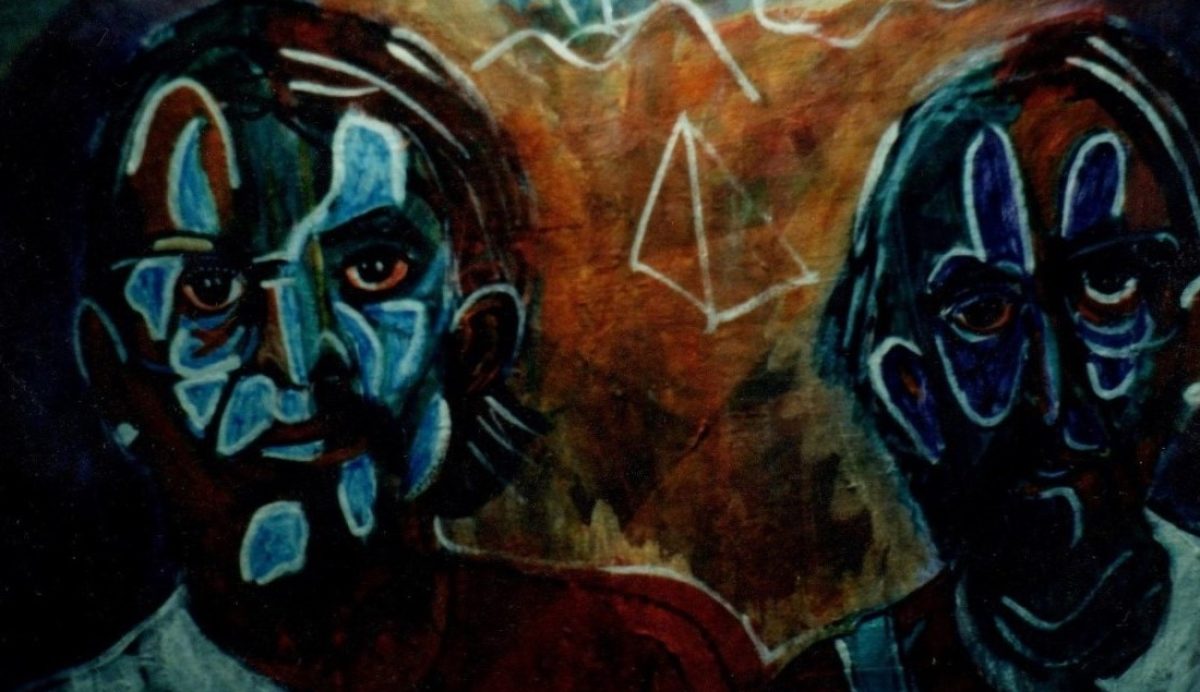
JOHANNA SCHOUTEN-ELSENHOUT (1910 – 1992)


     MI PRAKSERI                                   MY THOUGHT
 
     Mi prakseri sdon                             My thought is
     ini wan er' tra ten                          in quite a different time frame
     lek' a winti d' e way now                just like the wind that's now blowing 
     gi mi brok'ede                                is causing me problems

     m' e luku                                        I watch
     fa tranga winti                               how strong wind
     e sek' den bigi taki                         moves the large boughs
     trowe den youngu froktu                dropping the unripe fruits
     a tap mi owru dronpu                     on my old stoop    

     mi prakseri                                     My thought goes
     e sungu go                                      down
     n' a grebi f' bakaten                        the grave of afterthought
     di sa sor' en fesi                              that shall show its face


                                                    *


   BATO                                                                       BOAT OF LIFE

   Bato f' libi                                                                Boat of life
   sondro marki                                                            without code number
   a mindri grontapu maka                                            amid the world's vagaries
   luk' fa y' op' ede e brenki mindri den bromki              see how your bow is raised
   pe asege e sing' a moro hey sten                               shining among the flowers 
                                                               where crickets are singing the highest tune


   Bato f' libi                                                                  Boat of life
   nanga yu bradi seyri                                                   with your broad sails
   d' e kot' pangi mindri a son                                   displaying your plaids in the sun
   ondro wan busgasi f' sorgu                                    under an undergrowth of worries,
   d' e nak' dawra wik' sribi yorka               that beat the gongs to waken sleeping ghosts
   luk' fa kwasibita e wroko lek' prugasi               See how kwasibita works like purgative
   a mindri wan brudu swanpu                                   in a swamp of blood
   pe asema or' fayatiki e frey lek' edeman           where the vampire with torch in hand
                                                                               flies as the leader.

    Bato f' libi                                                                 Boat of life
    di kaka borsu lek' wan gansi                             sails with chest bulging like a gander
    e dukrun swen mindri brantimaka         that dives to swim under the spiny water plants
    a mindri wan se fu frenti nanga feyanti                      in a sea of amity and enmity
    pe mekunu e nyan sapa a ondrosey                    where trust ends up being the victim
    Wan dey e kon                                                          However,
    fu skin dongo nanga son a berpe sabana                     a day will come
    pe a ten sa tanapu skrifi                                            for the body to set with the sun
    a tap' wan por' udu mindri den yarfrey:                      in the savanna resting place
    "Dyaso a bato f' libi didon".                                where time will stand up and write
                                                                 on a piece of rotten wood among the termites:
                                                                                   "Here lies the boat of life."                  


                  Poems from 'Awese' copyright © by Johanna Schouten-Elsenhout Estate, Paramaribo, 1965
                        Copyright this English translation 'Awese: Light in This Everlasting Dark Moon' © by

                              D. France Olivieira, Paramaribo, Suriname, 2010


JOHANNA SCHOUTEN-ELSENHOUT (1910 – 1992)


    ADYANKRO                                                    JOHN CROW


    Poko yu poko                                                       Soar your soaring
    a mindri deb worku                                              amid the clouds
    mi braka dyakti                                                    my dear black-jacket
    dans' yu dripas-porka                                            dance your three-step polka
    a mindri aleysi-gron                                              in the rice field 
    froyt' lek' busgranman                                  cry like the master of the bush        
    a mindri den krasi wwri                                         amid the nettle weeds
    mi butabuta                                                          my dear whippoorwill
    yu eksi a seypasi waktiman                           your eggs are sentinels along the road
    kroypi a mindri tingi                                              wallow in the stench
    lek' skapuworon                                                     like the white haired caterpillar
    mi braka koti                                                         my dear cutaway
    srep' a mindri dedemeti                                         skate through the carcasses 
    mi tingifowru-edeman                                            my dear vulture king
    waka a tap' tinkoko                                                walk on your stilts
    mek' kondre si                                                       for all the world to see 
    bigin ker' mek' I eygi nesi                               start learning to build your own nest 
    mi opete                                                               my dear opete
    frey opo mindri a son                        &#0160
;                    fly off toward the sun

    bika yu na grandiyabru                                           because you're the big eye-sore
    wan adyankro f' Sranan                                           an adyankro  
                                                                                 of Sranan


                                                          *


     MI DREN                                                         MY DREAM

     Yere mi sten                                                  Heed my voice
     lek' wan grio e bari                                        sounding like a cicada
     a baka den bigi krepiston                               from behind the boulders
     mi ati e nak' te dede fu freed                 my heart beats to death from fear 
     m' e suk' wan kibri-olo                                    I'm searching for a lov-
     pe lobi de                                                      in' place to hide
     m' e frey lek' wan sonfowru                             like a sunbird
     mindri tranga winti                                         in the storm
     abra den moro hey bergi                         I'm flying across the highest mountains 
     sula e yere mi sten                                         the rapids are hearing my plea                               
     mi skin e degedege                                         but my body is weakening
     loktu wawan e si mi                                        heaven alone knows
     mindri banawtu                                              my tribulations 
     mi kondre mi pedrekubon                               here on earth
     mi nesi                                                           sometime in my dream
     sonten dede sa tuka mi                                   death and I will surely meet.
     ini mi dren


                    Poems from 'Awese' copyright © by Johanna Schouten-Elsenhout Estate, Paramaribo, 1965
                        Copyright this English translation 'Awese: Light in This Everlasting Dark Moon' © by

                              D. France Olivieira, Paramaribo, Suriname, 2010


JOHANNA SCHOUTEN-ELSENHOUT (1910 – 1992)

A MAN f’ SAR’ ATI                                      THE COMPASSIONATE ONE

   A dis’ n’ a braka dey                                  Is this the black day
di kis’ a nyunman-nen bunfreyda               that got nicknamed Good Friday
di brantmarki mi masra Yesu fesi              that branded my Lord Jesus’ face
pe sweti tron brudu                                  where sweat, turned into blood,
e lon lek’ watra e was’ doti puru                runs like water washing dirt away
f’ mi yeye nanga skin kon krin                   thereby cleansing my body and soul?
Nôn
o hey                                                 Heyday!
dis’ a trutru wan yoboprisiri.                     This is truly a great feast!
?Grontapu.                                               O, world
a dis’ n’ a moro big’ presenti                      is this the biggest present
di y’ ben abi f’ gi wan sar’atiwan                you could give a compassionate one
di sdon a tap’ penbangi lek’ spotpopki        who’d been at the torture bench
e brenki a mindri wi sondu maka               like an effigy made sport of;
di wer’ na en ede let’ togu                         one who shines amidst our thorn-like sins
pe krin konsensi n’ e geme ke.                   worn on his head as a fitting token
Sotru mi bun-ati masra Yesu                      where a clear conscience need not grieve?
kruktu-du trowe yu na bantama                 Truly, my dear Lord Jesus
pe kroysi donpu yu na ondrosey.                evil doings threw you in the morass
Sonduboku                                                where the cross depressed you downward.
no den surdati ma yu na krawasi                O, sinners
d’ e fadon lek’ agra a tap’ en skin.            not the soldiers, but you are the cat-o’-nine tails
Bita-ati                                                     that come down like bullets on his body.
a yu e tek’ wan nyun fayatiki                     O, vengeful ones
luk’ en a dungru ibri dey.                           it’s you who, with a fresh firebrand,
Konsensi f’ libi                                           every day look him in the dark.
opo greb’olo                                              O, life’s conscience
nanga mi masra Yesu                                 open my Lord Jesus’ grave
luku fa a kra
         &#0160
;                                                                 and see how the soul
e saka mek’ kosi bos’ en futu                     curtsies and kisses his feet
di ber’ pen                                                that bore his pains
a mindri grontapu doti                               on earth
f’ mi yeye nanga skin kon fri.                      to free my body and soul.

                                                              *

    EKSENPRE                                                VIRTUE

    Lobi dyari                                                 In love’s garden there’s no place for enmity
feyanti n’ e gro                                        nurtured in the soul to grow, nor for abuse.
kranpa or’ n’ ati
broko saka                                               Love does not take offense nor knows fear
n’ e psa drape                                          but walks right through nettle weeds
Lobi                                                        two-faced weeds
n’ e farsi ef’ frede                                    are not found blocking its path either.
a e waka
a mindri brantimaka                             Love knows no envy nor does it undermine amity
tufesi wwiri                                          like the termites that eat away from underneath.
no de f’ si a tap’ en pasi
Lobi                                                      Love has the power to grow in anyone’s heart
n’ e dyarusu nyan en kondreman            it does not insult nor does it beguile
lek’ uduloso a ondrosey                         
people whatever their color.
Lobi
a krakti f’ bow ini ibrisma ati                  Love has a clear conscience amid good and evil
a n’ e afrontu ef’ bedrigi                         in a well of holy water.
difrenti Kloru libisma
Lobi                                                      Truly, life must be tough for the Lord.
a wan krin ati
a mindri ogri nanga bun
ini wan peti fu seygiwatra
Fu tru
a libi faya
f’ wi masra Gado

Poems from ‘Awese’ copyright © by Johanna Schouten-Elsenhout Estate, Paramaribo, 1965
                                      Copyright this English translation ‘Awese: Light in This Everlasting Dark Moon’ © by

                                              D. France Olivieira, Paramaribo, Suriname, 2010

JOHANNA SCHOUTEN-ELSENHOUT (1910 – 1992)


  FREDE                                                           FEAR

  Frede a takru bedrigi                                     Fear is an ugly deception
  fu doystri ini eygi ay                                      aimed at blurring your vision
  a mindri smoko                                              as if surrounded by smoke
  pe y' e si                                                        letting you see ghosts
  yorka e spuku deyten                                     spooking around in broad daylight.
  Frede a wan konsensfonfon                            Fear is a troubled conscience
  d' e skrek' a yeye                                           that starts your soul
  mek' a lon moro tigri fes' winti             letting it run faster than the jaguar under the wind. 
  Frede a yere soso krey a dungru                     Fear is to hear only cries in the dark
  pe y' e prata bere ddon ppaya a gron      where you, lying flat on your stomach on the mat on  
  e luk' fa libi e tron                                         the floor,
  mekunu a tap' pikadu                                     are watching how life adds
  Frede a wan libisma                                       insult to injury.
  sondro kra                                                     Fear is a heartless human being
  di n' e bribi a Gado                                        who doesn't believe in God.
  Frede na futumarki                                        Fear is the footprint
  f' wan wiswasiman                                         of a coward
  d' e lib' todo sref' bron foto                     who even allows the toads to burn down the town.
  Frede a wan yorka                                         Fear is a ghost
  d' e prey bakafutu banya                                that dances the bakafutu banya 
 
te a fadon                                                      until it falls
  ini en eygi greb'olo                                         into its own grave. 

                                                                * 

     SOROMARKI                                            THE SCAR

     Dis' a wan pen                                        This is one great hurt
     a skin-ati                                               the pain
     fu den bakatifi                                       from the wisdom teeth
     a ten f' den yungu yari                            when I was young  
     di dray baka gwe                                    that has gone forever.
     Dis' na tere                               
     f' den bita yuru                                       This is the end
     fu tanapu                                               of the bitter hours
     nanga mankrakti                                     to make a manly stand  
     f' swar' den garperki                                and swallow the gall pills
     a mindri den krepiston                            while standing in the wilderness of pebbles.
     Dis' a wan dek'ati
     f' tyar' a kroysi                                        This is a special courage
     mindri den sorgu pkin                              to shoulder the cross
     Dis' na soromarki                                     while raising children.      
     di sabi diri                                              
     lib' a bakagron                                        This is the scar
     d' e seyri ini mi kabesa                            that knowledge
     sabiso                                                     left behind in the field
     tron watr
ây swanpu tide                         is still sailing in my mind.
     Fu tru                                                    
     Ondrofeni-skoro                                      This is the scar
     a basi                                                      that wisdom
                                                          &#01
60;        turned into a swamp of tears today.

                                                                   Truly, experience is
                                                                   the best schoolmaster. 


                           Poems from 'Awese' copyright © by Johanna Schouten-Elsenhout Estate, Paramaribo, 1965
                                   Copyright this English translation 'Awese: Light in This Everlasting Dark Moon' © by

                                           D. France Olivieira, Paramaribo, Suriname, 2010


JOHANNA SCHOUTEN-ELSENHOUT (1910 – 1992)


         "Awese is the name of the second ranking deity within the sky pantheon
          of the African Surinamese religion called Winti. This deity bestows
          healing powers and clairvoyant abilities to his devotees and mediums.
          Awese also refers to an abstract force that can best be translated as a
          conciliatory, healing and liberating power in human affairs."                                                       

                              – D. France Olivieira                                                                                     


         AWESE                                                                                                                                                                                                                                                            

        !Kabra.                                                                           
       troki gi den afkodreyman
       a mindri n' akapudyari
       pe fodu e lolo
       nanga santi ini en ay
       lek papawinti
       a mindri n' aladey son
       Wiki den mi kabra
       ini a dofokanpu
       mindri a doti f' Sranan
       troki mek' kromanti
       sekete nang' a pingi fu mandron
       a mindri den awese
       prisi a gronmama                                               AWESE            
       opo frey mi nengrekopu mindri a watrapan                                       
       A ten e kot' a greb'olo                                       Ancestral Spirits, Kabra-ô!
                                                                               send out your call-song to the adherents
                                                                               in the open tenement-yard
                                                                               where the fodu snake writhes
                                                                               with sand in his eyes
                                                                               like the papawinti
                                                                               during the heat of the day.
                                                                               Shake them up, my kabra,
                                                                               those in the ritual huts
                &
#0160;                                                              right down here in Sranan.
                                                                               Sing-call and let the kromanti spirits
                                                                 dance the sekete at the beat of the great drum  
                                                                               among the awese.
                                                                               Pay homage to the earth goddess
                                                     and then fly off, my black essence, over the water pans.
                                                                              Time is already digging the grave's hole. 


                                                                   *


       PE MI TANAPU                                            WHERE I STAND

       Pe mi tanapu                                             Where I stand
       ini a futmarki f' mi winsi                             in the footprint of my wishes
       ef' ini wan swanpu f' bigimenbre                 or in a swamp of conceit
       d' e freyri mi a tap' wan tiri dungru pasi      courting me on a quiet dark road
       d' e fet' fu broko mi saka a gron                  that's trying to get me on my knees

       Pe mi tanapu                                             Where I stand
       ini wan bâsman kapweri f'mi dren               in the grip of the backwoods of my dream
       d' e sor' ensref' lek' wan bigi gowt'busi         presenting itself as eldorado
       fu basra mi ati nanga fur' winmarki             to tempt my heart full with assurances
       a mindri wan faya sabana                           in the middle of a hot savanna
       di brad' mofo sondro kaba                          with its mouth wide open without letup.

       Pe mi tanapu                                             Where I stand
       a tap' wan ston pilari f' makti                      on the pinnacle of power
       d' e dwingi mi fu weg' ati                            forcing me to weigh the pains
       fu dedeyuru di ankra e wakti mi                 of my approaching death hour awaiting me.
       Pe mi tanapu
       grontapu libi                                              Where I stand
       Pe mi tanapu                                             There's life for you!
                                                                        Where I stand.


                                Poems from 'Awese' copyright © by Johanna Schouten-Elsenhout Estate, Paramaribo, 1965
                                      Copyright this English translation 'Awese: Light in This Everlasting Dark Moon' © by
                                              D. France Olivieira, Paramaribo, Suriname, 2010


JOHANNA SCHOUTEN-ELSENHOUT (1910 – 1992)


                                                  "A proud African-Surinamese rooted in the oral tradition of her culture

                                               she chose not to employ oral poetic techniques in her work, although
                                               she did utilize materials from that tradition for her poetic idioms,
                                               producing powerful poems in Sranan in a free style that sounded 
                                               conversational and fresh."
                                                                                       – D. France Oliviera


           KLORU


        No suk' a kloru f' yu buba
        mindri moysmoys' nesi
        suk' en ini den kruyara a opo-Sranan
        No suk' a kloru f' yu buba 
        a fes' wan drikant' grasloyki
        suk' en ini Parakriki
        mindri den kasaba pransun
        a mindri a son  f' y' ati
        No suk' a kloru f' yu buba
        a mindri alatafal
        suk' en a Stondansi mindri den bugrumaka
        a lobi f' yu eygi kondre 
        No suk' a kloru f' yu buba
        a mindri birbiri
        suk' en a Kosu mindri den bato
        No suk' a kloru f' yu buba
        a mindri den patata-bedi
        suk' en a brabakoto mindri SsÂbeni gongote 
        No suk' a kloru f' yu buba
        a dipi se mindri den sarki
        suk' en a mindri den nengrekondre pepresiri
        te doro gron f' y' ati 
        No suk' a kloru f' yu buba
        nanga leygi ay mindri kowru libi
        suk' en ini winti nanga alen mindri den aleysigron
        No suk' a kloru f' yu buba
        mindri den asema brudu
        suk' en ondro a pangi ef' sari f' yu mma
        No suk' a kloru f' yu buba
        lek' bigimenbre krabdagu
        a mindri akademi-sturu
        suk' en sondro f' afront' I yeye
        mindri Sranan udu bangi
        a mindri yu eygi kra            
                                                       THE COLOR OF YOUR SKIN        

                                                       Don't look for the color of your skin
                                                       in a mice nest
                                                       look for it in the canoes upriver
                                                       Don't look for the color of your skin
                                                       in front of a three-sided windowpane
                                                       look for it in a brook
                                                       amid the shoots in the cassava garden
                                                       in the sun of your heart 
                                                       Don't look for the color of your skin
                                                       in a rat trap
                     look for it at the Dancing Stones Falls amidst the bugrumaka palms 
                                                       in the love of your own country
                                                       Don't look for the color of your skin
                                                       in the underbrush
                                                       look for it in Kosu among the riverboats
                                                       Don't look for the color of your skin
                                                       in the potato patch
                     look for it on the smoking racks, at Sistah Abeni's gongote dance party 
                                                       Don't look for the color of your skin
                                                       in the deep among the sharks
                 &#01
60;                                     look for it among the seeds of the guinea pepper
                                                       down to the bottom of your heart
                                                       Don't look for the color of your skin 
                                                       with empty eyes in this cold life
                                                look for it in the wind and in the rain in the rice field
                                                       Don't look for the color of your skin
                                                       in the blood of the vampire
                                                       look for it under the wrapper cloth
                                                       if it's large enough to cover your mama
                                                       Don't look for the color of your skin
                                                       like the spoiled brat at the shrine
                                                       look for it without offending your yeye soul 
                                                       among the wooden benches
                                                       right in your very vital soul kra 

              
                        Poems from 'Awese' copyright © by Johanna Schouten-Elsenhout Estate, Paramaribo, 1965
                                      Copyright this English translation 'Awese: Light in This Everlasting Dark Moon' © by
                                              D. France Olivieira, Paramaribo, Suriname, 2010


JOHANNA SCHOUTEN-ELSENHOUT (1910 – 1992)


                       "Ms Schouten-Elsenhout was not "discovered" as a poet until she was almost fifty

                        years old, when she had, as she herself stated, 'never before read a poem nor
                        knew what a poem was'. Born and raised in an oral culture, she chose to write 
                        in Sranan, then considered a "non-language."  She showed that one could also 
                        express complex literary/poetic sentiments in this despised vernacular."   
                                                                                                               – D. France Oliviera


     SWETI                                              

     Mi nyun oloysi                           
     nanga prakiki                            
     di brad' en ffrey a tapu              
     di m' win' lek'                            
     nomru wan a pren                     
     bigin nak' yuru                           
     e waka a baka                          
     agers' m' e firi f' go ler' swen        
     nanga koni a mindri faya      
     wins' a f' wandey prisiri        
     f' dukrun wan kefe               
     mindri a se f' asema brudu    
     f' marki                               
     soso wan enkri drop' sweti f' mi libi                    
     d' e lon lek' kowru watra a mindrisey
     frede bigin dangra mi                                    
     pref' mi fadon nanga doro insey                      
     mi dyonpo nanga tap'ay
     a mindri Srananliba                    AGONY
     di m' op' ede a loktu baka
     mi si tak' a owru Betkayn            My brand new clock 
     mi fen' mi srefi                           with spread-eagled lovebirds
     mindri a smeri                            on top, I won at the fair
     f' den srafu dedebonyo                starts chiming time
                                                       though behind time; it seems
                                                       as if I want to learn to swim with cunning in fire
                                                       even if for just a one-day fling
                                                       to dive for a moment into a sea of vampire's blood
                                                       to mark
                                                       just one single drop of sweat
                                                       of my life that courses like cold water at the center.
           &#016
0;                                           Then I was gripped by fear;
                                                       instead of falling headlong indoors
                                                       I jumped with eyes shut tight into the river.
                                                       When I surfaced again I noticed that
                                                       I'd popped up right in the old jewish cemetery
                                                       with the rank smell of the bony remains of the slaves 
                                                       clogging my nostrils.  


                                                                 …


                      GOWTU ATI                                     A GOLDEN HEART

                      Wan gowtu ati                                 A golden heart
                      a wan di n' e krey                            is one that does not cry
                      awansi a no e waka                         even if not walking
                      a mindri soso rosu nomo                  only in a rose garden

                      wan gowtu ati                                 A golden heart
                      a wan di n' e kibri                            is one that does not hide
                      a baka kruktu                                  behind injustice
                      te reti sor' en fesi                            when justice shows up.

                      wan gowtu ati                                A golden heart
                      a wan d' e taki                                is one that speaks
                      a mindri wi brudu                           in our blood
                      lek' wan oloysi f' a ten                     like a clock shows time
                      awansi dede e kon                          even when death strikes.   


                                Poems from 'Awese'  ©  by Johanna Schouten-Elsenhout Estate, Paramaribo, 1986
                                             Copyright this English translation 'Awese: Light In This Everlasting Dark Moon'
                                                         ©  by D. France Olivieira - Paramaribo, Suriname, 2010


JOHANNA SCHOUTEN-ELSENHOUT (1910 – 1992)


                   "Johanna Schouten-Elsenhout (1910 – 1992), or Tante Jo as she was
                     affectionately called, was born in Paramaribo, Suriname, where she attended
                     middle school and learned English and German, though it is not clear whether 
                     she actually graduated. To have completed more than six years of schooling 
                     was quite a feat for anyone at that time but especially so for someone who
                     was both black and female. She later became a well-known stage and radio
                     personality who read her poems on the radio to a wide audience, both at
                     home and abroad (Austria, France,The Netherlands and Russia.)"  
                                                                                                    - D. France Olivieira


                   AMEMBA                                                   AMEMBA

                 Braka neti                                                Black nights
                 granaki ay                                                bright eyes
                 takru triki                                                turning tricks
                 a mindri                                                   on the cold ground.
                 kowru gron                                               Youthful years
                 Yongu yari                                                are seducing me
                 d' e kor' mi                                                while having fun.
                 a mindri prisiri                                          Death 
                 Sabana bromki                                          is staring at me 
                 di opo fesi                                                lets big dreams 
                 e waki mi so nya                                       show me
                 mek' bigi dren                                           a footprint
                 sor' mi                                                      where the morning star
                 wan futmarki                                            clears 
                 pe a musdey stari                                     the way
                 e trowe krinfaya                                       in the everlasting dark moon.
                 mindri a pasi
                  
fu têgo dungru mun 


  PREYGRON                                     PLAYGROUND


   A mindri a preydoti                         At the playground
   
m' e si a ten                                    I see time
   
e poko gwe a baka                           wobbling its way back in time
   
lek' wan dungru neti                        like a dark night
   
ini sma libi                                      in people's lives.
   
M' e si a wakt'oso                             I see the sentry box
   
e spuku mindri a tranga son             shimmering in the hot sun
   
ini pinaman brudu                           in the blood of the poor.
   
M' e yere den owruten                     I hear the past
   
abra wan se f' watrây                      across a sea of tears
   
e bbar' lek' dondru psa                     rolling like thunder peals
   
mindri faya                                     in between flashes.
   
M' e si den yeye f' disten                  I see today's souls idling about
   
e dray lontu                                    troubled by good and evil.
   
a mindri wan sorgu bagasi                I hear the lucky ones knocking
   fu
ogri nanga bun                  under a glass topped table at the center of the room
  
M' e yere fa den bakafinga               enjoying the sun
  
e naki ondro wan                             where sorrow strikes in the dark 
  
mindri-oso grastafra                        where I hear church bells toll
   
a mindri prisiri fu a son                    for God's sun
   
pe sari e nyan sapa a dungru            lighting up the playground
   
pe m' e yere kerki gengen                to free all our souls.
   e naki f' si gado faya                        
  
a mindri a preydoti                                                         
  
f' wi ala yeye kon fri


                                                                             *

                       Poems from 'Awese'  ©  by Johanna Schouten-Elsenhout Estate, Paramaribo, 1986
                             Copyright this English translation 'Awese: Light In This Everlasting Dark Moon'
                                           ©  by D. France Olivieira, Paramaribo, 2010


PARAMARIBO: EVENTS AND DREMPELS II


                                                                                    wan gowtu ati
                                                                                    a wan d' e taki
                                                                                    a mindri wi brudu
                                                                                    lek’ wan oloysi f’ a ten
                                                                                    awansi dede e kon
                                                                          - Johanna Schouten-Elsenhout
                                                                       from “Gowtu Ati”/ “A Golden Heart”


                  At the Piarco International airport, Trinidad, it’s getting harder to tell the
                  purpose of travel for outbound passengers. Used to be you could gauge
                  intention by the measure of bundled support and sentiment in the lobby:
                  families huddling, wishing the traveler safe trip, whether the flight is for
                  leisure, business or golden opportunity. Airport security procedures now
                  interrupt departure gate rituals for everyone. Besides, the world and its
                  transports pour in through multiple electronic inlets, stripping travel between
                  island and continent of that intuitive leap overseas.

                  For travelers coming in to the island there’s a welcome stimulus in the form
                  of the “Arts & Travel” magazine found in the pocket of the cabin seat.
                  Caribbean Beat has been around for awhile, but its expert glossy packaging
                  might tempt visitors not to leave it behind as they disembark; and its wide
                  spread of content (art, literature, cuisine, music, environment) reflect the
                  seriousness with which editor and contributors embrace the Caribbean as
                  home.

                  Local newspapers, available for en route travelers to keep updated,       
                  deliver commentary from tough, vigilant writers; like the columnist  
                  Raffique Shah – clearsighted, grounded in experience, spiked with humour. 
                  In that distinctive Trini word tradition, blazed by (the late) author Samuel
                  Selvon and (the late) columnist Keith Smith, Shah, who values truth, comes
                  across as a “mutineer” – against resident pomposity, vapor, rant.

                  Glimpses of ordinary life on the island might get your attention, as in this 
                  paragraph, done with steeups and style (by Vaneisa Baksh, Trinidad
                  Express
, 5/9/12): “On this hapless Hollis Street, a car has been
                  abandoned for years. At the corner with Bushe Street, a major thorough-
                  fare for those going to the Bus Route and the Aranjuez Savannah,  
                  another lot of land has been left to become a garbage dump overgrown  
                  with bushes. One day as I passed, I saw that someone had dropped off
                  four toilet bowls, lined them up like thrones looking out at passersby,
                  jeering it seemed, at the crap we have to take.”
V. S. Naipaul-lite you
                  could say.

 ≈☼≈


                  So where and what with its born free coconut palms is Surinam these days?

                  As its colonial destiny took shape, the land shared contours with adjoined
                  dependencies, forming a triplet of Guianas (British, French, Dutch). The
                  structures and dispositions laid down in the colonial period could not have
                  been more varied. The Netherlands granted Surinam its independence 30
                  years after territories in the region gained theirs.

                  Unlike Trinidad, it seems frugal with humour, though advanced in
                  courtesies; and just as unrestrained in costumed (Arrival or Abolition) street
                  celebrations. Once regarded as a country of placid order, easily overlooked,
                  Surinam, in recent years has begun to reconfigure its relevance and position
                  of influence in the region.

                  Paths of development are uppermost in the minds of “progressive”
                  individuals you might encounter in Paramaribo. They’ve kept good 
                  neighborly eyes on French Guiana, still a dependency; on Guyana, stuck
                  with delusions and foul play stench (awaiting cleansing agents or satire).
                  In Surinam, which offers surfaces of a benign multi-ethnic getting along,
                  contrasts have yet to sharpen into the identity issues that often uncover
                  fearful assumptions.

                  You might detect, however, a new stridency of tone among the
                  “progressives” when they speak of the former colonial power. They sense 
                  a patron-saintly readiness from The Hague to assist, and at the same time
                  a wish to leverage the inequities of old relations. They would move step by
                  step to decouple Surinam’s destiny from Dutch language and history, relo-
                  cate its future nearer the Caribbean and Latin America, close to those far
                  nations willing to invest. New links would introduce alternatives for tertiary
                  education, trade and economic partnership, vacation, language, romance.
             
                  Distrust of the shadowing Dutch canopy, a readiness to cast off in “truly
                  independent” directions, could exercise public energies across the land for
                  generations. Nothing is certain.

                  In the meantime, new “human capital” has swarmed ashore drawn to the
                  bells and the banners of “opportunity”: among them, opportunists, washed-
                  up carriers of inflated account; merchants of the cheap; oil riggers in search
                  of bullion; big shippers, high flyers; bold enterprise, new enemies; and an 
                  assortment of terrestrial “others” who protect their interests with potent
                  hardware and software. All eager to help shape the way forward, all set
                  to rebrand and market.

                  Young Surinamese, working or not working, appear indifferent to all this,
                  the fables of “progress” made flesh. Could be they’re not "plugged in", not
                  mature enough to grasp or care. 

                  At times clouds of speculation and rumor hover. Folks will assert – though
                  “it cannot be independently verified” – that the Americans plan to build a 
                  new embassy (or watch tower). On acreage viewed as swamp land. With
                  foundation supports elevated 3 metres. Why there? What do the Americans
                  know about the land that the locals don’t yet understand? 

                                                                                           ≈☼≈


                                                                     Dya mi bribi ankra mindri friman gron
                                                                     ini mi eygi masanga
                                                                     pe m’ e prey boskopu dron
                                                                     a mindri den loweman bậna
                                                                     dyaso mi ati doro man
                                                                        - Johanna Schouten-Elsenhout
                                                                       from”Masanga”/ “The Bush Cabin”


                  You might also find and enjoy the company of residents with different
                  passions; someone like Mr.Grauwde, a much travelled, urbane man with a
                  knowledge of wines and restaurants and citizenry in far-flung capitals;
                  and an appreciation of almost forgotten Olympic champion performers,
                  their special moments of glory.

                  Like Hasely Crawford, 1st champion for Trinidad, who came out of nowhere
                  to win gold (1976); who was honoured with a stadium and a postal stamp
                  and a kaiso ("Crawfie") in his name, but never repeated the success; and
                  Canada’s Ben Johnson (in the 80s) whose shoulder muscles bulged with rotor
                  blade effect, propelling him up and away from starting blocks; and the way 
                  in his heyday (in the 00s) the toes of the American Justin Gatlin peck-
                  pecked the track like a panther’s as he raced to the finish.

                  Our much loved legend is Jamaica’s Merlene Ottey, an intense, coal-glowing
                  presence on the track; winning bushels of medals in the 80s and 90s, but no
                  crowning glory; cast off as an “aging icon” in 2000, only to recalibrate her
                  goals, “globalize” her passion and identity (new citizen of Slovenia); and
                  continue the pursuit of triumphs that eluded her. A fine, fierce champion,
                  you’d have to say, of choice and individual liberty from the Caribbean.

                  Ardor and dedication of a different sort you might encounter in the person
                  of D. France Oliviera, a Surinam resident educator, also widely travelled,
                  committed now to restoring and raising the profile of a Surinamese poet
                  barely known in the region – Johanna Schouten-Elsenhout. He has edited,
                  translated and written an introduction to what he considers her best work,
                  a book of poems, Awese, “Light In This Everlasting Dark Moon(2010).

                      With little more than a high school education, Johanna Schouten-Elsenhout
                  (1910-1992) was well-known in her day as a stage and radio personality.
                  Her work was written and performed in Sranan, the Surinamese creole
                  language. Her fresh emergence in the region as a poet-performer invites
                  quick comparisons with Jamaica’s Louise Bennett (1919-2006); though there
                  are darker themes, grey hues of perplexity and resignation – with death or
                  “Lord Jesus” or the Awese felt as passageways of comfort towards 
                  emancipation.

                  Still, D. France Oliviera believes that anyone wondering how and why
                  Surinam exists could start the search for answers in her moonlit (if not
                  technically accomplished) lines – like these from “Gowtu Ati”/ “Golden
                  Heart”: “A golden heart/is one that speaks/in our blood/like a clock shows 
                  time/even when death strikes.”

                  Much like Jamaica’s Merlene Ottey, away and running, reinventing her own
                  destiny (and, too, the glamorous upgrade of the Trinidad-based Caribbean
                  Beat
magazine) Oliviera’s  tribute to a Surinamese poet sorting the nerve
                  ends of her tattered time and world must work its way through capricious
                  winds, sucking undercurrents; the sighting and promise of tangled destinies
                  ahead.
                                         -W.W.